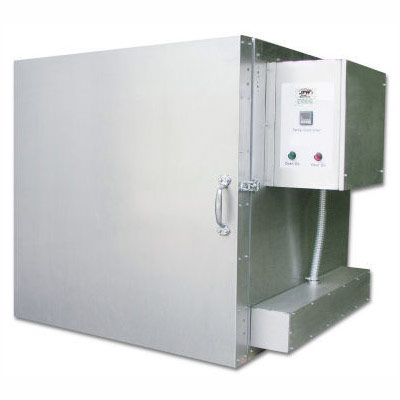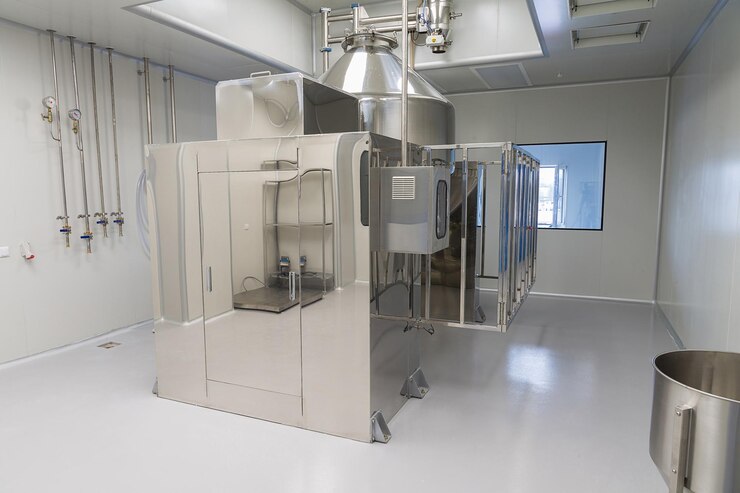


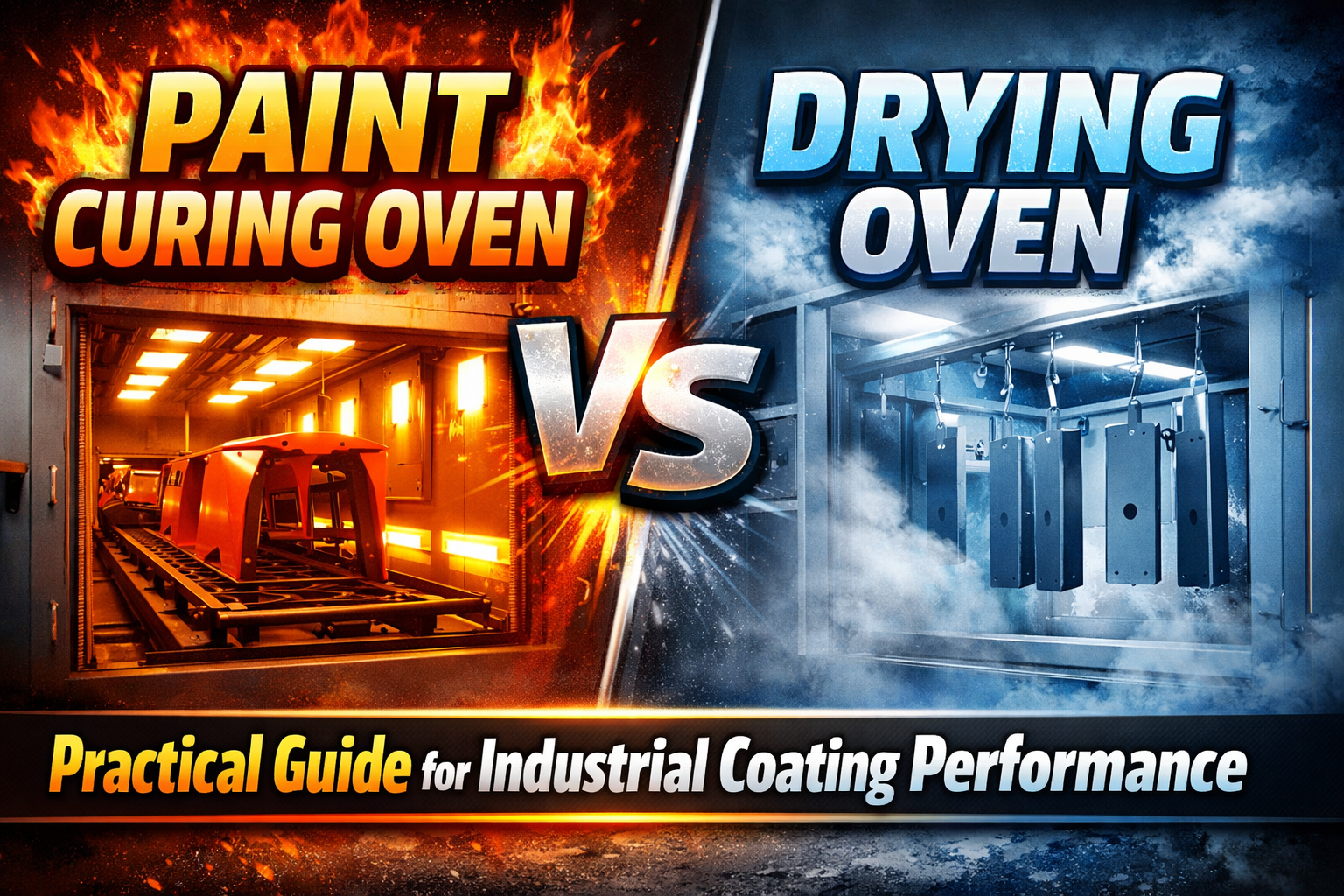
In industrial coating processes, understanding the differences between a Paint Curing Oven vs Drying Oven is not just academic — it directly impacts final product quality, throughput, and operational efficiency. These two oven types may appear similar on the surface, but they perform fundamentally different functions in your production line. This article offers a practical comparison to help you make the right equipment decision for your manufacturing needs, while also supporting the concepts in our in-depth guide on paint curing ovens at GBM Industries.
Understanding the Core Functions
Drying Oven — What It Really Does
A drying oven is designed primarily to remove moisture or solvents from coated or washed parts. It accelerates the physical evaporation process by circulating heated air around the product. Drying ovens are most commonly used:
- After washing or rinsing to remove water and prepare parts for coating.
- After applying a wet paint or pretreatment layer, where solvent evaporation is required before moving to the next stage.
Typical temperature ranges for drying ovens are low to medium heat, often between 40°C to 150°C depending on the application and solvent content.
The output from a drying oven is a part that is “touch dry” but not fully hardened or bonded. This step prepares the surface, but does not complete the chemical solidification of the coating.
Paint Curing Oven — The Final Quality Step
A paint curing oven, by contrast, is engineered to bring a coating to full hardness and durability through controlled heat and dwell time. This oven type applies heat that triggers chemical reactions, such as polymerization or cross-linking, that form a strong, bonded finish on the coated surface.
Curing is critical for final coating properties including:
- Hardness and scratch resistance
- Adhesion to the substrate
- Corrosion and chemical resistance
- Longevity in real-world environments
Most industrial curing ovens operate at higher temperatures than drying ovens — often 120°C and above for conventional liquid paints, and up to 200°C+ for powder coatings and thermosetting finishes.
Key Practical Differences
The following table highlights the fundamental technical and functional differences:
Drying Oven vs Paint Curing Oven – Practical Comparison
🔹 Drying Oven
- Main purpose: Remove moisture or solvent from coated or pre-treated parts
- Heat range: Low to medium temperature (approx. 40°C–150°C)
- Process involved: Physical evaporation of water or solvents
- Typical stage in line: Pre-coat or intermediate process
- End result: Surface appears dry but coating is not fully hardened
- Application focus: Prepares parts for the next manufacturing step
🔹 Paint Curing Oven
- Main purpose: Complete chemical curing and hardening of the coating
- Heat range: Medium to high temperature (typically 120°C–220°C+ depending on coating type)
- Process involved: Chemical cross-linking or polymerization of the coating
- Typical stage in line: Final coating application stage
- End result: Fully hardened, durable, and performance-ready coating
- Application focus: Ensures long-term performance, adhesion, and protection
This distinction is crucial in industrial coating lines. Many manufacturers may talk about “drying ovens,” but if the goal is coating performance and durability, a curing oven is often what your process truly needs.
Why This Matters in Real-World Production
1. Quality Consistency and Defect Reduction
For coatings to perform consistently, every part must experience the correct temperature profile and dwell time. Heat uniformity and airflow patterns dramatically impact coating outcomes. In a curing oven, uniform heat distribution ensures that every part of a component receives the same energy input — minimizing undercure or overcure defects.
Poor temperature uniformity or incorrect process settings can lead to:
- Bubbling or blistering
- Soft or under-bonded finishes
- Uneven gloss or color inconsistency
In contrast, drying ovens focus on solvent removal, and cannot compensate for or influence the chemical integrity of a coating.
2. Production Throughput and Efficiency
Drying steps are usually shorter and require less energy than full curing cycles. However, skipping or improperly executing curing will lead to quality failures that slow production and increase rework costs. For high-volume manufacturing, a well-configured curing oven ensures both speed and reliability.
For example, in powder coating, curing temperatures typically fall between 177°C to 204°C (350°F–400°F), and higher temperatures can reduce required cure time and improve throughput when properly controlled.
3. Matching Oven Design to Coating Chemistry
Different coatings have diverse curing requirements — from acrylics to epoxies to powder formulations. The correct oven must be selected based on the specific cure temperature and time recommended by your coating supplier. Industrial practice shows that temperature uniformity (often ±5–10°C tolerance across the chamber) and airflow design are key determinants of final coating quality.
This means a GBM paint curing oven should be matched to your coating’s technical data sheet to ensure optimal performance, rather than simply choosing an oven based on size or heat source alone.
When to Use Each Oven Type
Use a Drying Oven When:
- You need to remove moisture or solvent before the next coating stage.
- The process requires controlled pre-drying to reduce defects in the final finish.
- You want to accelerate surface drying before manual handling or inspection.
Use a Paint Curing Oven When:
- The process requires a hard, durable, long-lasting finish.
- Your coating must meet specific performance standards for adhesion, abrasion resistance, or chemical resistance.
- You are producing industrial parts that will face real-world stresses (e.g., automotive, appliances, metal furniture).
Many manufacturing lines use both ovens — first drying to remove solvents, then curing to finalize the coating’s properties.
Technical Selection Tips for Industrial Lines
Here are actionable points industrial engineers should consider when choosing between oven types:
Airflow & Temperature Control
Effective curing requires recirculated heated air with controlled airflow patterns to maintain uniform temperatures around all part surfaces. Drying ovens also use recirculation but do not need the same precision control for chemical cure.
Energy Considerations
Higher cure temperatures require more energy — thoughtful insulation and recirculation design can significantly reduce operating costs. Always align your choice with production volume and energy efficiency targets.
Part Geometry and Load
Large or complex geometries need ovens with robust airflow and zoning to prevent cold spots. Poor airflow can cause uneven cure, leading to defects.
Process Documentation
Record and document oven process parameters. Repeatable curing cycles build quality consistency over time. This includes recording set temperatures, dwell times, and measured profiles.
Conclusion: Choosing the Right Oven for Coating Success
In summary, a drying oven and a paint curing oven serve related but distinct roles. A drying oven handles moisture and solvent removal, preparing parts for coating or further processing, while a curing oven completes the chemical transformation that gives coatings their full strength and durability. Choosing the right oven improves final coating quality, reduces defects, and increases production efficiency.
If your goal is end-use performance and warranty-grade finishes in industrial manufacturing, the paint curing oven is the investment payoff — and understanding how it compares to a drying oven is critical to equipment selection and process design.
For a deeper dive into the design, temperature profiles, and industrial considerations for paint curing ovens, don’t miss our complete GBM Industries guide: Paint Curing Oven: Complete Industrial Guide for High-Performance Coating & Manufacturing Quality