

For decades, PHP has been one of the most widely used server-side scripting languages on the web. From powering early content management systems to supporting modern frameworks, PHP web development has continually evolved to meet changing technological demands. Today, another major shift is underway—driven by artificial intelligence (AI) and automation.
These technologies are not replacing PHP or the developers who work with it. Instead, they are reshaping how a PHP web development company operates, how teams collaborate, and how projects are delivered. The transformation is subtle in some areas and dramatic in others, affecting everything from code writing and testing to client communication and long-term maintenance.
This article explores how AI and automation are changing the traditional PHP web development company model, what that means for developers and businesses, and why adaptability has become a core competency in modern PHP web development.
The Traditional PHP Web Development Company Model
To understand the impact of AI and automation, it helps to look at how PHP web development companies traditionally functioned.
Historically, a typical workflow involved:
- Manual requirement gathering and documentation
- Developers writing most PHP code from scratch
- Repetitive testing and debugging cycles
- Human-driven deployment and server configuration
- Ongoing maintenance handled reactively
While frameworks like Laravel, Symfony, and CodeIgniter improved efficiency, much of the work still relied heavily on manual effort. Scaling teams often meant hiring more developers, and timelines were closely tied to human availability.
This model worked—but it also came with challenges:
- Time-consuming repetitive tasks
- Higher risk of human error
- Slower iteration cycles
- Difficulty predicting delivery timelines
AI and automation are now addressing many of these friction points.
AI as an Assistant, Not a Replacement
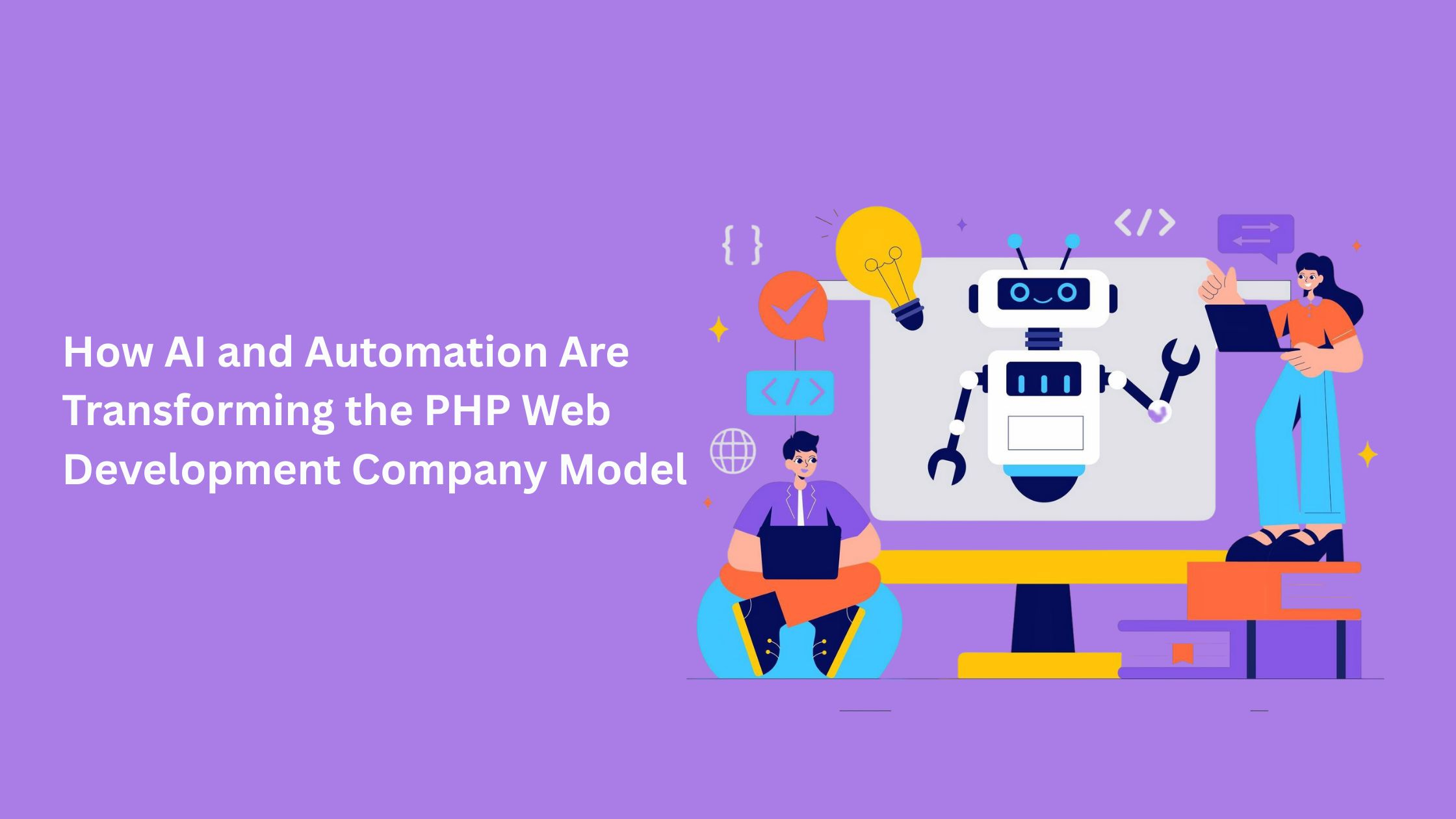
One of the most important shifts in PHP web development is how AI is being positioned—not as a developer replacement, but as an intelligent assistant.
Modern AI tools can:
- Suggest PHP code snippets based on context
- Identify syntax or logical errors early
- Recommend optimizations for performance and security
- Help refactor legacy PHP code
For a PHP web development company, this means developers spend less time on boilerplate tasks and more time on architectural decisions, business logic, and problem-solving. The human role becomes more strategic, while AI handles routine cognitive load.
This shift has changed hiring priorities as well. Instead of focusing solely on raw coding speed, companies now value:
- Critical thinking
- System design skills
- Ability to validate and refine AI-generated output
Automation in Code Quality and Testing
Testing has traditionally been one of the most resource-intensive phases of PHP web development. Writing test cases, running regression tests, and checking for edge cases could slow down delivery.
Automation has transformed this process.
Today, many PHP web development companies rely on:
- Automated unit and integration testing
- Continuous integration pipelines that test code on every commit
- Static code analysis tools that scan for vulnerabilities and inefficiencies
AI-powered testing tools go a step further by:
- Predicting which parts of an application are most likely to fail
- Generating test cases based on usage patterns
- Detecting anomalies that traditional rule-based tests might miss
As a result, quality assurance is no longer a bottleneck—it’s embedded into the development lifecycle.
Smarter Project Estimation and Planning
Project estimation has always been a challenge in web development. Over- or under-estimating timelines can damage trust between clients and a PHP web development company.
AI-driven analytics are now helping companies:
- Analyze historical project data
- Predict development timelines more accurately
- Identify risk factors early in the process
Automation tools can also break projects into smaller, trackable tasks and monitor progress in real time. This leads to more transparent workflows and fewer surprises during delivery.
For clients, this means clearer expectations. For teams, it means less stress and better planning.
Enhancing Security Through Automation
Security has become a major concern in PHP web development, especially as applications handle more sensitive data.
AI and automation contribute to security in several ways:
- Automated vulnerability scanning identifies known threats
- AI models detect unusual behavior patterns that may indicate attacks
- Dependency monitoring tools alert teams to insecure libraries
Instead of relying solely on periodic manual audits, a PHP web development company can now implement continuous security monitoring. This proactive approach reduces risks and improves long-term application stability.
Impact on Custom PHP Web Development
Custom development remains a core offering for many PHP web development companies. AI hasn’t eliminated customization—it has changed how it’s delivered.
Automation speeds up:
- API integrations
- Database schema generation
- CRUD operation scaffolding
AI tools can quickly analyze business requirements and suggest technical approaches, allowing developers to validate ideas faster.
This leads to:
- Shorter development cycles
- Faster prototyping
- More room for iteration and refinement
In practice, clients receive functional versions of their applications sooner, enabling earlier feedback and better alignment with real needs.
Redefining Maintenance and Support
Maintenance used to be reactive—bugs were fixed after users reported them. Automation is changing that dynamic.
Modern PHP web development companies increasingly rely on:
- Automated monitoring tools
- AI-driven performance analysis
- Predictive maintenance alerts
These systems can detect performance degradation, memory leaks, or unusual traffic patterns before they cause major issues. Maintenance becomes proactive rather than reactive.
This shift also changes how support teams operate. Instead of spending most of their time troubleshooting emergencies, they can focus on optimization and long-term improvements.
Changing Team Structures and Roles
As AI and automation take over repetitive tasks, team structures within a PHP web development company are evolving.
Some noticeable changes include:
- Smaller, more agile teams
- Developers working across broader responsibilities
- Increased collaboration between developers, data analysts, and DevOps engineers
Roles are becoming less siloed. A PHP developer today may interact more closely with deployment pipelines, analytics dashboards, and AI-assisted tools than ever before.
This evolution encourages continuous learning, as professionals must stay comfortable with both PHP web development fundamentals and emerging technologies.
Client Expectations in an AI-Driven Environment
AI and automation don’t just change internal workflows—they also shape client expectations.
Clients increasingly expect:
- Faster turnaround times
- More accurate cost estimates
- Data-driven decision making
- Continuous improvements post-launch
A PHP web development company that leverages AI effectively can meet these expectations more consistently. However, transparency remains crucial. Clients still value human communication, clear explanations, and thoughtful guidance—areas where automation cannot replace human judgment.
Ethical and Practical Considerations
While AI offers many benefits, it also introduces new challenges.
PHP web development companies must consider:
- Over-reliance on AI-generated code without proper review
- Data privacy when using AI tools
- Bias in AI-driven decision systems
Responsible use of AI means treating it as a support mechanism, not an unquestioned authority. Human oversight remains essential, particularly in areas involving security, compliance, and user experience.
The Future of PHP Web Development Companies
AI and automation are not signaling the end of PHP web development. Instead, they are extending its relevance.
PHP continues to power a significant portion of the web, and modern frameworks have kept it competitive. When combined with AI-driven tools and automated workflows, PHP web development becomes more efficient, scalable, and resilient.
The PHP web development company model of the future will likely be:
- Leaner and more adaptive
- Focused on strategic problem-solving
- Supported by intelligent tools rather than manual processes
Success will depend not on how much code a team writes, but on how effectively it integrates technology, human expertise, and business understanding.
Also, read: PHP Web Development in 2026: Trends, Tools, and Best Practices
Conclusion
AI and automation are quietly but profoundly transforming how PHP web development companies operate. From coding and testing to security, planning, and maintenance, these technologies are reshaping workflows and redefining roles.
Rather than replacing developers, AI enhances their capabilities. Rather than eliminating customization, automation accelerates it. And rather than reducing the importance of human insight, these tools make strategic thinking more valuable than ever.
For anyone involved in PHP web development—whether developers, project managers, or business stakeholders—the message is clear: adaptability is now as important as technical skill. Those who learn to work alongside AI and automation will help shape the next chapter of PHP-powered web experiences.