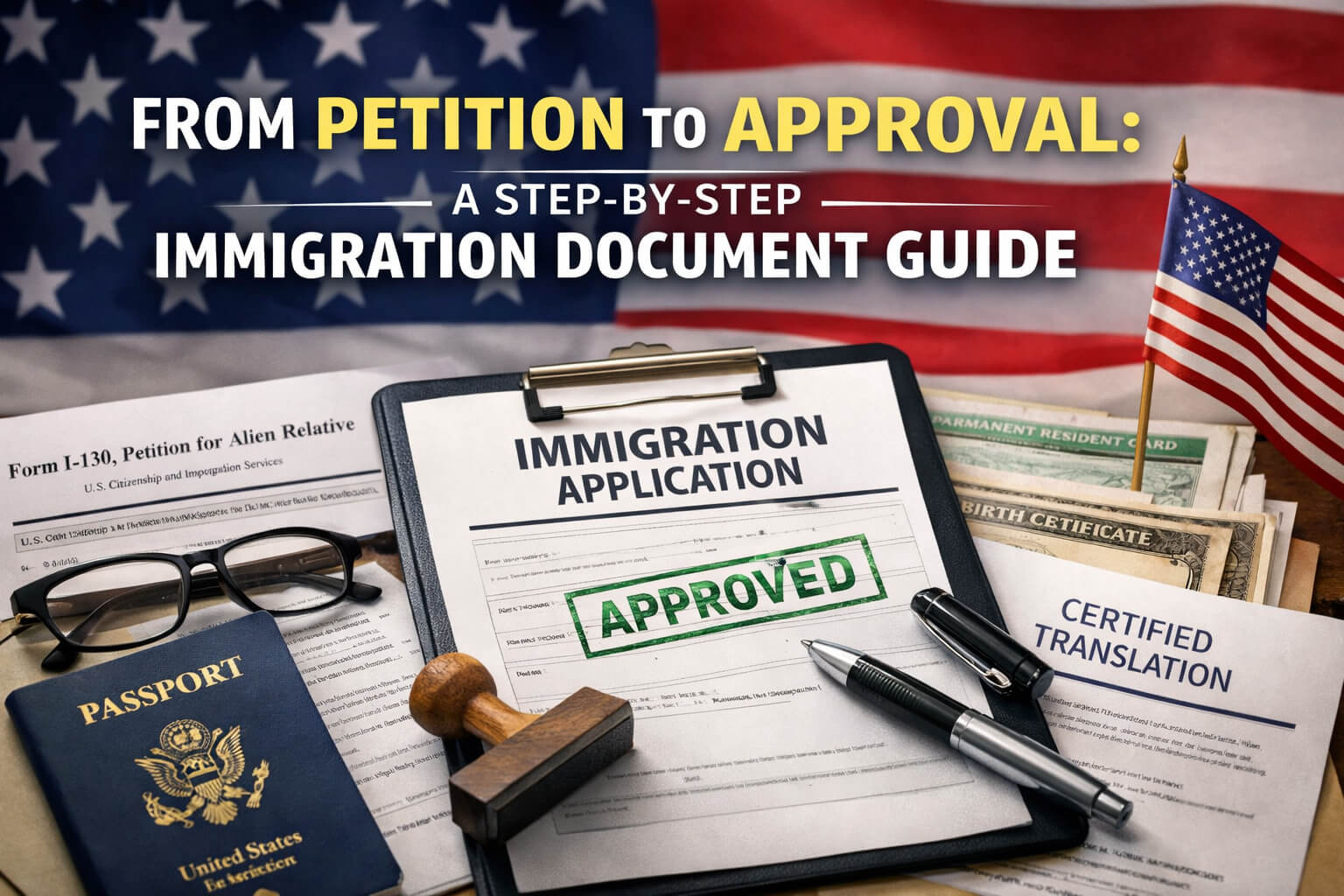
Applying for immigration benefits in the United States can feel overwhelming. Between unfamiliar forms, strict requirements, and changing timelines, many applicants are left wondering whether they’ve done everything right. One of the most common—and most misunderstood—parts of the process is documentation, especially when documents are not in English.
This guide walks you through the immigration journey from petition to approval, with a clear focus on what documents are required, when translations are needed, and how to avoid unnecessary delays or rejections. Whether you’re applying for a visa, adjusting status, or petitioning for a family member, this article is designed to help you navigate the process with confidence.
Step 1: Understanding Your Immigration Pathway
Every immigration application begins with identifying the correct pathway. This determines which forms you file, which documents you submit, and how your case will be reviewed.
Common pathways include:
- Family-based immigration
- Employment-based immigration
- Fiancé(e) visas
- Adjustment of status
- Naturalisation and citizenship
- Asylum or humanitarian relief
Each category has its own document requirements, but one rule applies to all:
Any document not in English must be fully and accurately translated.
Step 2: Gathering Your Core Documents
Once you know your pathway, the next step is collecting supporting documents. These are used to verify identity, relationships, eligibility, and background.
Typical documents include:
- Birth certificates
- Marriage certificates
- Divorce decrees
- Passports and national ID cards
- Police clearance certificates
- Academic records
- Employment letters
- Financial statements
If these documents were issued outside the United States, they are almost always issued in another language—and this is where many applications encounter problems.
Step 3: Translation Requirements You Cannot Ignore
US immigration authorities are extremely clear when it comes to translations.
Every non-English document must be accompanied by:
- A complete English translation
- A certification of accuracy
- A statement confirming the translator is competent to translate
Missing or incorrect translations are a leading cause of Requests for Evidence (RFEs) and processing delays.
Common translation mistakes include:
- Partial translations (only translating headings or summaries)
- Missing stamps, annotations, or handwritten notes
- Using uncertified or informal translations
- Inconsistent names or dates across documents
At USCIS Official Translation, we regularly see applications delayed not because the applicant was ineligible—but because the paperwork did not meet technical requirements.
Step 4: Petition Stage – Submitting the Application
At this stage, you submit your petition or application package. This may include:
The main immigration form (e.g. petition or adjustment form)
- Supporting documents
- Certified translations
- Filing fees
Everything submitted is reviewed as a single package. If one document is missing, mistranslated, or unclear, the entire application can be put on hold.
This is why it’s critical that:
- Translations match the original documents exactly
- Names, dates, and formatting are consistent
- Translations are easy for an officer to review
- A well-prepared application does not just meet requirements—it makes the officer’s job easier.
Step 5: Requests for Evidence (RFE) – Why They Happen
An RFE is not a denial, but it does pause your case.
RFEs are commonly issued for:
- Missing documents
- Unclear or incomplete translations
- Inconsistent personal details
- Documents that do not meet format requirements
Responding to an RFE often means:
- Obtaining new documents
- Re-translating paperwork
- Resubmitting certified translations under time pressure
Avoiding an RFE in the first place can save weeks or even months of processing time.
Step 6: Interviews and Additional Verification
Some applications require an interview or further verification. At this stage, officers may cross-check:
- Original documents vs translations
- Personal information across forms
- Relationship or employment evidence
If translated documents raise doubts—because of errors, omissions, or unclear language—it can create unnecessary complications during interviews.
Accurate, professional translations ensure your documents speak clearly for you, even when you’re not in the room.
Step 7: Decision and Approval
Once all documentation has been reviewed and verified, a decision is made.
Approvals happen faster when:
- Documents are clearly translated
- No follow-up evidence is needed
- The application tells a consistent, credible story
From the authority’s perspective, translations are not just paperwork—they are evidence.
Common Immigration Documents That Require Certified Translation
Applicants frequently ask which documents need translation. In practice, almost all foreign-language documents do, including:
- Birth certificates
- Marriage and divorce records
- Court judgments
- Police certificates
- Academic transcripts
- Medical or vaccination records
- Affidavits and sworn statements
If a document is submitted as evidence and is not in English, it should be translated—no exceptions.
Why Translation Quality Matters More Than You Think
Immigration officers are not linguists. They rely entirely on the English translation in front of them.
A poor translation can:
- Change the meaning of a document
- Create inconsistencies
- Raise doubts about authenticity
A professional, certified translation:
- Preserves the original meaning
- Reflects official formatting
- Meets compliance standards
This is why working with a service that specialises specifically in immigration translations matters.
Where USCIS Official Translation Fits In
Immigration is not just about forms—it’s about trust, accuracy, and compliance.
USCIS Official Translation focuses exclusively on:
- Immigration-related documents
- Certified translations that meet official requirements
- Clear, review-ready formatting
- Fast, reliable turnaround without cutting corners
We understand how immigration cases are assessed because we work with these documents every day.
Final Thoughts: Preparing for Success
From petition to approval, your documents are the foundation of your application. Clear, complete, and compliant translations can mean the difference between a smooth process and months of delay.
If you’re preparing an immigration application and your documents are not in English, taking translation seriously is not optional—it’s essential.
A well-prepared application tells your story clearly, accurately, and confidently from the very first submission.