The Asia Pacific UAV (Drone) Market has emerged as the primary global engine of drone innovation and adoption. Across the region, unmanned aerial vehicles are transitioning from experimental technologies into foundational infrastructure supporting defense modernization, logistics transformation, and the rise of the low altitude economy. Governments, industries, and technology innovators across Asia Pacific are integrating drones into strategic planning, making the Asia Pacific UAV (Drone) Market one of the fastest growing and most influential in the world.
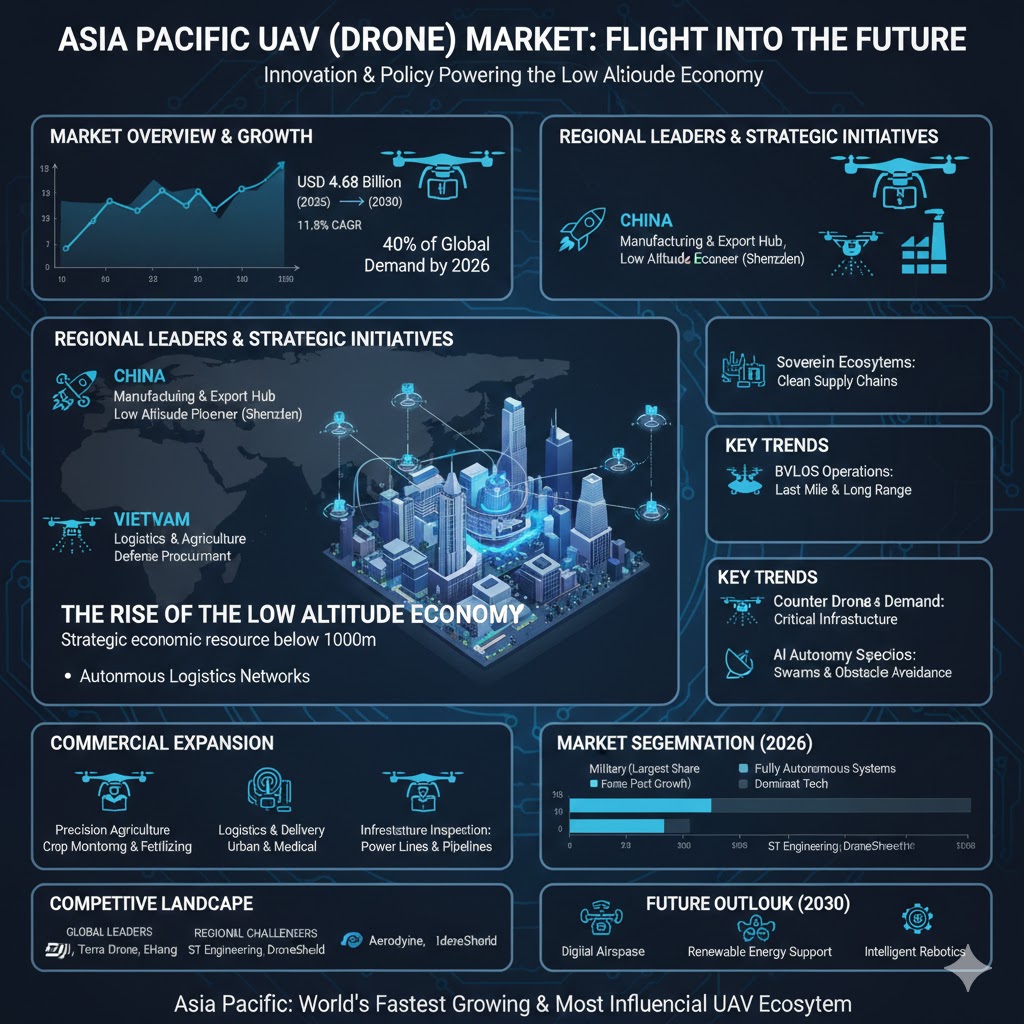
The Asia Pacific UAV (Drone) Market is expected to grow from USD 4.68 billion in 2025 to USD 8.18 billion by 2030, registering a compound annual growth rate of 11.8%. Market expansion is driven by rapid defense modernization, enhanced border surveillance, and increasing investment in autonomous technologies. At the same time, commercial adoption across agriculture, infrastructure, and logistics continues to accelerate, supported by regulatory reform and expanding domestic manufacturing capacity.
By 2026, the Asia Pacific UAV (Drone) Market represents nearly forty percent of global demand. The region is moving decisively toward a model where drones are not simply tools but essential components of economic and technological infrastructure.
Market Size and Growth Outlook
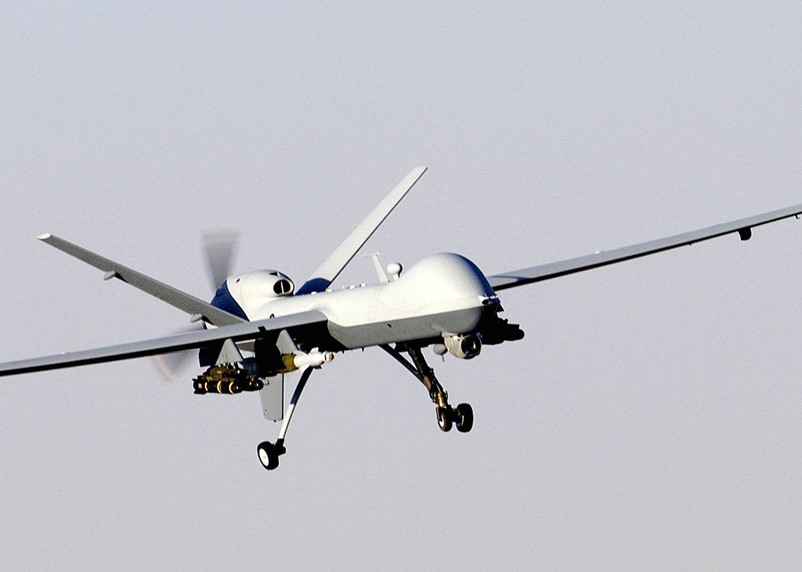
The Asia Pacific UAV (Drone) Market demonstrates strong and sustained growth. From USD 4.68 billion in 2025, the market is projected to reach USD 8.18 billion by 2030. Defense platforms currently account for the largest share of spending, particularly in counter drone systems and loitering munitions. However, commercial sectors such as logistics and precision agriculture are expanding at the fastest rate.
Fully autonomous UAVs represent the dominant technological segment, accounting for a majority of deployments as artificial intelligence enables advanced navigation and reduced human intervention. Commercial platforms are growing fastest in volume, while military platforms continue to dominate market value.
China leads manufacturing and export activity, while India is rapidly expanding through domestic production and defense procurement. Japan and South Korea focus on precision technology and robotics, and Australia emphasizes surveillance, mining, and counter drone capability.
The Rise of the Low Altitude Economy
The defining concept shaping the Asia Pacific UAV (Drone) Market in 2026 is the Low Altitude Economy. Governments across the region are treating airspace below one thousand meters as a strategic economic resource similar to telecommunications or high speed transport.
This policy approach encourages rapid deployment of drone infrastructure, including digital traffic management, drone ports, and autonomous logistics networks. Countries such as China and Vietnam are investing heavily in regulatory frameworks, subsidies, and industrial policy to support this transformation.
The Low Altitude Economy is turning drones into a core component of urban logistics, agricultural productivity, and industrial automation across the Asia Pacific UAV (Drone) Market.
Download PDF Brochure: https://www.marketsandmarkets.com/pdfdownloadNew.asp?id=162314749
Regional Leaders and Strategic Initiatives
China dominates the Asia Pacific UAV (Drone) Market through large scale manufacturing, export leadership, and strong government support. The fifteenth five year plan identifies drones as a strategic emerging industry, with Shenzhen becoming a global center for unmanned aviation and eVTOL development.
India is focusing on manufacturing sovereignty through its production linked incentive program, transforming the country into a regional export hub. Regulatory frameworks such as no permission no takeoff compliance have standardized drone operations nationwide.
Vietnam is expanding rapidly in logistics and agriculture, deploying thousands of drones across the Mekong Delta and establishing alliances to promote the low altitude economy.
Thailand is exploring urban air mobility and tourism applications, including air taxi trials in major tourist destinations.
Australia focuses on counter drone systems and surveillance, with domestic companies securing major international defense contracts.
Key Trends Transforming the Asia Pacific UAV (Drone) Market
Sovereign drone ecosystems are becoming essential. Many countries are prioritizing clean supply chains to reduce dependence on restricted foreign components.
Beyond visual line of sight operations are expanding rapidly, enabling last mile delivery and long range inspection across urban and rural areas.
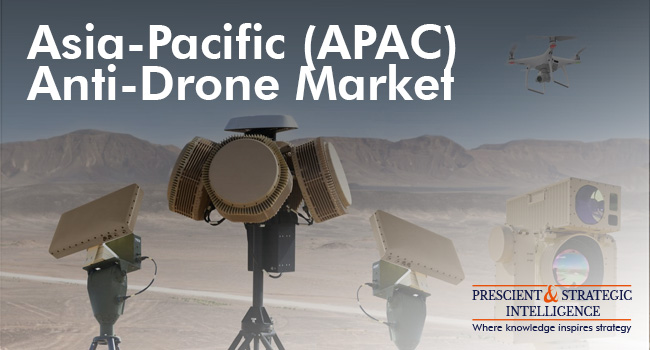
Counter drone demand is rising sharply as governments integrate detection and defense systems into airports, public venues, and critical infrastructure.
Artificial intelligence driven autonomy is transforming operations. Modern UAVs can coordinate in swarms, avoid obstacles automatically, and perform missions with minimal human oversight.
These trends are positioning the Asia Pacific UAV (Drone) Market at the forefront of global drone technology.
Commercial Expansion Across Industries
Precision agriculture is one of the fastest growing applications in the Asia Pacific UAV (Drone) Market. Drones are widely used for crop monitoring, fertilizer distribution, and soil analysis, improving productivity and sustainability.
Logistics and delivery are expanding rapidly, particularly in densely populated cities where drones bypass traffic congestion. Medical and e commerce deliveries are becoming routine in several countries.
Infrastructure inspection is another major sector. Drones monitor power lines, pipelines, construction sites, and transportation networks, providing high resolution data and reducing operational risk.
Mining, environmental monitoring, and disaster response also contribute to commercial expansion across the Asia Pacific UAV (Drone) Market.
Segmentation of the Asia Pacific UAV (Drone) Market
Fully autonomous systems dominate due to rapid advancement in artificial intelligence and onboard processing. Military applications account for the largest share of revenue, while commercial applications grow fastest. Agriculture and logistics represent key commercial segments. Battery powered UAVs dominate, while hydrogen and hybrid systems are emerging for extended endurance missions.
Competitive Landscape of the Asia Pacific UAV (Drone) Market
Leading manufacturers such as SZ DJI Technology dominate commercial platforms globally. Companies such as Terra Drone, MicroMultiCopter, EHang Intelligent, and Yuneec play major roles in technology and platform development.
Emerging regional challengers such as Aerodyne, IdeaForge, and Gremsy are gaining market share in enterprise and government segments. Defense and high technology firms including ST Engineering and DroneShield dominate specialized military and counter drone systems. International players such as Baykar, Israel Aerospace Industries, and General Atomics also participate through partnerships and exports.
Challenges in the Asia Pacific UAV (Drone) Market
Supply chain security and component restrictions create manufacturing challenges. Skilled workforce shortages affect scaling in some countries. Airspace integration and safety regulation remain complex as drone density increases.
Despite these challenges, strong government support and industrial demand ensure continued expansion of the Asia Pacific UAV (Drone) Market.
Future Outlook of the Asia Pacific UAV (Drone) Market
The future of the Asia Pacific UAV (Drone) Market will be shaped by autonomy, digital airspace infrastructure, and sovereign manufacturing. The low altitude economy will expand, making drones a core component of transportation, logistics, and industrial monitoring.
Artificial intelligence will enable fully autonomous operations and coordinated swarms. Beyond visual line of sight operations will become routine. Domestic manufacturing will strengthen supply chain resilience.
By 2030, the Asia Pacific UAV (Drone) Market will remain the world’s fastest growing and most influential unmanned aviation ecosystem, leading global innovation in autonomous flight, commercial drone applications, and integrated airspace systems.
Related Report:
North America UAV (Drone) Market by Application (Military, Commercial, Government & Law Enforcement, Consumer), Platform (Defense & Government, Civil & Commercial), Type, Mode of Operation, MTOW, Range, Function, Technology, and Country – Forecast to 2030
European UAV (Drone) Market by Application (Military, Commercial, Government & Law Enforcement, Consumer), Platform (Defense & Government, Civil & Commercial), Type, Mode of Operation, MTOW, Range, Function, End Use, and Country – Forecast to 2030
Middle East UAV (Drone) Market by Type (Fixed Wing, Rotary Wing, Hybrid), Platform (Civil & Commercial, and Defense & Government), End Use, Technology, Function, Application, Mode of Operation, MTOW, Range, and Country - Forecast to 2030