


Temperature measurement is so deeply embedded in science, industry, and everyday life that it’s easy to forget how long humans have been refining the tools that make it possible. Among the most enduring of these tools is the Glass Tube Thermometer—a simple yet remarkably reliable instrument whose design has stood the test of centuries.
While modern technology offers digital sensors, smart probes, and automated monitoring systems, the glass tube thermometer remains widely used across laboratories, manufacturing environments, HVAC systems, and calibration processes. Understanding its history and modern relevance not only provides technical insight but also highlights why traditional measurement tools still matter today.
The Early History of Temperature Measurement
Before thermometers existed, temperature was judged purely by human sensation—hot, cold, or somewhere in between. This subjective approach was unreliable, especially for scientific study or industrial work.
The Birth of the Glass Tube Thermometer
The origins of the glass tube thermometer date back to the early 17th century. Galileo Galilei is often credited with developing one of the earliest temperature-measuring devices, known as a thermoscope. While it did not have a numerical scale, it laid the groundwork for what would become the modern thermometer.
By the mid-1600s, scientists discovered that sealing a liquid inside a glass tube allowed temperature changes to be measured consistently. The liquid would expand when heated and contract when cooled—an elegant and repeatable principle that still defines how glass tube thermometers work today.
Mercury vs Alcohol: Choosing the Right Liquid
Two liquids eventually became standard:
• Mercury, valued for its uniform expansion and wide temperature range
• Alcohol, preferred for lower temperature measurements
The choice of liquid influenced accuracy, safety, and application. Mercury thermometers dominated industrial and laboratory environments for centuries, while alcohol-based versions became common in meteorology and household use.
Standardization and Scientific Accuracy
The glass tube thermometer gained widespread acceptance once standardized temperature scales were introduced.
The Role of Temperature Scales
In the 18th century, three major scales emerged:
• Fahrenheit
• Celsius
• Kelvin
These scales transformed the glass tube thermometer into a precise scientific instrument. For the first time, researchers across different regions could compare temperature data reliably, accelerating progress in chemistry, physics, medicine, and engineering.
How a Glass Tube Thermometer Works
Despite its age, the operating principle of a glass tube thermometer is beautifully straightforward.
1. A sealed glass tube contains a temperature-sensitive liquid
2. The liquid expands or contracts with temperature changes
3. A calibrated scale along the tube shows the temperature reading
Because it relies on physical expansion rather than electronics, the glass tube thermometer offers consistent accuracy, especially in stable environments.
Why Glass Tube Thermometers Still Matter Today
With digital technology everywhere, it’s fair to ask why glass tube thermometers are still in use. The answer lies in reliability, transparency, and precision.
Key Advantages
• No power source required
• Unaffected by electromagnetic interference
• Easy visual verification
• Long calibration stability
In many controlled settings, these advantages outweigh the convenience of digital displays.
Modern-Day Applications of Glass Tube Thermometers
Laboratory and Research Environments
In laboratories, accuracy and repeatability are critical. Glass tube thermometers are commonly used as reference instruments to verify digital sensors and automated systems. Their predictable behavior makes them ideal for calibration work.
Industrial Processing and Manufacturing
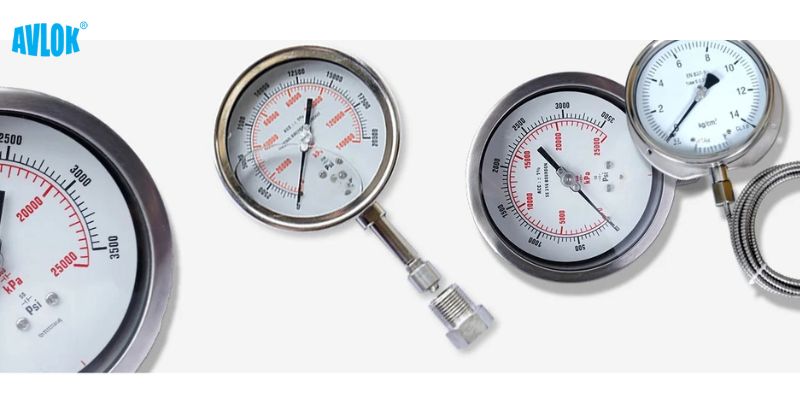
Many manufacturing processes rely on stable temperature control. Glass tube thermometers are often integrated into systems alongside other analog instruments such as the Liquid Filled pressure Gauge, providing operators with immediate visual confirmation of operating conditions.
In environments where vibration, moisture, or electrical noise could affect digital devices, analog instruments remain a trusted solution.
HVAC and Mechanical Systems
Heating, ventilation, and cooling systems frequently use glass tube thermometers to monitor fluid and air temperatures. These instruments are often installed near Panel mounted gauge assemblies, allowing technicians to check pressure and temperature at a glance.
The ability to visually inspect system health without powering up diagnostic tools is a significant advantage during maintenance and troubleshooting.
Relationship with Pressure Measurement Instruments
Temperature and pressure are closely linked in many systems, which is why glass tube thermometers are commonly paired with pressure gauges.
Liquid Filled Pressure Gauge Integration
A Liquid Filled pressure Gauge is designed to dampen vibration and stabilize readings in harsh environments. When used alongside a glass tube thermometer, it helps operators understand how pressure fluctuations correspond to temperature changes—critical information in steam systems, hydraulic lines, and chemical processing units.
Panel Mounted Gauge Systems
In control panels, a Panel mounted gauge setup often includes both pressure and temperature indicators. Glass tube thermometers fit well into these configurations because they are easy to read, durable, and require minimal maintenance.
Safety, Accuracy, and Environmental Considerations
Mercury Use and Modern Alternatives
While mercury-based glass tube thermometers are highly accurate, environmental and health concerns have led many industries to transition toward safer alternatives. Modern glass tube thermometers often use non-toxic liquids that still provide reliable readings.
Calibration and Maintenance
Glass tube thermometers are known for long-term stability, but periodic calibration is still important, especially in regulated industries. Their simple construction makes calibration verification easier compared to electronic sensors.
Comparing Glass Tube and Digital Thermometers
Digital thermometers offer speed and convenience, but they are not always superior.
Feature Glass Tube Thermometer Digital Thermometer
Power Required No Yes
Visual Verification High Moderate
EMI Sensitivity None Possible
Long-Term Stability Excellent Sensor-dependent
For many professionals, the choice isn’t one or the other—it’s using both together for cross-verification and system confidence.
Educational Value and Training Use
Glass tube thermometers remain widely used in educational settings. Their transparent operation makes them ideal teaching tools, allowing students to physically see how temperature changes affect matter.
This visibility helps build foundational understanding before learners move on to more complex digital systems.
The Future of Glass Tube Thermometers
Despite advances in automation and IoT-based monitoring, glass tube thermometers are unlikely to disappear. Instead, they continue to evolve alongside modern instruments, serving as dependable reference points in increasingly complex systems.
Their simplicity is their strength—a reminder that good engineering doesn’t always require complexity.
Final Thoughts
The Glass Tube Thermometer is more than a historical artifact. It is a proven, trusted instrument that continues to play an important role in laboratories, industrial systems, HVAC applications, and educational environments.
When paired with tools like a Liquid Filled pressure Gauge or installed within a Panel mounted gauge system, it contributes to a clearer, more reliable understanding of how temperature and pressure interact in real-world operations.



If you want safety and the security of knowing you’ll be able to inflate a tire on the side of the road in minutes, or if you’re looking to air up and air down quickly out on the trail, then the Special Ops Air Armor M240 portable air compressor is for you.
It’s just a quality, 12-volt portable tire inflator built into a cool looking ammo can – because some things are just better left alone.
They say it’s one of the best portable tire inflators.
Airing up has never been easier thanks to the M240’s high output patented design.
Instrument panel with built-in pressure gauge, extended 50% duty cycle and an unprecedented 25′ hose that reaches all 4 tires of even the longest wheelbase vehicles.