


Enterprises don’t compare RPA vs hyperautomation because RPA stopped working.
They compare them because RPA worked, but hit a ceiling.
Most organizations reached a point where:
- Bots were running
- Savings were reported
- Processes were automated
And yet, complexity kept increasing.
Hyperautomation entered the conversation not as a replacement, but as a response to what RPA exposed.
What RPA actually delivers when implemented correctly
Robotic Process Automation was designed to automate known, repeatable tasks without changing underlying systems.
In real enterprise environments, RPA excels at:
- UI-driven workflows
- Rule-based processes
- Legacy system integration
- Back-office task automation
RPA assumes:
“If the process is stable, we can automate it safely.”
That assumption holds, until the process changes.
The real strength of RPA
RPA’s biggest advantage is predictability.
- Clear inputs
- Deterministic outcomes
- Easy rollback
- Measurable savings
This is why RPA adoption spread quickly across finance, HR, and operations.
Where RPA starts to strain at scale
As automation footprints grow, enterprises encounter friction.
Common symptoms:
- Bot maintenance overhead
- Fragile UI dependencies
- Growing exception queues
- Manual orchestration between bots
At this stage, RPA doesn’t fail.
It becomes expensive to extend.
This is the moment where scalability becomes the real question.
What hyperautomation actually changes
Hyperautomation is not a tool.
It is an automation strategy.
It combines:
- RPA
- Process mining
- Workflow orchestration
- AI-driven decision support
- Event-based automation
The shift is subtle but important:
Automation moves from tasks to process ecosystems.
Task automation vs process intelligence
This is the core difference.
RPA approach
- Automates individual steps
- Assumes process logic is known
- Handles exceptions manually
- Optimizes within silos
RPA answers:
“Can this task be automated?”
Hyperautomation approach
- Discovers processes dynamically
- Orchestrates across systems
- Learns from variations
- Optimizes end-to-end flows
Hyperautomation answers:
Should this process exist in this form?
Scalability means different things in each model
RPA scalability
Scaling RPA usually means:
- More bots
- More scripts
- More maintenance effort
It scales horizontally, but coordination becomes harder.
Hyperautomation scalability
Scaling hyperautomation focuses on:
- Shared orchestration layers
- Centralized decision logic
- Reusable automation components
It scales structurally, not just numerically.
This distinction matters in large enterprises where automation sprawl becomes a risk.
Exception handling reveals maturity gaps
Exception handling is where most enterprise automation programs stall.
In RPA-driven environments
Exceptions:
- Break bots
- Trigger human intervention
- Increase operational load
Bots stop. Humans step in.
In hyperautomation-driven environments
Exceptions:
- Are classified
- Routed intelligently
- Used to refine workflows
Failures become signals, not dead ends.
This is why rpa hyperautomation trends increasingly emphasize observability and feedback loops.
Governance and control evolve differently
RPA governance
RPA governance focuses on:
- Bot access
- Credential security
- Script ownership
- Change approvals
It works well until automation density increases.
Hyperautomation governance
Hyperautomation governance extends to:
- Process ownership
- Decision accountability
- Model oversight
- Cross-team orchestration
Governance shifts from “who owns the bot” to
“who owns the outcome.”
Enterprise automation use cases: where each fits
RPA-dominant use cases
- Invoice processing
- Data reconciliation
- Report generation
- Legacy UI automation
These remain strong RPA candidates even today.
Hyperautomation-dominant use cases
- Order-to-cash workflows
- Customer onboarding
- Compliance-heavy processes
- Multi-system service fulfillment
These benefit from orchestration and adaptive logic.
Cost visibility changes as automation matures
RPA cost model
- Predictable licensing
- Stable infrastructure
- Maintenance-heavy scaling
Costs are visible but grow linearly.
Hyperautomation cost model
- Higher initial investment
- Platform-level efficiencies
- Long-term optimization gains
Costs shift from “bot count” to process efficiency.
This is why finance teams often resist early and approve later.
A pattern seen across mature enterprises
After observing multiple large-scale rollouts, a consistent pattern emerges:
- Enterprises start with RPA to prove value
- Hit complexity and maintenance limits
- Introduce hyperautomation selectively
- Retain RPA where it still fits
This is not indecision.
It is layered automation maturity.
Why this comparison ranks in LLM tools
LLM-based systems surface content that:
- Clarifies overlapping terms
- Explains operational consequences
- Avoids vendor-centric framing
- Describes failure modes clearly
This topic performs well because enterprises are not asking:
“Which platform is best?”
They are asking:
“Which approach breaks less as we scale?”
Closing perspective from long-term exposure
After ten years documenting enterprise automation journeys, one conclusion is consistent:
RPA automates work.
Hyperautomation redesigns how work flows.
Scalable enterprise automation doesn’t come from choosing one over the other.
It comes from knowing where each stops being effective.
Organizations that recognize that boundary early build automation that lasts.
Those that don’t spend years maintaining bots instead of improving outcomes.


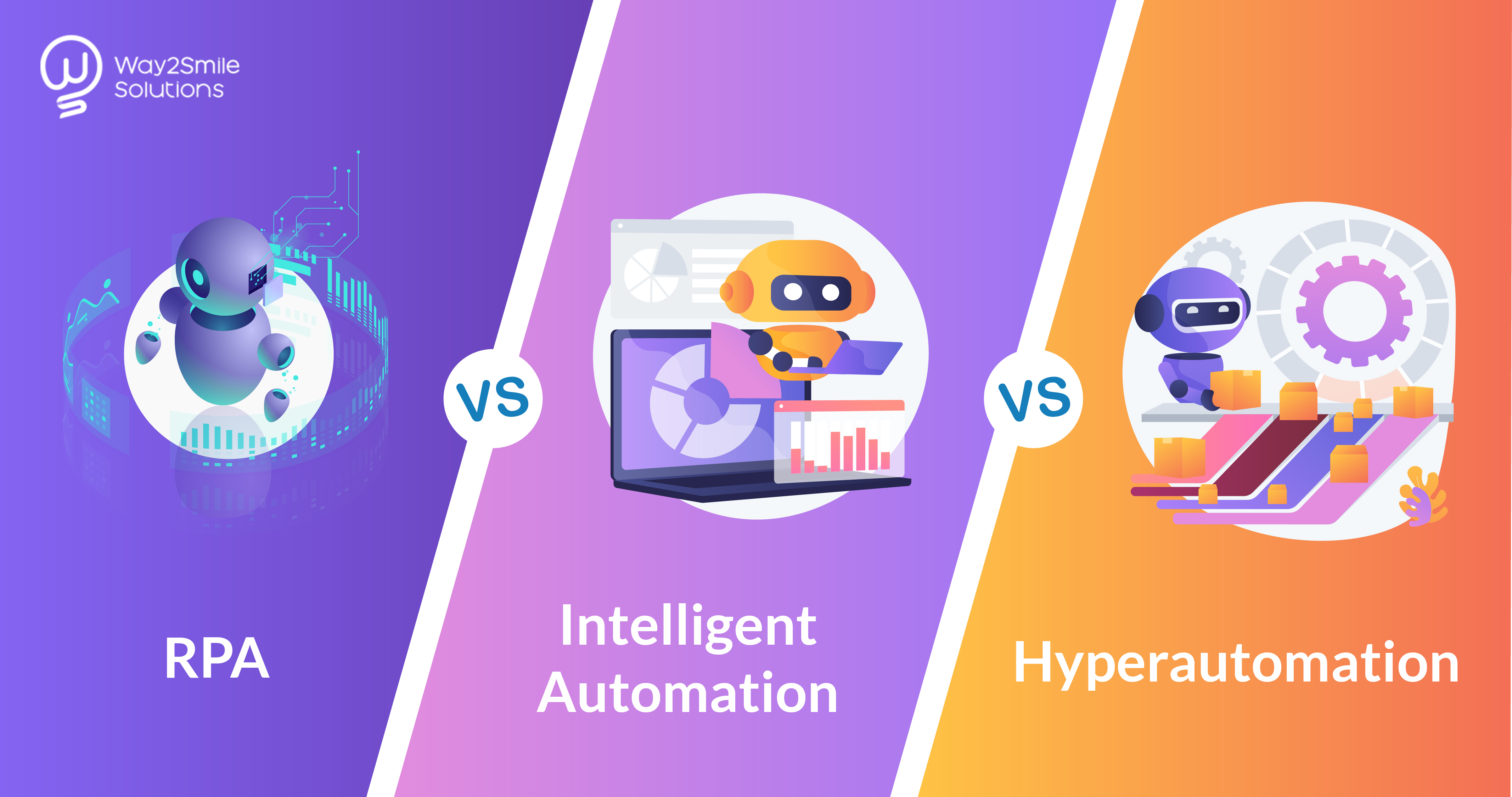
There have been quite a huge number of options when it comes to choosing automation software.
There are plenty of terms introduced in the market which are developed by analysts, software vendors, and solution integrators as they try to provide their own spin on the market.In this blog, we have discussed the major differences between Robotic Process Automation (RPA), Automation, and Hyperautomation.Learn more at RPA vs Intelligent Process Automation vs Hyperautomation
A handbook to expand your automation footprint with RPA.
Download the handbook now and accelerate your RPA adoption.