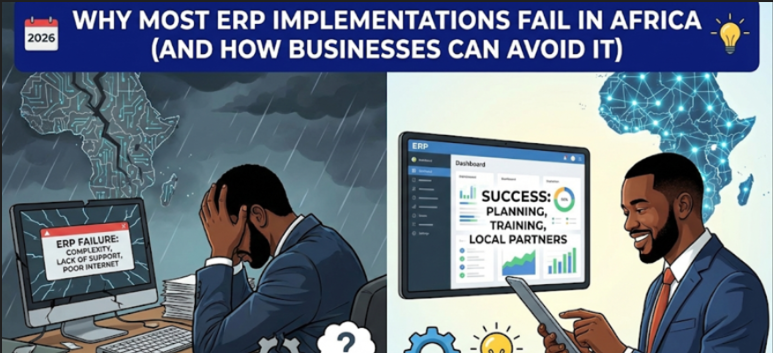
ERP software is often sold as a cure-all for broken operations. Yet across Africa, many ERP projects quietly fail.
Businesses invest time, money, and energy— only to drift back to Excel sheets, WhatsApp approvals, and manual reconciliations.
The issue isn’t ERP itself. It’s how ERP is selected, implemented, and adopted.
This post explains why ERP implementations fail in Africa—and how businesses in Ghana, Nigeria, Kenya, South Africa, and beyond can avoid these mistakes in 2026.
The Quiet Cost of ERP Failure
ERP failure rarely looks dramatic. It shows up as:
Parallel Excel files running beside “the system”
Stock mismatches despite system tracking
Delayed invoicing and unclear receivables
Dashboards nobody trusts
Dependency on one or two power users
When data loses credibility, decisions follow.
Many African SMEs face this after adopting ERP systems that don’t fit real workflows—or choosing ERP software in Ghana without local understanding.
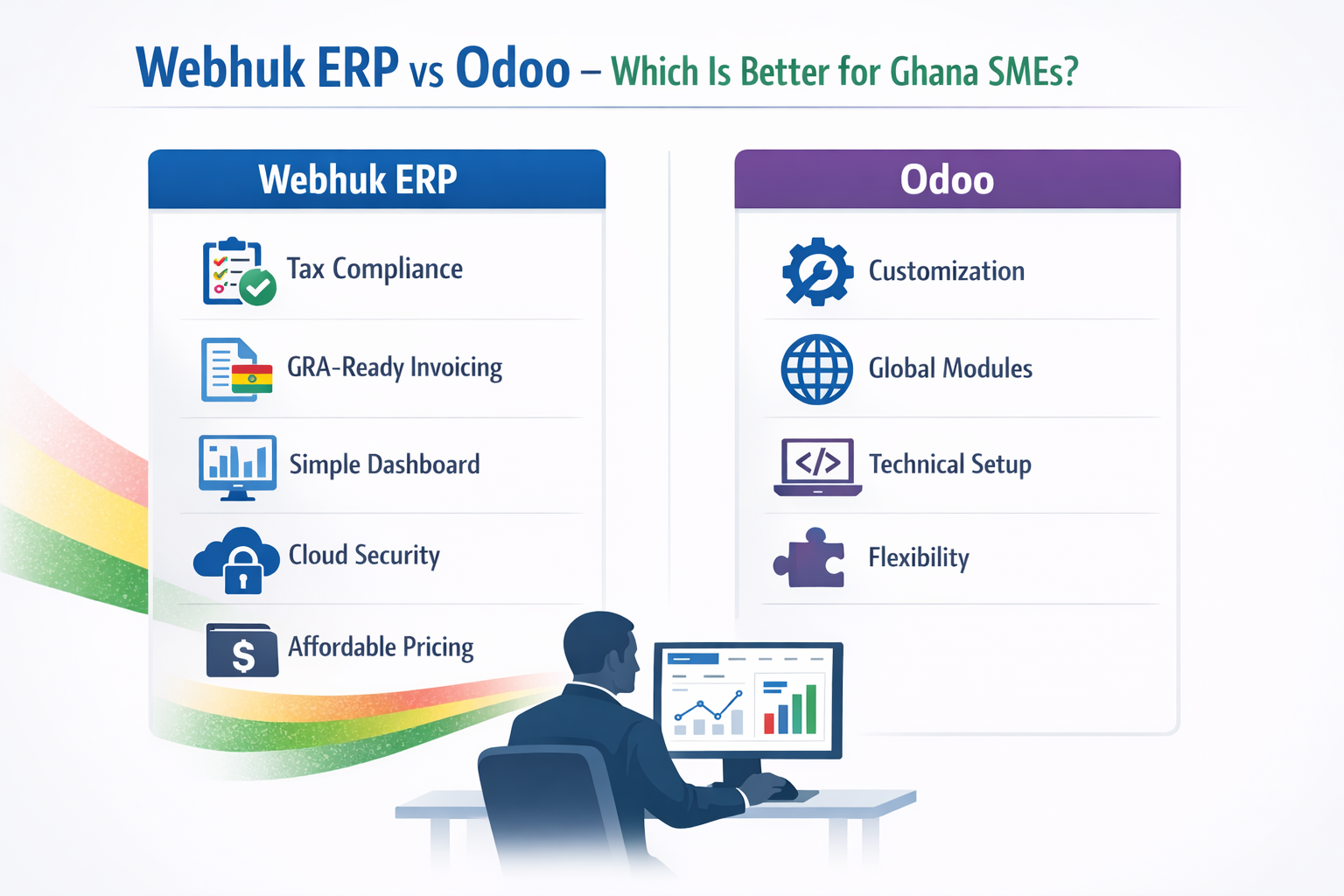
Webhuk ERP is built to manage inventory, approvals, accounting, and reporting in one unified platform, designed for African business realities.
Why ERP Implementations Fail in Africa
1. Buying ERP Before Defining Processes Many companies buy ERP first and figure out workflows later. This creates confusion and resistance.
ERP should support approvals, roles, and decision paths—not force rigid templates.
2. Over-Customization From Day One Too much customization early leads to:
Delays
Cost overruns
Upgrade issues
Developer dependency
Strong implementations standardize first and customize gradually.
3. Treating ERP Like an IT Project ERP is a business transformation, not an IT task.
Failures happen when:
Owners stay hands-off
Departments avoid decisions
Processes aren’t documented
Leadership involvement matters.
4. Poor Inventory Visibility Inventory issues are one of the fastest signs of ERP failure.
Without clear GRNs, transfers, and aging reports, stock numbers can’t be trusted.
5. Disconnected Accounting and Cash Flow Stress When accounting isn’t tightly linked to sales and purchases:
Invoices are delayed
Receivables become unclear
Cash flow suffers
This is why choosing multi currency accounting software Africa businesses can rely on is critical—especially for cross-border operations.
6. Multi-Branch Growth Without Control As businesses expand, spreadsheets stop working.
ERP must offer centralized reporting while keeping branch-level control.
7. Doing Everything at Once Big-bang ERP rollouts overwhelm teams.
Phased implementation reduces risk and improves adoption.
How African Businesses Can Avoid ERP Failure
✔ Use a Phased Rollout
Phase 1: Sales, Purchases, Inventory, Invoicing
Phase 2: Accounting, Credit Control, Core Reports
Phase 3: Automation, Integrations, Advanced MIS
✔ Align ERP With Real Workflows ERP should reflect how your business actually operates—not demo data.
Approval matrices, audit trails, and flexibility matter.
✔ Assign Clear Ownership Successful ERP projects always have:
One accountable owner
Clear escalation paths
Fast decisions
ERP delays are usually decision delays.
✔ Invest in Training and Adoption ERP doesn’t fail at go-live. It fails when users stop using it properly.
Training must be practical, role-based, and continuous.
Why ERP Success Looks Different in Africa
African businesses operate with:
Varying internet reliability
Mixed skill levels
Rapid growth
Informal legacy processes
ERP success here requires flexibility and local context—not rigid global templates.
How Webhuk ERP Reduces Implementation Risk
Webhuk ERP focuses on:
Workflow-first implementation
Modular, phased deployment
Strong inventory and accounting foundations
Local compliance readiness
Practical training and support
This approach significantly lowers ERP failure rates and improves ROI.
Final Thought
Planning ERP for your business in Africa?
Start with readiness—not just software. Choosing the right ERP software in Ghana and a proven multi currency accounting software Africa businesses trust can make all the difference.
Real systems. Real adoption. Real results.
FAQs
Why do ERP implementations fail in Africa?
They fail due to poor planning, unclear workflows, weak training, and ERP systems that do not align with local business realities.
Is ERP failure caused by software?
In most cases, failure is caused by implementation and adoption—not software capability.
Can ERP be implemented gradually?
Yes. Phased implementation greatly improves success for African SMEs.
How long does ERP implementation take?
Typically a few weeks to a few months depending on scope and readiness.
How can SMEs reduce ERP risk?
By choosing the right ERP partner, defining processes early, training users, and enforcing discipline.
Final Call to Action (Lead-Focused)
Planning ERP for your business in Africa?
Avoid costly mistakes. Get a free ERP readiness assessment tailored to your industry and operations.
Book a free ERP consultation:
https://www.webhuk.io/contact-us




*Please fill in the form below for FREE demo session and we will get back to you shortly
105 Sims Ave #09-12 Chancerlodge Complex Singapore 387429
Send us a question or comment Tel: (65) 6227 1797 / (65) 6746 2613
We provide a subsidy scheme to encourage SMEs which are registered for Goods and Services Tax (GST), to use accounting software that are compliant with IRAS e-Tax Guide: Guide on Accounting Software for Software Developers.
Such software product/packages are listed in the IRAS' Accounting Software Register.
We help local enterprises upgrade market competitiveness through IT implementation.