Introduction: How Do Systems Think and Act Automatically?
When a customer submits a request online and receives updates without speaking to a human, it may look effortless. But behind that smooth experience is a structured engine evaluating rules, checking data, and guiding the process step by step.
Modern enterprises cannot rely on manual workflows for critical operations. They need platforms that can think logically, follow policies, and execute tasks automatically. One such enterprise platform is PEGA.
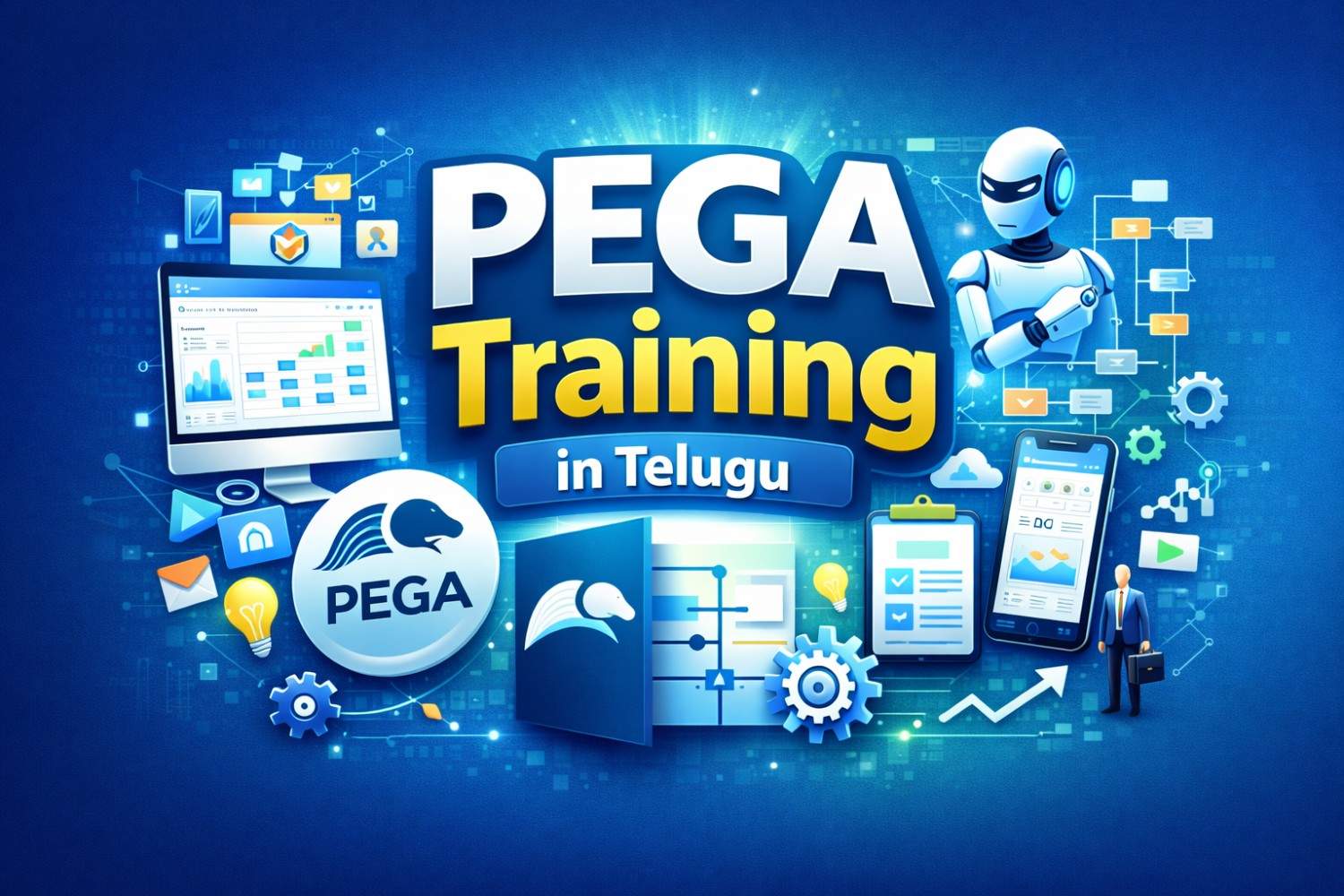
If you are exploring PEGA Training in Telugu, it is important to understand PEGA from a system design and automation perspective. This article explains how PEGA works internally, how it manages business processes, and why it remains relevant in enterprise environments.
What is PEGA?
PEGA is an enterprise low-code platform designed for Business Process Management (BPM), Case Lifecycle Management, and Intelligent Decision Automation.
From a technical standpoint, PEGA allows organizations to build applications using rule configurations and workflow models instead of writing large volumes of traditional code.
Its core objectives include:
- Automating structured business processes
- Managing case-based transactions
- Implementing dynamic business rules
- Supporting compliance and governance
- Scaling across enterprise operations
PEGA is primarily used in industries where process accuracy and regulatory control are essential.
The Core Engine: Rule Resolution
The foundation of PEGA lies in its rule resolution mechanism.
Instead of embedding business logic directly into application code, PEGA stores logic as configurable rules. During runtime, the system evaluates context and determines which rule to apply.
Types of rules include:
- Decision rules for evaluating conditions
- Validation rules for ensuring data accuracy
- Assignment rules for routing tasks
- Escalation rules for monitoring deadlines
This modular structure makes applications easier to update and maintain.
Case Management Explained
Case management is central to PEGA’s architecture.
A case represents a specific business interaction. Examples include:
- Loan approval request
- Insurance claim submission
- Customer service complaint
- Account opening process
Each case follows a defined lifecycle composed of stages and steps.
Typical stages might include:
- Submission
- Verification
- Review
- Approval
- Completion
This structured approach ensures visibility and accountability.
Workflow Execution in Action
Consider an example from the insurance sector.
When a customer files a claim:
- A case is created automatically.
- Required documents are validated through configured rules.
- Policy information is retrieved via integration services.
- Decision tables evaluate eligibility criteria.
The case is escalated if additional review is needed.
Final settlement status is recorded.
All these actions occur based on predefined workflow and rule configurations.
This automation reduces errors and ensures consistency.
- Architectural Overview
- PEGA operates through interconnected architectural layers.
- User Interface Layer
- Handles portals, dashboards, and forms.
- Business Logic Layer
Contains workflows, rule definitions, and case configurations.
Data Layer
Defines structured properties and relationships.
Integration Layer
Connects to external enterprise systems using APIs.
The rule engine coordinates across these layers to execute workflows dynamically.
Intelligent Decision Management
PEGA integrates decision automation capabilities.
These include:
- Predictive analytics
- Risk scoring mechanisms
- Context-based recommendations
- Next-best-action strategies
For example, in customer engagement platforms, PEGA can recommend personalized actions based on user behavior and history.
This combination of automation and analytics enhances operational intelligence.
Industry Applications
PEGA is widely adopted in sectors requiring structured workflow governance.
Key industries include:
- Banking and Financial Services
- Insurance
- Healthcare
- Telecommunications
- Government Services
- Retail Enterprises
In these industries, automation improves operational efficiency and compliance adherence.
Why Learn PEGA in Telugu?
Learning PEGA in Telugu can help learners clearly understand rule-based systems, workflow modeling, and case lifecycle concepts when foundational technical ideas are explained in a familiar language; this builds stronger conceptual clarity before engaging in enterprise-level technical environments.
Skills Required to Work with PEGA
Although PEGA reduces heavy coding requirements, certain skills are beneficial:
- Logical reasoning
- Analytical thinking
- Understanding of business workflows
- Basic database knowledge
- Familiarity with integration services
Advanced professionals may focus on architecture design and system optimization.
Advantages of PEGA
PEGA offers several enterprise-level benefits:
- Centralized rule repository
- Faster development lifecycle
- Scalability for large workloads
- Built-in compliance tracking
- Integration with AI-driven analytics
These characteristics make it reliable for mission-critical enterprise systems.
Challenges and Governance
- A balanced understanding is important.
- Enterprise implementations require structured governance.
- Rule dependencies must be documented carefully.
- Complex deployments demand experienced architectural planning.
- Proper system design ensures long-term sustainability.
Future Scope of PEGA
Enterprise automation continues evolving alongside advancements in:
- Artificial Intelligence
- Cloud-native architectures
- Intelligent process automation
- Real-time analytics
Low-code platforms are projected to grow as organizations prioritize agility and digital transformation.
PEGA’s rule-driven adaptability ensures continued relevance.
Career Ecosystem Around PEGA
Professionals skilled in PEGA contribute in roles such as:
- System Architect
- BPM Specialist
- Application Developer
- Enterprise Automation Consultant
- Decision Strategy Analyst
These roles involve designing and maintaining scalable workflow systems.
Conclusion
As businesses grow more complex, the need for structured workflow automation becomes critical. PEGA provides a rule-driven framework that supports case management, intelligent decision-making, and enterprise scalability.
By separating business logic from traditional programming, it enables organizations to adapt quickly while maintaining compliance and governance.
As enterprises increasingly depend on automation to stay competitive, could mastering platforms like PEGA become a defining capability in the future of enterprise technology?