Introduction: How Does an Idea Become a Live Application?
Every successful application starts as an idea. That idea turns into code, the code becomes a working product, and eventually millions of users interact with it. But between writing code and delivering it to users lies a complex journey.
In the past, that journey was slow and error-prone. Today, it is automated, structured, and continuous — thanks to DevOps.
If you are exploring a DevOps Course in Telugu, understanding how DevOps manages the entire journey from development to deployment will give you clarity about modern software engineering practices.
What is DevOps?
DevOps is a methodology that combines development and operations practices to automate and streamline the software delivery lifecycle.
Its key goals include:
- Continuous integration and delivery
- Faster software releases
- Reduced human errors
- Automated infrastructure management
- Continuous monitoring and improvement
DevOps connects people, processes, and technology to deliver applications efficiently.
Why DevOps Became Necessary
Earlier, development and operations teams worked separately. Developers focused on writing code, while operations teams managed servers and deployments. This separation created:
- Communication gaps
- Slow release cycles
- Manual configuration errors
- Reactive troubleshooting
DevOps eliminated these silos by encouraging collaboration and automation across all stages.
The DevOps Lifecycle Explained
DevOps works as a continuous cycle rather than a one-time process.
Planning
Teams define features and system requirements.
Development
Developers write and update application code.
Build
Applications are compiled and packaged.
Testing
Automated tests validate code functionality and performance.
Release
Software is prepared for deployment.
Deployment
Applications are deployed automatically to production or cloud platforms.
Operations
Systems are managed to ensure uptime and performance.
Monitoring
Logs and performance metrics are analyzed continuously.
This loop supports ongoing improvement and faster innovation.
Core DevOps Practices
Continuous Integration (CI)
Developers integrate code changes frequently into a shared repository. Automated tests verify each integration.
Continuous Delivery (CD)
Applications remain deployment-ready at all times, reducing release risk.
Infrastructure as Code (IaC)
Infrastructure configuration is automated using scripts and configuration files.
Containerization
Applications are packaged into containers to ensure consistent execution across environments.
Continuous Monitoring
Real-time monitoring ensures quick detection and resolution of issues.
Key DevOps Tools
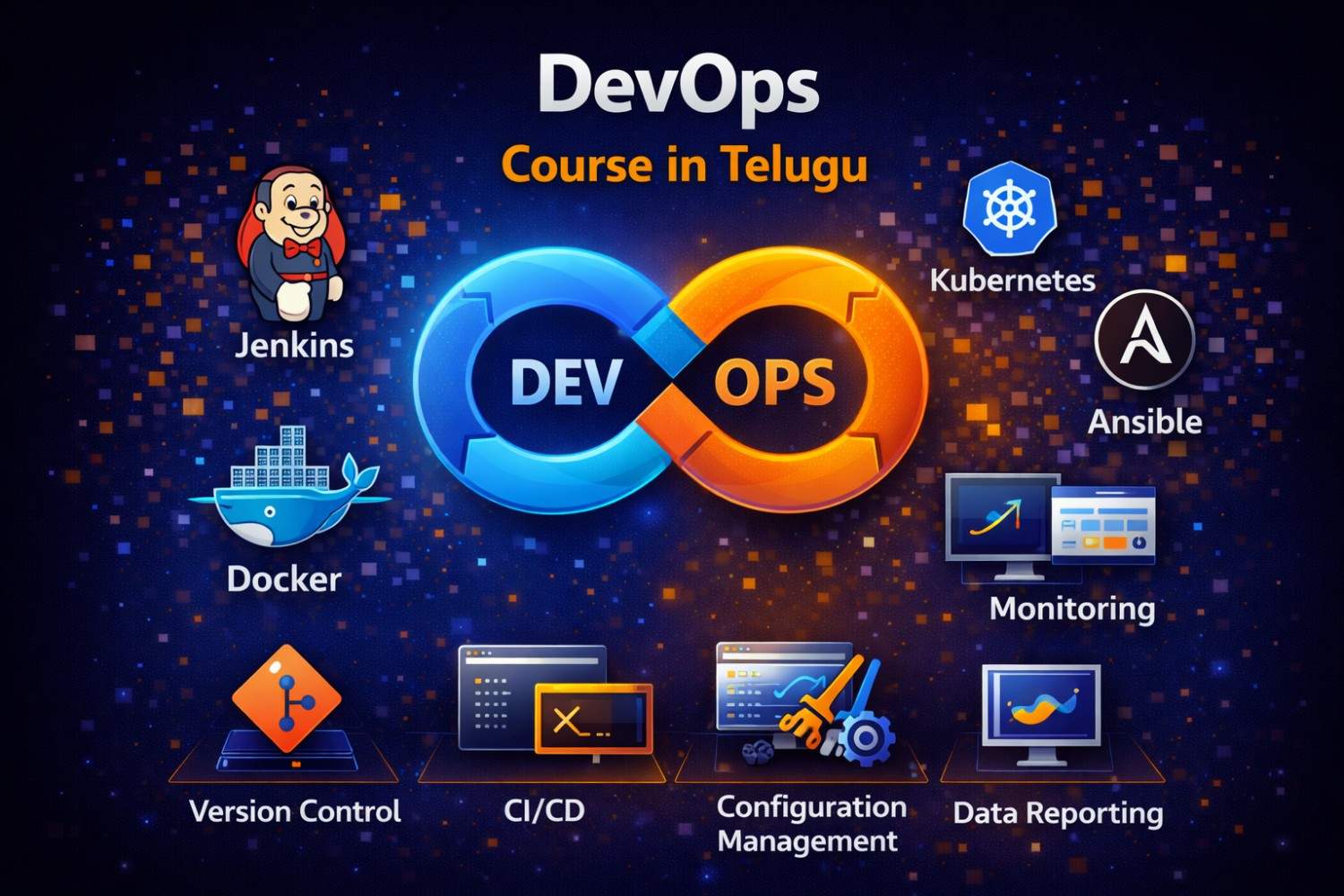
DevOps relies on multiple tools to automate its workflow.
Version Control
- Git
CI/CD Tools
- Jenkins
- GitHub Actions
Containers
- Docker
Orchestration
- Kubernetes
Configuration Management
- Ansible
Infrastructure Automation
- Terraform
Monitoring
- Prometheus
- Grafana
Each tool supports a specific stage in the software lifecycle.
Role of Cloud in DevOps
Cloud computing plays a critical role in DevOps implementation.
Popular cloud platforms include:
- AWS
- Microsoft Azure
- Google Cloud
Cloud services enable automated provisioning, scaling, and high availability.
What You Learn in a DevOps Course in Telugu
A structured DevOps curriculum typically includes:
Linux Fundamentals
Understanding system operations and command-line usage.
Git
Managing code repositories and branching workflows.
CI/CD Pipelines
Configuring automated build and deployment pipelines.
Docker
Creating and managing containerized applications.
Kubernetes
Orchestrating and scaling containers.
Infrastructure as Code
Automating server setup and configuration.
Cloud Deployment
Deploying and managing applications in cloud environments.
Hands-on practice is essential to mastering these skills.
Why Learn DevOps in Telugu?
Learning DevOps in Telugu can help beginners clearly understand automation workflows, infrastructure management, and CI/CD pipelines when foundational topics are explained in a familiar language; this builds strong conceptual clarity before working in professional DevOps environments.
Skills Required for DevOps Engineers
To succeed in DevOps, you should develop:
- Strong Linux fundamentals
- Basic scripting skills
- Networking knowledge
- Analytical thinking
- Automation mindset
Collaboration skills are equally important.
Advantages of Learning DevOps
DevOps offers strong professional advantages:
- High demand across industries
- Exposure to cloud technologies
- Continuous learning opportunities
- Strong career growth potential
Modern organizations depend heavily on DevOps methodologies.
Challenges in DevOps
Professionals may encounter:
- Managing complex toolchains
- Ensuring security and compliance
- Continuous monitoring responsibilities
- Handling distributed systems
Strong foundational knowledge helps address these challenges.
Future Scope of DevOps
DevOps continues evolving with:
- DevSecOps integration
- AI-driven monitoring systems
- Serverless architectures
- Multi-cloud deployment strategies
Automation and digital transformation ensure sustained demand for DevOps professionals.
Career Opportunities in DevOps
Professionals skilled in DevOps can pursue roles such as:
- DevOps Engineer
- Site Reliability Engineer
- Cloud Engineer
- Automation Engineer
- Release Manager
Industries including finance, healthcare, e-commerce, and IT services rely heavily on DevOps practices.
Conclusion
DevOps transforms the journey from idea to live application into a structured, automated, and continuous process. By integrating development, testing, deployment, and monitoring, it ensures faster releases and greater system reliability.
Understanding DevOps principles, lifecycle, and tools prepares professionals for modern IT ecosystems.
As businesses increasingly prioritize speed, automation, and scalability, could mastering DevOps become one of the most stable and future-ready career paths in the technology industry today?