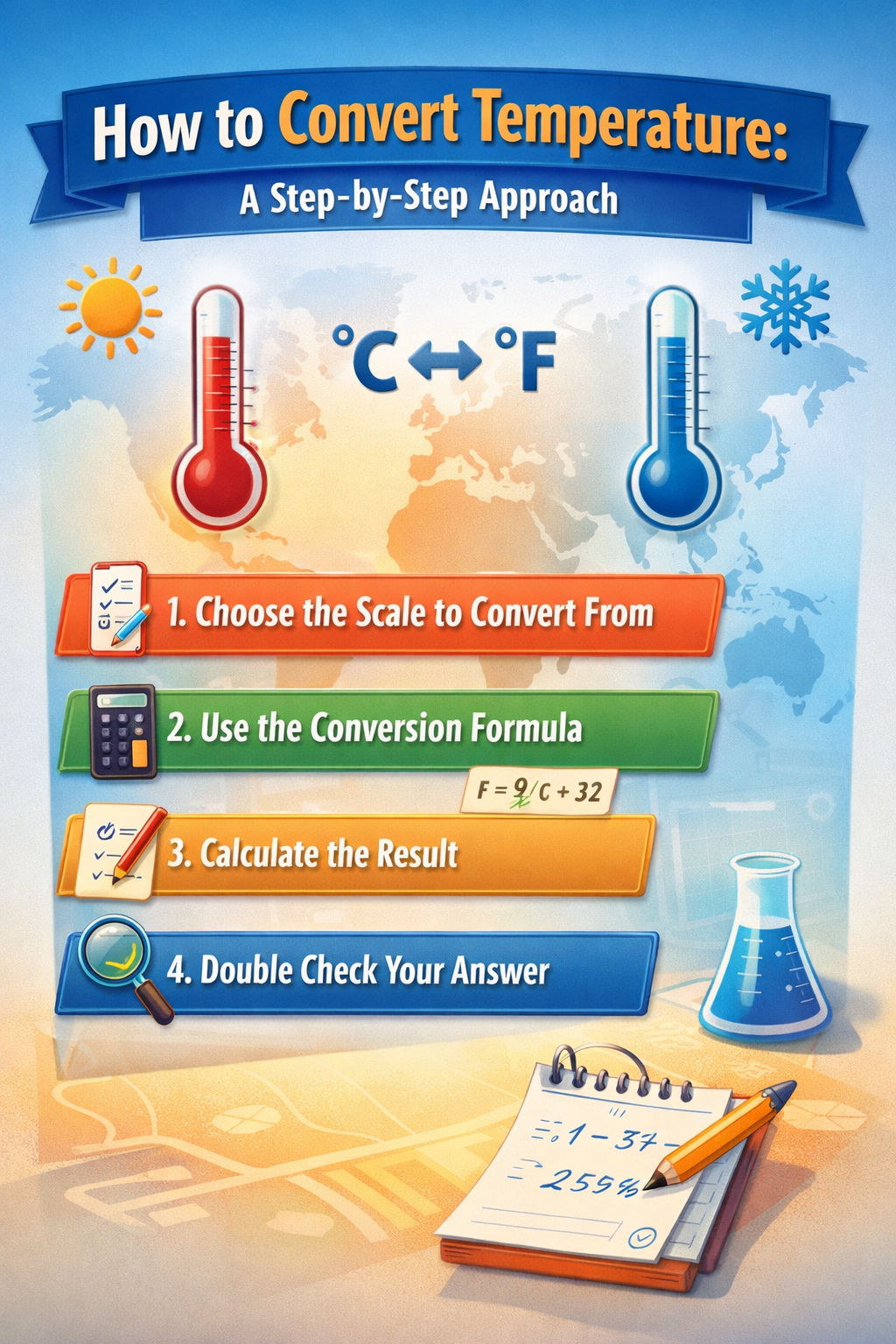
Temperature conversion is something we encounter more often than we realize. Whether you’re checking the weather in another country, cooking using an international recipe, studying science, or working in engineering or healthcare, understanding temperature units is essential.
Different countries use different temperature scales, which makes temperature conversion important for accuracy and clarity. This guide explains how to convert temperature step by step, using simple language, formulas, examples, and common mistakes to avoid.
What Is Temperature Conversion?
Temperature conversion is the process of converting a temperature value from one unit to another. The most commonly used temperature units are:
Celsius (°C)
Fahrenheit (°F)
Kelvin (K)
Each unit follows a different scale, so direct comparison without conversion can be misleading.
Why Do We Need Temperature Conversion?
Different regions and industries follow different temperature measurement systems.
Temperature Scales Used Worldwide
Celsius (°C):
Used in most countries for weather, cooking, and daily use
Fahrenheit (°F):
Used mainly in the United States for weather and household measurements
Kelvin (K):
Used in science, physics, chemistry, and engineering
Because of these differences, temperature conversion becomes necessary in many real-world situations.
Where Temperature Conversion Is Required
Temperature conversion is commonly required in:
Weather forecasting and travel
Cooking and baking (international recipes)
Education and science experiments
Medical and healthcare fields
Engineering and industrial processes
Climate and environmental studies
Using a reliable temperature converter helps avoid confusion and incorrect calculations.
Common Temperature Units Explained
Celsius (°C)
Celsius is based on the freezing and boiling points of water:
Water freezes at 0°C
Water boils at 100°C
It is widely used in daily life across most countries.
Fahrenheit (°F)
Fahrenheit uses a different scale:
Water freezes at 32°F
Water boils at 212°F
It is commonly used in the United States.
Kelvin (K)
Kelvin is an absolute temperature scale:
0 K represents absolute zero
No degree symbol is used with Kelvin
Kelvin is mainly used in scientific and technical applications.
How to Convert Temperature Step-by-Step
There are many online temperature conversion tools available today. For example, you can use an online temperature converter to convert values quickly and accurately without manual calculations.
However, understanding the steps helps you avoid mistakes and know what’s happening behind the scenes.
Step 1: Identify the Given Temperature Value
Start by identifying the numerical value of the temperature you want to convert.
For example, you may have:
25 degrees Celsius
77 degrees Fahrenheit
300 Kelvin
Step 2: Identify the Original Temperature Unit
Next, determine which unit the temperature is currently in:
Celsius
Fahrenheit
Kelvin
Choosing the correct starting unit is crucial for accurate conversion.
Step 3: Select the Target Temperature Unit
Decide which unit you want to convert the temperature into.
Examples:
Celsius to Fahrenheit
Fahrenheit to Celsius
Celsius to Kelvin
Step 4: Apply the Correct Conversion Formula
Each temperature conversion uses a specific formula. Applying the correct formula ensures accurate results.
Temperature Conversion Formulas (With Examples)
Knowing the formulas helps when online tools are unavailable.
Celsius to Fahrenheit
Formula:
Fahrenheit = (Celsius × 9/5) + 32
Example:
If the temperature is 25°C:
(25 × 9/5) + 32 = 77°F
Fahrenheit to Celsius
Formula:
Celsius = (Fahrenheit − 32) × 5/9
Example:
If the temperature is 77°F:
(77 − 32) × 5/9 = 25°C
Celsius to Kelvin
Formula:
Kelvin = Celsius + 273.15
Example:
If the temperature is 25°C:
25 + 273.15 = 298.15 K
Kelvin to Celsius
Formula:
Celsius = Kelvin − 273.15
Example:
If the temperature is 300 K:
300 − 273.15 = 26.85°C
Fahrenheit to Kelvin
Formula:
Kelvin = (Fahrenheit − 32) × 5/9 + 273.15
Example:
If the temperature is 68°F:
(68 − 32) × 5/9 + 273.15 = 293.15 K
Kelvin to Fahrenheit
Formula:
Fahrenheit = (Kelvin − 273.15) × 9/5 + 32
Example:
If the temperature is 310 K:
(310 − 273.15) × 9/5 + 32 = 98.33°F
Quick Temperature Conversion Reference
0°C = 32°F = 273.15 K
25°C = 77°F = 298.15 K
100°C = 212°F = 373.15 K
Common Temperature Conversion Mistakes
Mistake
Why It Happens
How to Fix
Mixing formulas
Confusion between units
Use the correct formula
Forgetting +32 or −32
Memory errors
Write the full formula
Ignoring 273.15
Kelvin confusion
Always include the offset
Rounding too early
Habit
Round only at the end
Benefits of Using an Online Temperature Converter
Saves time
Reduces calculation errors
No need to memorize formulas
Useful for students and professionals
Accurate and instant results
Frequently Asked Questions (FAQs)
What is the easiest way to convert temperature?
Using an online temperature converter is the easiest and most accurate method.
Why is Kelvin used in science?
Kelvin is an absolute scale and is essential for scientific calculations.
Is Celsius better than Fahrenheit?
Neither is better; they are used for different purposes in different regions.
Are temperature converters accurate?
Yes, they use internationally accepted formulas.
Final Thoughts
Temperature conversion is an essential skill in a world where different measurement systems coexist. Whether you are converting Celsius to Fahrenheit, Fahrenheit to Kelvin, or Kelvin to Celsius, understanding the steps and formulas ensures accuracy.
Using a reliable temperature conversion tool can save time, reduce errors, and make calculations effortless.


Apps66 provides you a tool by which you can convert excel to PDF.
All tools of Apps66 are simple and straightforward.
You can convert easily without timed file limits and no ad watermarks.
Visit Apps66 to convert and reduce the size of your files and maintain good quality.