


Introduction: From Click to Database
When a user clicks “Submit,” what really happens?
Behind that simple click, a chain reaction begins. The browser validates inputs, the request travels to the backend, APIs process the data, the database updates records, logging services capture events, and a response is sent back — often within seconds.
If any link in this chain fails, the user experiences an error.
Modern applications are built as interconnected systems, not isolated programs. That is why testing must go beyond checking individual screens. It must validate the entire flow.
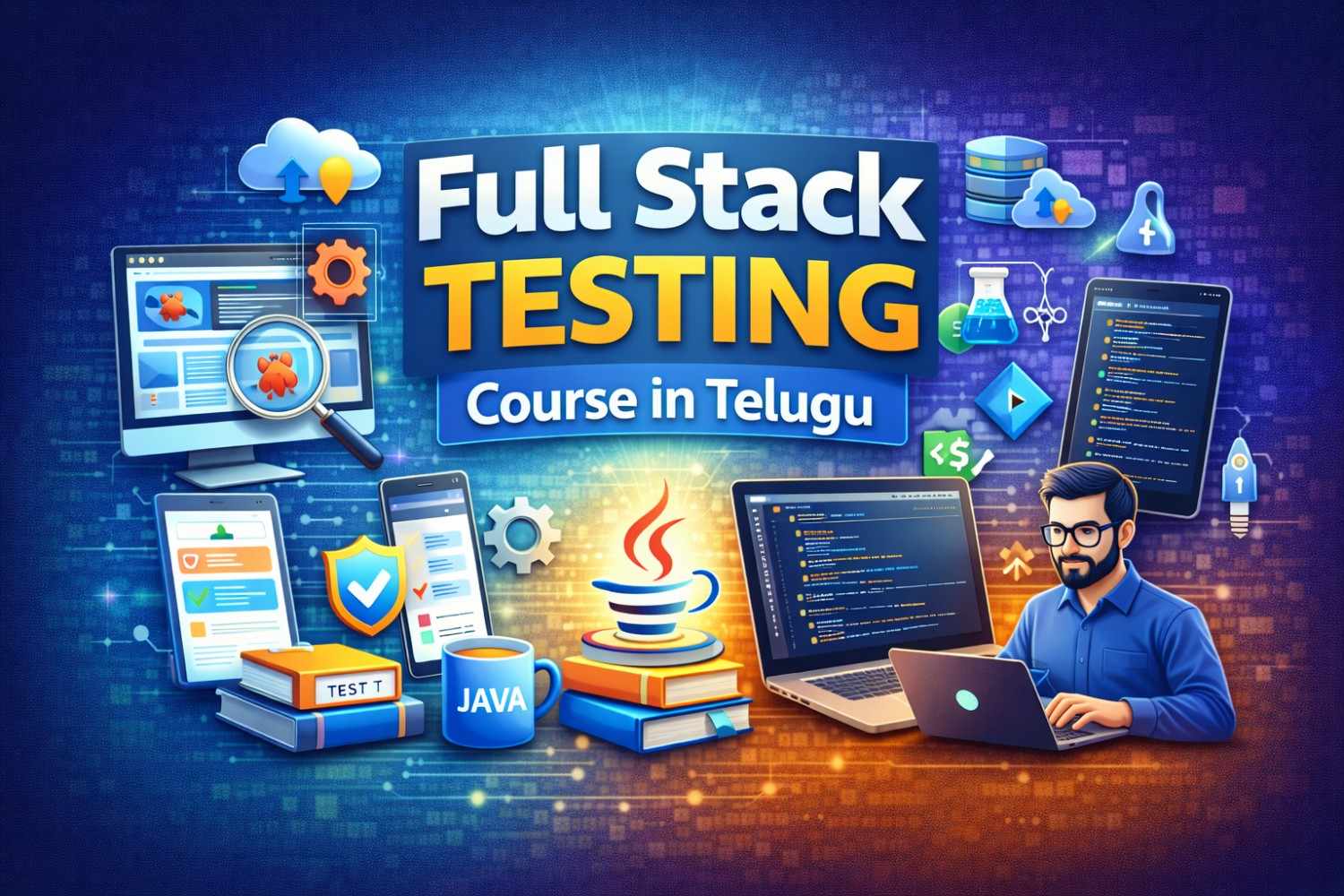
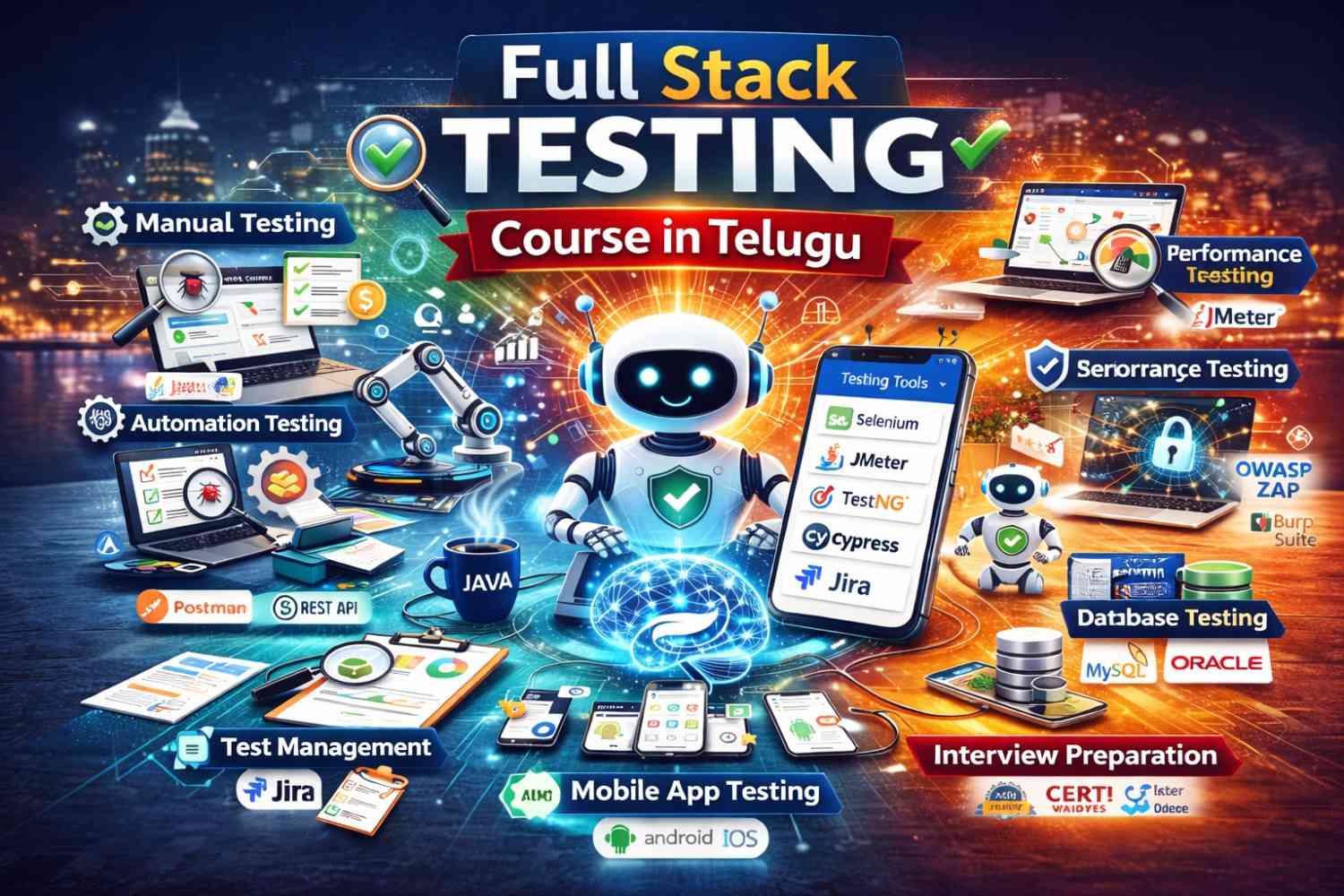
This growing need explains why many learners search for a Full Stack Testing Course in Telugu — to understand how complete software systems are tested from user interface to backend infrastructure.
Full stack testing focuses on validating real-world workflows end to end.
What Is Full Stack Testing?
Full stack testing involves testing every layer of an application:
- Frontend (UI interactions)
- Backend logic
- REST APIs
- Database systems
- Integration between services
- Performance and scalability
It ensures that all components function correctly both individually and collectively.
For example, in a loan application system:
- User submits loan request.
- Backend validates eligibility rules.
- Database stores applicant information.
- Risk assessment service evaluates data.
- Decision status is updated and displayed.
Each of these steps must work smoothly for the system to function properly.
Why Full Stack Testing Is Necessary Today
Software architecture has evolved significantly.
Modern systems are:
- Microservices-based
- Deployed on cloud platforms
- Updated continuously through CI/CD
- Integrated with external APIs
Because systems are distributed, defects often occur at integration points.
Full stack testing helps:
- Detect cross-layer issues
- Maintain consistent data flow
- Reduce system downtime
- Ensure stable releases
- Enhance overall quality
Organizations increasingly expect testers to understand application architecture, not just execute test cases.
Core Areas Covered in Full Stack Testing
A structured approach to full stack testing includes multiple domains.
1. Testing Fundamentals
Every full stack tester must understand foundational concepts.
Key topics include:
- Software Development Life Cycle (SDLC)
- Software Testing Life Cycle (STLC)
- Test case design strategies
- Bug lifecycle management
- Functional and regression testing
These fundamentals strengthen analytical skills.
2. Frontend Testing
Frontend testing ensures correct user interaction.
It verifies:
- Form validations
- Button actions
- Navigation consistency
- UI responsiveness
- Cross-browser support
Tools like Selenium automate UI testing processes.
Frontend testing ensures positive user experience.
3. API Testing
APIs connect frontend and backend systems.
API testing validates:
- Request-response structure
- Authentication and authorization
- HTTP status codes
- Data integrity
- Error handling
Postman and REST-assured are commonly used tools.
API testing is critical in microservices architecture.
4. Database Testing
Database testing ensures reliable data operations.
It verifies:
- Data insertion and updates
- Accurate retrieval
- Relationship constraints
- Data consistency
SQL knowledge is essential for backend validation.
Data integrity directly affects system credibility.
5. Automation Testing
Automation testing improves efficiency and repeatability.
Popular tools include:
- Selenium
- TestNG
- JUnit
- Cucumber
Automation frameworks allow repeated execution of test cases in various environments.
Automation skills are highly valued in the IT industry.
6. Performance Testing
Performance testing measures system behavior under load.
It evaluates:
- Response times
- Scalability
- Stability
- Resource utilization
- JMeter is widely used for load simulation.
Performance testing ensures applications remain reliable during peak usage.
7. Integration and End-to-End Testing
Integration testing verifies that modules communicate correctly.
- End-to-end testing simulates real user scenarios across the system.
- These approaches validate complete workflows.
- Full stack testing heavily depends on them.
8. Continuous Testing and DevOps
Modern software development integrates testing into CI/CD pipelines.
Continuous testing ensures:
- Automated validation after every code update
- Faster feedback loops
- Reliable deployments
Understanding DevOps workflows enhances full stack testing capabilities.
Skills Required for Full Stack Testing
To become a skilled full stack tester, one must develop:
- Logical reasoning
- Attention to detail
- Basic programming knowledge
- SQL expertise
- API understanding
- Automation framework proficiency
- Awareness of system architecture
Testing requires both technical depth and structured thinking.
Why Learn Full Stack Testing in Telugu?
Understanding automation frameworks, API workflows, and database validation concepts in Telugu can improve conceptual clarity during the early stages of learning.
Career Opportunities
Full stack testing skills enable professionals to work as:
- QA Engineer
- Automation Test Engineer
- API Tester
- Performance Test Engineer
- SDET
These roles are in demand across startups, enterprises, SaaS companies, and product-based organizations.
Challenges in Full Stack Testing
Full stack testing introduces challenges such as:
- Managing automation frameworks
- Testing distributed microservices
- Handling dynamic UI elements
- Ensuring full test coverage
Keeping pace with evolving technologies
Continuous learning is essential to remain relevant.
Future Trends in Testing
The future of testing includes:
- AI-assisted automation
- Shift-left testing approaches
- DevSecOps integration
- Cloud-native testing environments
- Quality engineering is becoming more strategic.
Full stack testing aligns with these modern development trends.
The Bigger Picture
- Testing is no longer a final checkpoint before release.
- It is an ongoing process integrated into the entire development lifecycle.
- Full stack testers ensure reliability across frontend, backend, APIs, and databases.
- They act as the final safeguard before software reaches users.
Summary
Full stack testing focuses on validating complete application ecosystems — from user interface interactions to backend processing and database accuracy.
By mastering manual testing, automation frameworks, API validation, and performance analysis, professionals help build stable and dependable digital systems.
As software systems continue to grow more distributed and interconnected, the important question remains — are you ready to understand how entire application stacks are tested and become the quality backbone behind modern technology?

Register For Online Course Software Testing Tutorial Course
Online Course Software Testing Freelance read of the package to permit the business to perceive and understand the risks of package implementation.
It involves the execution of a package element or system to judge one or additional properties of interest.
Software testing will give objective, freelance info regarding the standard of package and risk of its failure to users and/or sponsors.
To perform package tests to make sure quality
Software testing is conducted as before long as a possible package exists.