





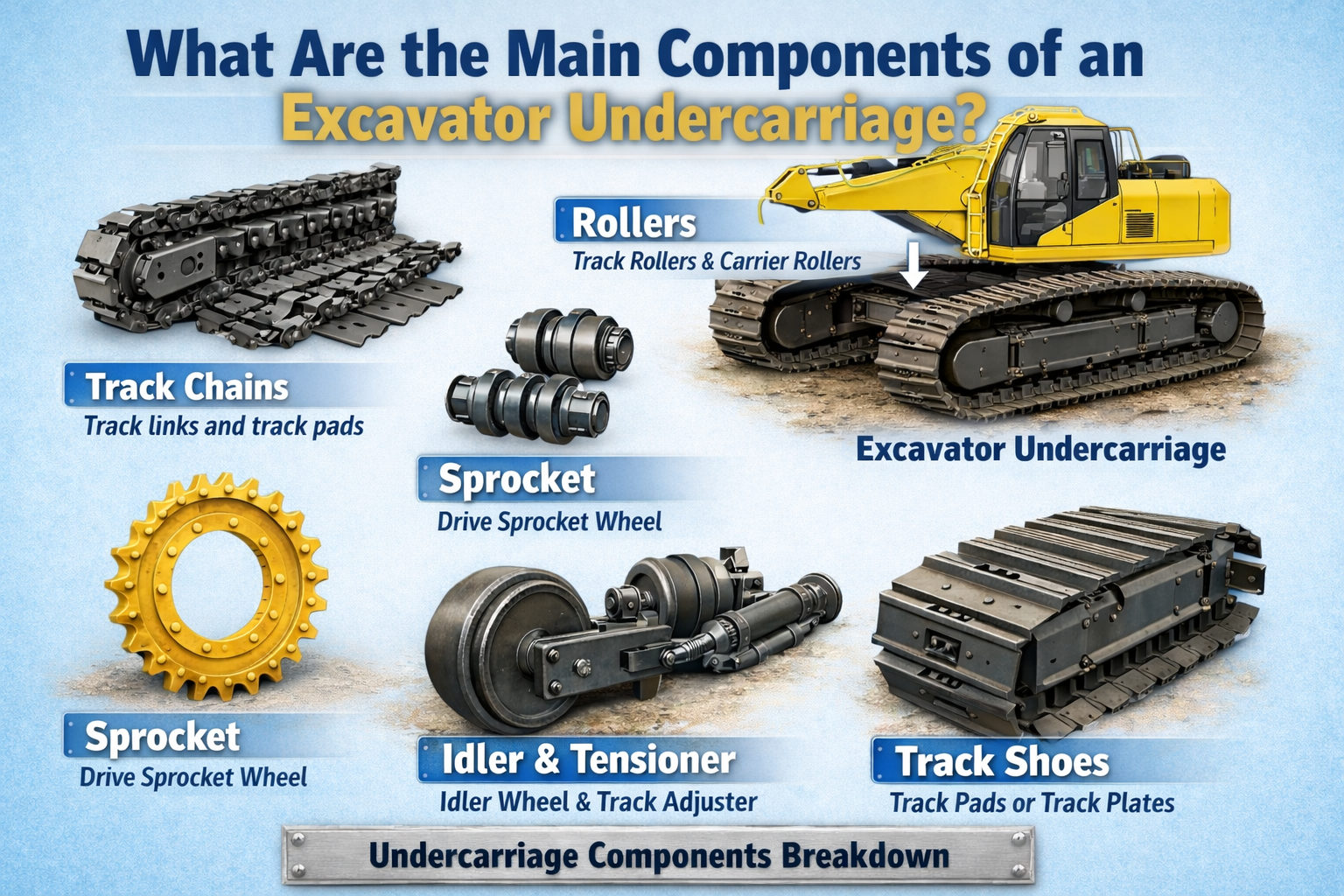
Excavator undercarriage parts carry the entire weight of the machine. They help the excavator to move, turn, and stay stable while working. When you dig, lift, or travel on rough ground, the undercarriage handles most of the stress.
If one part wears out or malfunctions, it affects the machine and increases repair costs. That is why it is important to understand the main components and how they work together.
7 Excavator Undercarriage Parts You Should Know
Here are 7 excavator undercarriage parts operators should know about.
1. Track Chains
Track chains form the moving loop at the bottom of the excavator. They connect all the main undercarriage parts together and allow the machine to move.
The chain is made of many metal links connected with pins and bushings. Track shoes are attached to these links. When the excavator moves, the chain rotates around the sprocket, rollers, and idler. This rotation is what makes the machine move forward or backward.
2. Track Shoes
Track shoes are the metal plates fixed to the track chains. These are the parts that touch the ground directly.
Their job is to provide grip and keep the machine stable. When the excavator moves or digs, the track shoes spread the machine’s weight evenly and help prevent slipping.
If the shoes become bent, cracked, or heavily worn, the excavator may lose balance and traction. This puts extra pressure on other undercarriage parts and reduces working efficiency.
3. Sprocket
The sprocket is the drive wheel located at the rear of the undercarriage. It has teeth that fit into the track chain.
When hydraulic power turns the sprocket, its teeth push against the track chain. This movement pulls the chain and allows the excavator to travel.
If the sprocket teeth wear out, the track may slip and movement becomes rough.
4. Track Roller
Track rollers are positioned at the bottom of the undercarriage. They carry most of the excavator’s weight.
As the machine moves, the track chain rolls over these bottom rollers. Their job is to support the load and keep the track moving smoothly.
If bottom rollers wear unevenly, leak oil, or seize, the track chain may shift out of alignment. This increases stress on other parts and reduces smooth movement.
5. Carrier Rollers
Carrier rollers are located at the top of the undercarriage frame. They support the upper section of the track chain.
While they do not carry as much weight as bottom rollers, they help maintain proper track alignment and prevent sagging.
6. Idler
The idler is located at the front of the undercarriage. Its main job is to guide the track chain and help maintain correct tension.
The idler works with the track tensioning system to ensure the track is not too loose or too tight.
7. Track Frame
The track frame is the strong metal structure that supports all excavator undercarriage parts. It holds the rollers, sprocket, idler, and track assembly in place.
A solid track frame keeps all components aligned and stable during operation. It absorbs load and impact while the machine works.
Bottom Line
The excavator undercarriage works as one complete system. Every part must function properly for the machine to move and stay stable.
When you understand the main excavator undercarriage parts, you can maintain them better and reduce unnecessary wear.



The swelling emphasis towards expansion of high value service industries merged with economic diversification has motivated the incorporation of earth moving equipment like crawler excavators.
In addition, the mining industry has been interested to acquire advanced undercarriage components, which has propitiously backed the global undercarriage components market in the recent past.
Fact.MR has recently published a new assessment that discreetly investigates the highs and lows of the global undercarriage components market to present an insightful forecast analysis.
This study is titled “Undercarriage Components Market Forecast, Trend Analysis & Competition Tracking - Global Market insights 2018 to 2028”, which discourses various facets including market value, volume, Y-o-Y growth and market attractiveness.
The report also covers wider perceptions associated to absolute dollar opportunity, supply chain analysis, value chain assessment and Porter’s five forces model.Request Sample Report- https://www.factmr.com/connectus/sample?flag=S_id=1623The expediency of undercarriage components in the construction industry is marked as a primary reason back the growing construction projects at the global scenario.
For example, construction of new highways, dams as well as expansion of airports are projected to amplify demand for construction and earth moving equipment, thereby, supporting the sales of undercarriage components.