Introduction
A lot of people picture a chef’s life as artistic plating, calm kitchens, and food that looks good under studio lights. That picture sells well online. Real kitchens do not work like that. Real kitchens run on speed, pressure, systems, and discipline. This gap between expectation and reality becomes a serious problem for students who enter culinary education without understanding scale.
A culinary management course in Kolkata exists for one clear reason. The city’s food ecosystem runs on volume. Hotels execute banquets serving 500 to 2,000 covers. Cloud kitchens process thousands of daily orders. Institutional kitchens feed hospitals, offices, trains, and events where delays are unacceptable. In these environments, creativity matters, but consistency matters more. Speed matters more. Hygiene, cost control, and manpower coordination decide success or failure.
Students who train only for boutique cooking struggle in these kitchens. They freeze during rush hours. They miscalculate yields. They lose control over time, food cost, and staff coordination. That gap costs jobs, confidence, and career growth.
This is where culinary management colleges in Kolkata take a very different approach. They train students for scale, pressure, and repetition. They teach how to cook for hundreds without losing quality. They focus on SOP-driven production, kitchen workflow optimisation, bulk cooking techniques, and leadership under stress.
This article breaks down how culinary management education in Kolkata prepares students for real commercial kitchens, not Instagram kitchens. If you want to understand how chefs survive and succeed in high-volume operations, reading ahead will save you from costly misconceptions.
The Reality of High-Volume Commercial Kitchens in India
High-volume cooking in India does not mean busy. It means relentless. A hotel banquet kitchen often produces food for 500 to 1,500 covers within a 90-minute service window. A QSR outlet processes 300–600 orders per hour during peak time. Cloud kitchen production systems in metro cities handle 1,000+ daily orders across multiple brands. These are not exceptions. They are the norm.
Kolkata sits at the heart of this reality. The city supports large wedding banquets, corporate events, railway catering, hospitals, educational institutions, and delivery-driven food businesses. These operations demand chefs trained in high-volume food production, not small-batch artistry.
Time-bound output defines success here. Late service creates guest complaints. Inconsistent taste damages brand trust. Poor coordination creates wastage. Industry data shows that kitchens without standardised production systems experience 8–12% higher food cost leakage compared to kitchens using structured SOPs.
A culinary management course in Kolkata introduces students early to this scale. Students learn that cooking is not just about flavour. It is about managing time, manpower, and process simultaneously. Colleges emphasise menu standardisation, batch cooking, and disciplined execution because these skills determine survival in India’s commercial kitchens.
Curriculum Design Aligned with Large-Scale Kitchen Operations
Curriculum design reveals intent. Culinary management education in Kolkata builds curriculum around systems, not spotlight moments. Students study cooking through the lens of operations.
Batch cooking becomes a core skill. Students learn how to scale recipes from 10 portions to 1,000 portions using large-scale recipe standardisation methods. They calculate yields, portion sizes, and cooking loss. They understand how minor miscalculations multiply into major losses at scale.
Kitchen math receives heavy emphasis. Students calculate raw-to-cooked ratios, holding times, and replenishment cycles. Food cost control systems are taught alongside cooking techniques. Industry benchmarks show that a well-managed kitchen maintains food cost within 28–35%, while untrained kitchens exceed 40%, destroying profitability.
Theory integrates tightly with practice. Students plan mise en place for volume. They schedule production timelines. They follow SOP-driven cooking protocols because improvisation collapses under pressure.
This curriculum prepares students for commercial kitchen operations, not restaurant experiments. The focus remains simple. If a student can feed 800 guests accurately and on time, cooking for 80 becomes easy.
Training in Industrial Equipment and Commercial Kitchen Layouts
High-volume kitchens rely on machines as much as skills. Culinary programs in Kolkata expose students to industrial kitchen equipment training early and repeatedly.
Students work with combi ovens, tilting kettles, bulk fryers, blast chillers, and conveyor dishwashers. They learn output capacity, energy efficiency, and safety protocols. This training matters because industrial equipment reduces labour dependency and increases consistency.
Commercial kitchen layouts receive equal focus. Students understand zoning for the hot kitchen, cold kitchen, bakery, and washing areas. They study kitchen workflow optimisation to reduce cross-movement, accidents, and delays.
Industry data shows that poorly designed kitchen workflows increase service delays by 20–25% during peak hours. Culinary management programs teach students to read layouts and adapt production accordingly.
This exposure prepares students for banquet kitchen management, QSR kitchen operations, and cloud kitchen production systems where efficiency directly impacts revenue and guest satisfaction.
Operational Discipline, Speed, and Multi-Tasking Under Pressure
Speed without control creates chaos. Control without speed fails service. Culinary management training balances both.
Students undergo timed production drills. They simulate peak-hour service. Faculty introduce live counters, simultaneous orders, and back-to-back service windows. This builds stamina and decision-making under stress.
Operational discipline becomes non-negotiable. Students follow SOPs for plating, holding temperatures, replenishment timing, and waste management. These habits matter because high-volume kitchens allow zero margin for error.
Industry data indicates that kitchens with structured service drills reduce order errors by 30–40% compared to kitchens relying on ad-hoc coordination. Culinary programs replicate this discipline repeatedly.
Coordination with service teams also becomes part of training. Students communicate with front-of-house teams during mock banquets and live service. This prepares them for real hospitality operations training environments where teamwork decides outcomes.
Food Safety, Hygiene Compliance, and Regulatory Training
Food safety risks multiply at scale. One lapse affects hundreds. Culinary management education treats hygiene as a system, not a checklist.
Students study HACCP and food safety compliance in detail. They monitor temperature control, cross-contamination risks, storage protocols, and documentation practices. They understand why bulk kitchens face stricter audits.
Data from food safety authorities shows that over 60% of food safety violations occur in high-volume kitchens, not small restaurants. This reality explains the focus on compliance training.
Students practice audit simulations. They maintain logs. They learn corrective actions. This training prepares them for institutional catering management, where compliance failures shut down operations instantly.
Hygiene discipline becomes a habit. That habit protects careers.
Manpower Management and Kitchen Leadership Development
Cooking skills alone do not run kitchens. People do. Culinary management programs prepare students for leadership early.
Students learn kitchen manpower planning and culinary operations management. They assign stations. They manage shifts. They plan leave rotations. They control attrition. These skills matter because Indian kitchens face high staff turnover.
Industry studies show average annual attrition in food service kitchens ranges between 35–45%. Kitchens with strong leadership reduce this by nearly 15–20%.
Students practice communication across language and cultural barriers. They learn conflict resolution and motivation techniques. Culinary leadership development becomes part of everyday training.
This focus prepares graduates for supervisory roles faster. Employers value chefs who manage people as well as food.
Industry Exposure Through Internships and Live Production Kitchens
Training completes only when theory meets reality. Culinary programs in Kolkata emphasise internships heavily.
Students gain exposure to hotels, banquet kitchens, QSRs, institutional kitchens, and cloud kitchens. They handle real volumes, real deadlines, and real consequences.
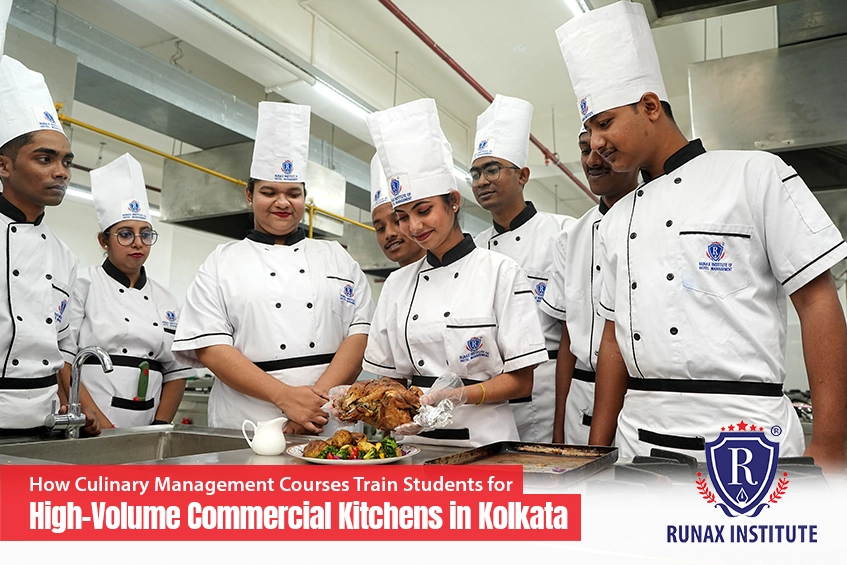
Live production kitchens inside colleges replicate commercial output levels. Students cook for large numbers daily. This builds confidence and speed.
Industry feedback consistently shows that graduates with high-volume internship exposure perform 40% better during initial employment assessments than those without hands-on training.
This exposure bridges the gap between classroom and career. Graduates step into jobs ready, not overwhelmed.
Conclusion
Culinary success in India depends on scale, not spotlight. High-volume commercial kitchens define the hospitality industry more than boutique restaurants ever will. A culinary management course in Kolkata exists to prepare students for this reality.
These programs train students to cook with systems, manage pressure, control cost, ensure hygiene, and lead teams. They prioritise SOP-driven execution, workflow optimisation, and manpower coordination because these skills sustain careers.
This education demystifies culinary glamour. It proves that real chefs succeed through discipline, speed, and consistency. Students who embrace this training thrive in banquets, QSRs, cloud kitchens, and institutional catering.
Cooking for hundreds builds professionals. Cooking for applause builds hobbies. Kolkata’s culinary education chooses the harder path because it delivers lasting careers.
Frequently Asked Questions
1. What makes high-volume kitchens different from regular restaurants?
High-volume kitchens focus on speed, consistency, and scale rather than customised cooking.
2. Does a culinary management course focus more on operations than creativity?
Yes. Creativity exists, but operational control decides employability and growth.
3. Are students trained for cloud kitchens and QSR operations?
Yes. Training includes QSR kitchen operations and cloud kitchen production systems.
4. Why is food safety training critical at scale?
One hygiene lapse impacts hundreds and can shut down operations.
5. Do these courses help in leadership roles later?
Yes. Manpower planning and culinary leadership development prepare students for supervisory positions early.