


Remember how the IKEA Place app allowed us to experience what it would feel like to have their signature pieces in our homes? Pokémon Go sent the younger demographics on a wild chase even as it gave the world a taste of what Augmented Reality (AR) technology can do.
The world of humans and machines is intertwined and symbiotic today. The reality around us has always been three-dimensional but for decades our understanding was based on two-dimensional pages and screens that fell short of what we wanted to know. Until Augmented Reality started narrowing the gulf between the real and digital worlds.
Such is its demand that Marketsand Markets1 predicts the global augmented reality market to grow to $77B by 2025 from $15.3B in 2020 at a CAGR of 38%. From an estimated 598 million devices by the end of 2020, the number of AR active devices is expected to touch 1.73 billion by 2024.
AR is the convergence of the digital and the real world. AR has become mainstream and is being leveraged in all areas including manufacturing.
As demand for remote assistance and collaboration from enterprises continues to rise, AR-based apps are now being extensively used for monitoring, identifying, and fixing technical issues. They also play a pivotal role in various areas of manufacturing IT services such as designing, retrofitting, assembling, manufacturing, repairing, etc.
Equipped with AR wearables, the manufacturing workforce can now achieve feats that were previously unthinkable. Here’s a sneak peek into the many roles this tech plays in empowering the manufacturing IT services industry.
1. Offers Live Support and Equipment Maintenance
Caterpillar Inc. used an innovative augmented reality-based live support video calling platform to take its commitment to provide remote assistance to the next level. This helped technicians from enterprise application services to perform service and maintenance checks while taking pictures, having live support, and getting step-by-step instructions to complete a task.
AR enables customers, dealers, and technicians to interact with products and visualize 3D renderings of equipment, and collaborate in real-time. In the new normal of contactless interaction, AR presents the perfect solution to enterprise application services to offer expert support to their customers anywhere in the world. This not only saves time and effort but minimizes downtime significantly.
AR also helps identify problems and errors that may stop machines and equipment from working optimally. Mitsubishi also offers maintenance support using AR wherein technicians wear smart glasses to check the order of inspection of items on AR display and records results with voice entries. This method comes in handy in noisy environments and eliminates manual errors.
AR takes away the guesswork from maintenance and ensures methodical response and faster recovery time. AR devices enable the maintenance team to instantly see all the details such as operation times, date of the last service, potential points of failure, etc.
2. Facilitates Product Design and Development
Augmented reality when used for product design can accelerate workflows, reduce costs, and infuse precision. While we are familiar with prototyping, AR allows developers to evaluate concepts even before the prototyping stage with a concept called ‘pretotyping’. It allows them to critically evaluate product variants and ascertain if they are indeed building the right thing with the required precision. Explains Brenden Monahan CPO at Vusar, “Faster failings result in even more successes and also fewer missed chances. With AR your initial prototype could be your last.”
NASA too has utilized AR to speed up the construction of the Orion spacecraft while its Mission to Mars2 AR app is giving users a virtual ride to the Martian planet. With AR, it’s almost akin to seeing a product being designed and built-in real-time. Design teams can collaborate, deliberate, and offer insights to eliminate the tedious back and forth communications and iterations. With AR, manufacturing companies are now able to reduce turnaround times as well as delivery times.
3. Aids Complex Assembly
Boeing – the world’s leading manufacturer of commercial jetliners – managed to cut production time by a whopping 25% with a nearly zero error rate using AR technology to wire hundreds of planes. As Randall MacPherson, senior manager of Boeing’s Electrical Strategic Fabrication Center in Mesa, Arizona puts it, “We’ve seen significant productivity increases in our wiring harness facility from this technology where we’ve tested it, and it resulted in a substantial improvement to first-time quality. Wearable technology is helping us amplify the power of our workforce.”
AR is now being used by pretty much all modern manufacturing companies that need to put together a zillion pieces in complex assemblies at the speed of thought. There are assembly instructions to adhere to that can now be seen in the work field in real-time during conception as well as maintenance phases of manufacturing.
4. Ensures Quality Control
AR with its ability to overlay the real world with digital data helps manufacturers conduct quality control processes with precision. It informs technicians about defective product components and whether product components meet quality parameters with quick inspections. The findings can be further compiled in precise reports for future reference.
Automobile giant Porsche has already implemented AR to test processes in real-time, conduct quality audits with suppliers via video conference, and subsequently set new quality benchmarks. AR gives technicians a decisive advantage to analyze performance, compare systems, and detect deviations. Incorrectly installed parts can be visualized while missing parts can be identified. The results obtained using AR help manufacturers save time and live up to their promise.
5. Streamlines Logistics
Every time a customer places a new order, certain procedures need to be followed. From checking the inventory to scanning the product, to preparing it for delivery to actually delivering it – there’s an elaborate process involved. But with AR, it’s easy and quick. In fact, AR proved to be quite a game-changer for DHL that set new standards in order picking by allowing its workers to see things like picking instructions, locations of items, and exact placement on carts through head-mounted displays.
DHL claimed AR implementation in warehousing operations helped improve its picking process by 25 percent. Hands-free order picking has helped increase productivity and has played a big role in improving operations during transportation, last-mile delivery, and a host of value-added services that allow them to collaborate better with their partners and make their customers happy.
6. Aids in Training and Upskilling Employees
Often, putting someone new on the floor can lead to safety concerns since they are unfamiliar with the protocols and equipment. But AR ensures they can be trained without any compromise on safety by explaining the ‘why’ and ‘how’ pertaining to their jobs. AR-enabled apps can offer complete visibility that helps trainees to get hands-on experience.
With AR at the helm, trainees do not have to struggle with manuals all the time. AR works alongside to help them even in the most challenging environments providing them step-by-step guidance to understand documents, manuals, and other work-related stuff. This helps them get hands-on experience along the way.
Jaguar Land Rover (JLR) too leveraged AR in collaboration with Bosch to train their employees with a technical training app that digitally visualized an X-ray into the Range Rover Sport vehicle dashboard. Manufacturers are now using AR even for upskilling to boost the abilities of production workers for better performance, safety, and worker satisfaction.
How AI + AR Are Reshaping Manufacturing Operations
Artificial Intelligence is adding a cognitive layer to Augmented Reality, transforming it from a visual aid into an intelligent decision-support system. Together, AI + AR are turning manufacturing environments into adaptive, predictive, and self-improving ecosystems.
1. How will AI + AR reshape live support and equipment maintenance?
AI transforms AR from a visual support tool into a predictive intelligence layer.
Instead of merely displaying maintenance instructions, AI analyzes IoT sensor data, historical failure patterns, and real-time machine performance to predict potential breakdowns. AR then overlays:
The exact component at risk
- Failure probability
- Step-by-step corrective actions
- Ranked troubleshooting suggestions
This reduces trial-and-error diagnostics and enables predictive, not reactive maintenance. Over time, the system learns from every repair, continuously improving accuracy and minimizing downtime.
2. How will AI + AR transform product design and development?
When combined, AI + AR move product development from visualization to intelligent simulation.
AR allows engineers to view full-scale 3D designs in real environments. AI simultaneously analyzes:
- Structural stress simulations
- Manufacturability risks
- Assembly feasibility
- Ergonomic constraints
- Maintenance accessibility
Design teams can instantly see potential design flaws overlaid onto the product model before physical prototyping begins. This shortens design cycles, reduces costly iterations, and enables faster “fail-fast” innovation.
AI + AR also creates real-time feedback loops from the field back to engineering, accelerating continuous product improvement.
3. How will AI + AR enhance complex assembly operations?
AI enables AR to become adaptive rather than static. In complex assemblies involving hundreds of components, AI can:
- Validate part selection using computer vision
- Detect incorrect orientation or skipped steps
- Optimize assembly sequences dynamically
- Adjust instructions based on worker skill level
AR provides visual guidance, while AI ensures correctness in real time. This leads to:
- Higher first-pass yield
- Reduced rework
- Faster onboarding
Lower dependence on tribal knowledge
For high-mix, configurable manufacturing environments, AI + AR dramatically reduces configuration errors.
4. How will AI + AR revolutionize quality control processes?
Traditional AR highlights inspection zones, while AI adds automated intelligence. Using computer vision and machine learning, AI can:
- Detect surface defects, misalignment, or missing components
- Compare live product builds against CAD models
- Predict quality risks based on batch history and operator trends
AR visually flags problem areas and suggests corrective action in real time. This shifts quality control from manual inspection to AI-assisted precision validation, improving consistency and reducing warranty costs.
5. How will AI + AR streamline logistics and warehouse operations?
AI enhances AR-guided logistics with intelligent optimization. Instead of just showing picking instructions, AI can:
- Optimize pick paths dynamically
- Predict inventory shortages
- Detect mis-picks in real time
- Forecast order bottlenecks
AR provides hands-free visual cues, while AI ensures the most efficient workflow. The combination improves order accuracy, speeds fulfillment, and adapts instantly to demand fluctuations. This is particularly powerful in high-velocity, high-variation supply chains.
6. How will AI + AR redefine training and workforce upskilling?
AI makes AR-based training personalized and data-driven. While AR provides immersive, hands-on guidance, AI analyzes:
- Error frequency
- Task completion time
- Confidence indicators (hesitation patterns)
- Skill progression trends
The system then adapts instructions accordingly, offering more detailed overlays for new workers and streamlined prompts for experienced ones. AI can also identify systemic skill gaps across the workforce and recommend targeted retraining programs. This transforms workforce development from static onboarding into a continuous, intelligent learning ecosystem.
The Bigger Shift: From Digital Assistance to Cognitive Manufacturing
AR overlays digital content onto the physical world. AI interprets context, predicts outcomes, and learns from patterns.
Together, AI + AR create:
- Self-improving workflows
- Context-aware guidance
- Predictive decision-making
- Embedded operational intelligence
Manufacturing evolves from manual execution to intelligent execution — where expertise is digitally amplified and continuously refined.
Give your business the AR + AI edge with Trigent
AI + AR are no longer experimental technologies, they are strategic enablers helping manufacturers improve productivity, reduce downtime, enhance precision, and build a more resilient workforce.
At Trigent, we go beyond standalone AR implementations. We combine AI-powered analytics, computer vision, predictive maintenance models, and intelligent automation with immersive AR experiences to create connected, data-driven manufacturing ecosystems.
The future of manufacturing lies at the intersection of human expertise and machine intelligence. With Trigent’s AI-driven manufacturing solutions, you can transform your shop floor into a smarter, faster, and more agile operation, ready for the next era of digital transformation.




OverviewGlobal Intelligent Vehicle Ar/Vr Market Size, Status and Segment by Types and Application.
The report is a comprehensive analysis of the Intelligent Vehicle Ar/Vr market and covers facts and growth drivers for the market profile.
Manufacturing technologies and applications that form a part of this market success are also included in the report.
Further, the report has an acute focus on global players, products with the highest demand, and the various product categories, which are causative of the Intelligent Vehicle Ar/Vr market growth.
The study of the market has been taken place during 2021, the base year and the forecast period stretches till 2027.Key Players Profiles in This Research Report are- Microsoft,Daqri LLC,Infinity Augmented Reality Inc,Qualcomm Inc,Metaio GmbH,Apple,Samsung Gear VR,Microsoft Corporation,PlayStation VR,Blippar Inc,Facebook,EON Reality, Inc,Vuzix Corporation,Cyberglove Systems LLC,Osterhout Design Group (ODG),Sony,GoogleThe report extensively includes the industry overview, which consisting of details like the market size and share, estimated growth, along with future cost, demand, revenue, and supply data.
While covering the market dynamics, the report details several industry drivers such as restrictions, recent developments, and opportunities for rising market players.
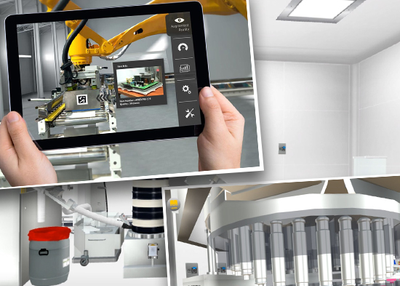
By leveraging the richness of 3D and IoT we can create compelling augmented reality experiences that help improve efficiencies, build better products and enable safer, more productive environment for workers and customers.
Advantages of Augmented Reality in manufacturing
Following are some of the obvious benefits on using AR in manufacturing sector.
Manufacturing requires putting together hundreds or thousands of components in a precise sequence as fast as possible.
For example – In aerospace manufacturing process, assembly assistance are using projectors to show the next part placement.
The augmented reality makes different today is mainly size, adaptability, and capability.