


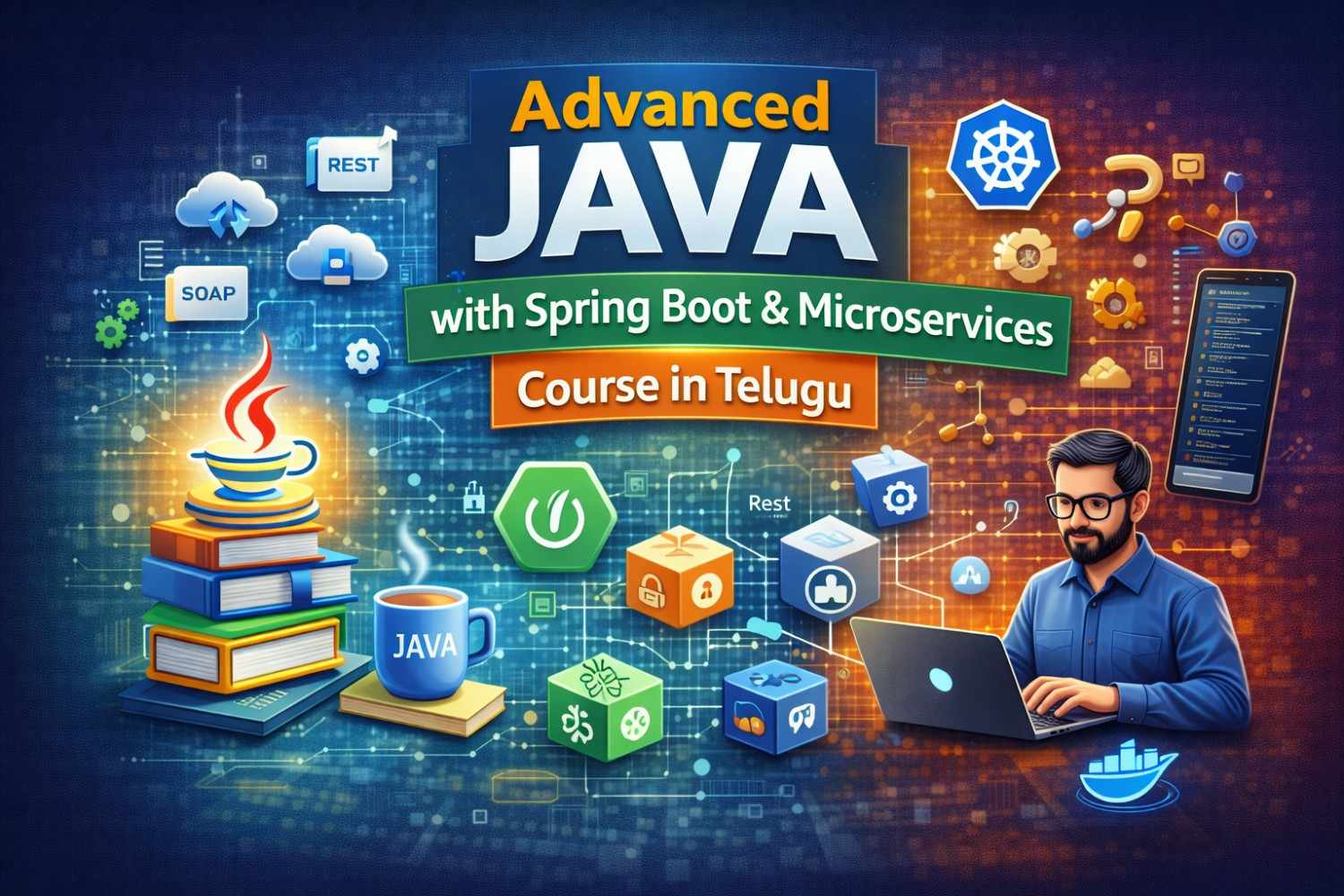
Introduction: What Makes Enterprise Applications Powerful?
When you open a banking app, place an online order, or log into a corporate portal, the experience feels simple. But behind that simplicity lies a highly structured backend system handling authentication, database transactions, security validation, API communication, and scalability management.
Such systems are not built using basic Java alone.
They rely on Advanced Java concepts, frameworks like Spring Boot, and modern architectural styles such as Microservices.
That is why many learners explore Advanced Java with Spring Boot & Microservices Course in Telugu — to understand how enterprise backend systems are designed to be scalable, secure, and reliable.
This technology stack represents the foundation of modern backend engineering.
Advanced Java: Building the Backend Core
Advanced Java extends Core Java into web and enterprise development.
It typically covers:
- JDBC for database connectivity
- Servlets for handling HTTP requests
- JSP for generating dynamic web content
- Multithreading for handling concurrent processes
- Networking basics
- Enterprise-level design patterns
These technologies prepare developers to build server-side applications that interact with databases and users.
Spring Framework: Structured Application Design
The Spring Framework introduced clean architecture principles to Java development.
Its core concepts include:
- Dependency Injection (DI)
- Inversion of Control (IoC)
- Loose coupling between components
- Aspect-Oriented Programming (AOP)
These principles improve maintainability and scalability.
Spring helps developers focus on business logic while managing dependencies efficiently.
Spring Boot: Faster Backend Development
Spring Boot simplified enterprise application development by reducing configuration overhead.
It offers:
- Auto-configuration
- Embedded web servers like Tomcat
- Simplified dependency management
- Quick application setup
- Production-ready features
With Spring Boot, developers can rapidly build REST APIs and backend services.
REST API Development
Modern systems communicate through RESTful APIs.
Spring Boot enables developers to:
- Build REST controllers
- Handle HTTP methods (GET, POST, PUT, DELETE)
- Validate input data
- Implement global exception handling
- Connect APIs with databases
- Secure endpoints
REST APIs form the backbone of microservices architecture.
Database Integration with JPA and Hibernate
Enterprise applications depend on reliable data storage.
Spring Boot integrates with JPA and Hibernate to provide:
- Object-relational mapping (ORM)
- Automatic entity mapping
- CRUD operations
- Transaction management
- Custom query support
This abstraction simplifies database interaction and improves productivity.
Microservices Architecture: Modern System Design
Traditional monolithic systems combine all features into a single deployable application. As systems grow, this structure becomes difficult to scale.
Microservices architecture divides applications into smaller, independent services.
Each microservice:
- Focuses on a specific business capability
- Maintains its own database
- Communicates via REST APIs
- Can be deployed independently
This improves scalability, flexibility, and fault tolerance.
Essential Components in Microservices
When implementing microservices using Spring Boot, common components include:
- API Gateway
- Service Discovery (Eureka)
- Load balancing
- Circuit breaker mechanisms
- Centralized configuration server
These components ensure reliable communication between services.
Communication Between Microservices
Microservices communicate using:
- REST APIs
- Feign Clients
- Messaging systems such as Kafka
Efficient communication ensures system stability and performance.
Security in Backend Applications
Security is critical in enterprise systems.
Spring Security supports:
- Authentication and authorization
- Role-based access control
- JWT-based authentication
- OAuth2 integration
Strong security implementation protects sensitive data and services.
Deployment and Cloud Readiness
Modern backend systems are deployed using:
- Docker containers
- Kubernetes orchestration
- Continuous Integration and Deployment pipelines
- Cloud platforms
Spring Boot applications are lightweight and optimized for cloud-native environments.
Skills Required to Master This Stack
To excel in Advanced Java with Spring Boot and Microservices, learners should develop:
- Strong Core Java fundamentals
- OOP and design pattern knowledge
- REST and HTTP architecture understanding
- SQL and database management skills
- Basic DevOps awareness
- System design thinking
This stack requires both programming expertise and architectural insight.
Why Learn in Telugu?
Understanding advanced backend topics like dependency injection, distributed systems, REST communication, and microservices architecture in Telugu can improve conceptual clarity and reduce learning complexity.
Career Opportunities
Mastering this stack opens roles such as:
- Java Backend Developer
- Spring Boot Developer
- Microservices Engineer
- API Developer
- Cloud Backend Engineer
Enterprise organizations widely rely on Java and Spring technologies.
Industry Demand and Future Scope
Java continues to be one of the most trusted enterprise programming languages.
Spring Boot and Microservices are widely adopted in:
- Banking systems
- E-commerce platforms
- SaaS applications
- Cloud-native enterprise solutions
As organizations adopt distributed and scalable architectures, demand for these skills remains strong.
Conclusion
Advanced Java with Spring Boot and Microservices represents the shift from writing simple programs to designing scalable, secure, and distributed enterprise systems.
By mastering Spring architecture, REST API development, database integration, security implementation, and microservices design, developers can build resilient backend applications.
As modern software increasingly relies on distributed and cloud-native architectures, the important question becomes — are you ready to architect and develop scalable enterprise systems using Advanced Java and Spring Boot?
Join Java courses in Kothrud, Pune.
Codekul.com provides java courses in Kothrud, Pune, get basic to advanced level best Java Courses in Pune.
CodeKul.com will provide you the practical oriented java education with 100% placement assistance in India.
We ensure that you will become java Expert from this Java Course.
CodeKul will help you to solve your doubts at the time of the session.
Attend Free Demo Lecture of Java Training Course.