In the history of data transmission infrastructure, breakthroughs are often associated with faster speeds or new protocols. Yet sometimes the most transformative innovation is physical rather than digital. Very Small Form Factor (VSFF) fiber optic connectors are one such development—quietly redefining how modern data centers, hyperscale networks, and high-performance computing environments scale bandwidth without expanding physical footprint. While traditional connectors like LC and MPO have dominated for decades, the rise of cloud computing, AI workloads, and 800G+ networking is accelerating a shift toward smaller, denser, and more efficient optical interconnect solutions.
The Density Problem Driving Innovation
Over the last decade, traffic patterns in data centers have fundamentally changed. East-west traffic between servers now far exceeds north-south traffic between users and servers. This shift, driven by distributed computing, virtualization, and AI training clusters, has created unprecedented demand for port density inside switches and patch panels.
Traditional duplex LC connectors, long considered the industry standard, occupy relatively large front-panel real estate. When transceiver counts were low, this was not an issue. But modern 1U switches may require 64 or more optical ports. At this scale, physical connector size directly limits scalability. Network architects increasingly face a choice: either increase rack space or reduce connector footprint. VSFF technology was designed to eliminate this compromise.
What Makes VSFF Connectors Different?
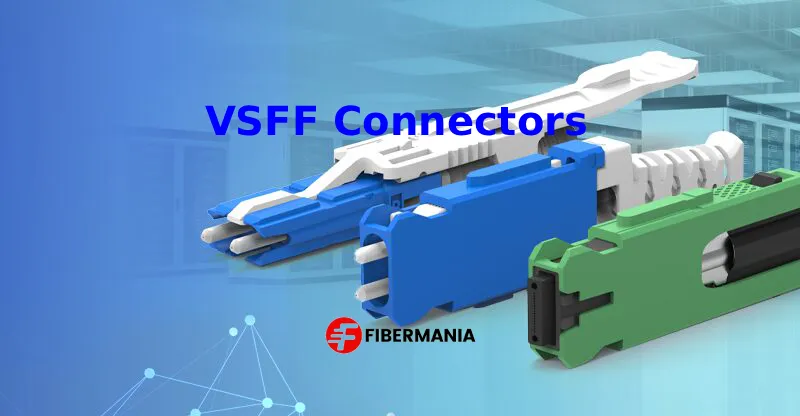
VSFF connectors—such as SN, CS, MDC, and others—achieve higher density primarily by shrinking ferrule size and optimizing latch design. Many use 1.25 mm ferrules like LC connectors but package them in slimmer housings, allowing more connectors per panel. Some designs even support duplex transmission in footprints previously occupied by simplex connectors.
Key engineering advantages include:
- Higher port density – up to 2× the connections in the same panel space
- Improved airflow – smaller connectors reduce front-panel obstruction
- Better cable management – thinner cables and boots simplify routing
- Compatibility with next-gen transceivers – especially OSFP and QSFP-DD modules
- These improvements are not cosmetic; they directly influence thermal efficiency, installation time, and long-term scalability.
The Role of 400G, 800G, and Beyond
The transition from 100G to 400G networking marked a turning point. At these speeds, transceivers require more lanes, more fibers, or more advanced modulation schemes. As the industry now prepares for 800G and 1.6T optics, physical interface constraints are becoming as critical as electrical or optical ones.
VSFF connectors align perfectly with these requirements. Their compact form allows manufacturers to design higher-density transceiver cages and breakout configurations without enlarging switch chassis. This is particularly important for hyperscale operators who measure efficiency in watts per gigabit and ports per rack unit.
In other words, VSFF is not just a connector evolution—it is an infrastructure enabler for next-generation bandwidth.
Market Adoption Trends
Although VSFF connectors are still considered emerging compared to LC, adoption is accelerating rapidly in several sectors:
1. Hyperscale Data Centers
Major cloud providers are early adopters because their scale magnifies even small efficiency gains. A 30% density improvement can translate into thousands of additional ports per facility.
2. High-Performance Computing (HPC)
Supercomputing clusters prioritize bandwidth density and airflow optimization, both of which VSFF designs enhance.
3. AI Training Infrastructure
GPU clusters require massive parallel connectivity. Compact connectors allow more optical links within constrained hardware geometries.
4. Telecom Edge Facilities
As edge computing expands, space-limited sites benefit from higher fiber termination density.
Industry analysts increasingly predict that while LC connectors will remain widely used for legacy and enterprise deployments, VSFF formats will dominate new high-density builds over the next five to ten years.
Engineering Challenges and Solutions
Despite their advantages, VSFF connectors introduce design and manufacturing complexities. Smaller components require tighter tolerances, more precise polishing, and stricter quality control. Alignment accuracy becomes more critical because even microscopic deviations can increase insertion loss.
Manufacturers must therefore invest in advanced production techniques, automated inspection, and high-precision ferrule fabrication. Reliable suppliers with deep expertise in fiber optic assembly play a crucial role in ensuring consistent performance. Companies specializing in custom fiber solutions—such as OEM and ODM patch cord manufacturing—are particularly well positioned to support this transition, since they can tailor cable assemblies for specific connector ecosystems and deployment environments.
Compatibility and Standardization
One factor influencing adoption speed is interoperability. Unlike LC connectors, which are universally standardized, multiple VSFF designs currently coexist. Each has unique mechanical interfaces, which means organizations must select formats compatible with their transceivers and infrastructure roadmap.
However, industry standardization bodies and multi-source agreements are actively working to ensure cross-vendor compatibility. As standards mature and economies of scale improve, costs are expected to decline, further accelerating adoption.
Environmental and Operational Benefits
- Beyond density, VSFF connectors contribute to sustainability and operational efficiency:
- Reduced material usage due to smaller housings
- Lower cooling costs from improved airflow
- Shorter installation times thanks to lighter cables
- Simplified maintenance with higher-density patching
For large facilities operating thousands of racks, these incremental gains can significantly reduce total cost of ownership.
The Future Outlook
The trajectory of optical connectivity mirrors that of microelectronics: smaller, faster, and more integrated. VSFF connectors represent a logical step in this evolution. As network speeds continue doubling and physical space remains finite, compact interconnect solutions will become indispensable.
- Looking ahead, several trends are likely:
- Integration of VSFF interfaces directly into active optical cables (AOCs) and co-packaged optics
- Increased adoption in enterprise environments as prices decrease
- Hybrid panels supporting both LC and VSFF during transition periods
- Greater automation in manufacturing to maintain precision at scale
Ultimately, the question is no longer whether VSFF connectors will gain widespread adoption, but how quickly they will become the default choice for high-performance optical infrastructure.
Conclusion
The rise of VSFF connectors signals a shift in how the industry approaches scalability. Instead of simply increasing speed, engineers are rethinking physical connectivity itself. By enabling higher density, better airflow, and improved cable management, VSFF designs solve some of the most pressing constraints facing modern networks.
As data demand continues to surge—driven by AI, cloud services, and real-time applications—the importance of compact, high-precision optical components will only grow. Organizations that understand and adopt these innovations early will be better positioned to build infrastructure capable of supporting the next decade of digital expansion.
In the grand narrative of networking evolution, VSFF connectors may appear small—but their impact is anything but.