





According to Cargoson, approximately 57% of companies use ERP or some form to manage their operations.
However, many of them face issues. These issues majorly include slow system performance, risks related to data security, unexpected downtime, limited scalability, and, most importantly, high infrastructure costs.
In results, these challenges directly affect business productivity and customer experience.
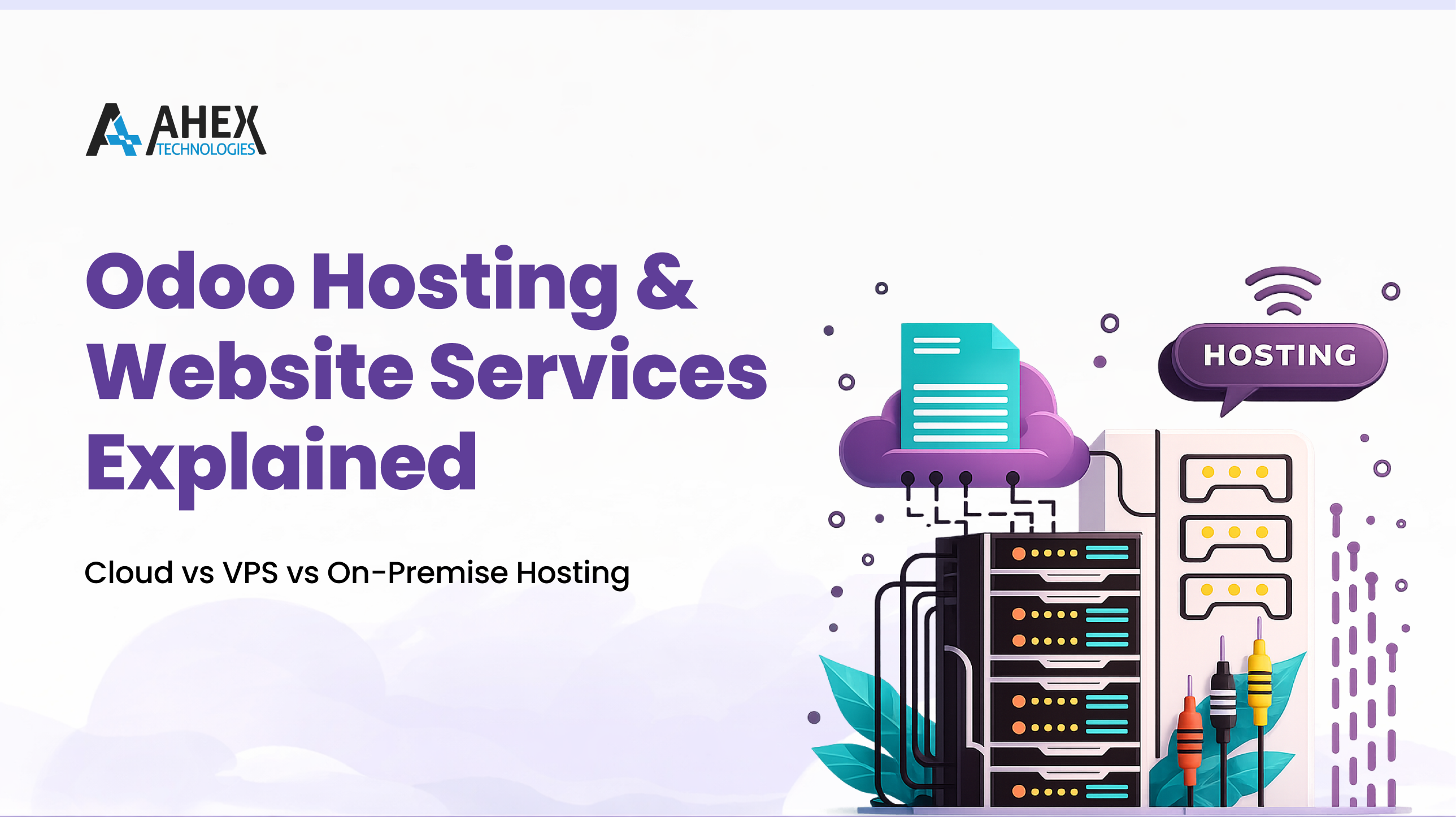
To tackle these common challenges, Odoo ERP hosting can help. By choosing the right hosting environment for your ERP and website, you can make your systems function efficiently. Also, your data remains secure, and your business can easily scale.
So, in this article, we have explained the different options for hosting that include Cloud, VPS, and On-Premise. Read till the end to understand each and choose the right one.
What is Odoo Hosting?
As you already know, Odoo is an open-source business management suite. It includes multiple processes in a single platform.
Now, Odoo hosting refers to the infrastructure environment where your Odoo applications and databases are deployed and maintained.
Odoo hosting requirements:
- Optimizing the PostgreSQL database
- Server configuration
- Background workers support
- Practices for secure deployment
- Regular backups and monitoring
When you choose the right hosting, you ensure smooth performance, faster loads, minimal downtime, and better protection of data. If not, then you face reversed challenges. So, let’s understand about each hosting type in the next section.
Types of Odoo Hosting
There are three major types of Odoo hosting: Cloud, VPS, and on-premise.
- Odoo Cloud Hosting
The first type of hosting is Odoo Cloud Hosting. It runs Odoo on shared or dedicated cloud infrastructure offered by Amazon Web Services, Microsoft Azure, or Google Cloud Platform.
How It Works
You deploy Odoo apps on virtual cloud servers maintained by a cloud provider (AWS, Azure, GCP).
Advantages of Cloud Odoo ERP Hosting
The benefits of Odoo cloud hosting are:
- Highly scalable
- Pay-as-you-go pricing
- High uptime reliability
- No physical hardware investment
Limitations
With benefits, it has some limitations, such as:
- Can become expensive when used more
- It requires technical setup.
Best For
Odoo Cloud hosting is best for growing businesses that expect fluctuating traffic or growth.
Odoo VPS (Virtual Private Server) Hosting
Odoo VPS hosting is an option for Odoo web hosting, in which you deploy your ERP and website on a virtual private server or VPS.
The VPS has dedicated RAM, CPU, and storage resources. All of these are optimized for Odoo workloads.
Advantages of Odoo VPS
The advantages of VPS Odoo hosting are:
- Dedicated RAM and CPU for Odoo processes
- Better PostgreSQL performance
- Custom worker configuration
- Cost-effective for growing businesses
Limitations
The major drawbacks of Odoo VPS are:
- It requires Odoo-specific server configuration
- Manual setup of backups, SSL, and security
- Its scaling requires server upgrades or migration
Best For
The VPS Odoo web hosting is best for small to mid-sized businesses that need control, better performance, and moderate-level scalability.
On-Premise Hosting
On-premise hosting is the third option for Odoo Enterprise hosting. In this, Odoo ERP is deployed on servers that are located physically in the business premises.
Advantages of On-Premise Odoo ERP Hosting
The benefits of on-premise Odoo hosting are:
- You have full control over the infrastructure.
- You can do maximum customization.
- It is suitable for strict compliance requirements.
Limitations
Some limitations are as follows:
- High hardware costs in the initial stage.
- You will need an in-house IT team.
- Scalability is limited.
Best For
On-premises hosting is best for large enterprises with strict regulatory or data control needs.
Top Features to Look for in Odoo ERP Hosting
Below are the key features that you should evaluate before selecting your Odoo hosting.
Dedicated Resources (RAM, CPU & SSD Storage)
Odoo is a resource-intensive ERP system, especially when multiple users operate it simultaneously. So, always look for the following for smooth working:
- Minimum 4GB RAM for small teams
- Scalable RAM options (8GB–32GB+) for growing businesses
- SSD or NVMe storage
- Dedicated CPU cores
If the resources are Insufficient, they could cause slow dashboards, lags, and delayed work.
PostgreSQL Database Optimization
Odoo runs entirely on the database called PostgreSQL. A good Odoo hosting provider
should offer you the following:
- PostgreSQL tuned to handle high query loads
- Regular database vacuum and maintenance
- Proper indexing configuration
- Optimized backup
If your database is slow, your operations become slow. So, ensure its performance for better ERP speed, reporting, and user experience.
Odoo Worker & Performance Configuration
Odoo requires configurations to handle concurrent users efficiently. Hence, you Odoo hosting should support:
- Multi-user setup
- Long-polling configuration
- Reverse proxy setup
- Gzip compression and caching
Improper configuration of your Odoo can result in system crashes during peak usage.
Automatic Backups & Disaster Recovery
Since Odoo can contain your financial, operational, and other crucial data, it becomes important that you are prepared with backups.
So, ensure that your Odoo web hosting includes the following:
- Automated backups (daily)
- Offsite backup storage
- One-click restore functionality
- Backup retention (for at least 7–30 days)
Automatic backup and disaster recovery in your Odoo hosting can protect your business from accidental data loss or cyber incidents.
Security & Compliance Measures
ERP systems are very vulnerable to cyberattacks. Hackers can get unauthorized access to your ERP and steal sensitive information.
So, it is crucial that you include essential security features such as the following:
- SSL certificate (HTTPS encryption)
- Firewall configuration
- DDoS protection
- Malware scanning
- Two-factor authentication support
- Regular security patch updates
If you are in industries like healthcare or finance, a compliance-ready Odoo hosting infrastructure is necessary.
Scalability & Upgrade Flexibility
As your business grows, your Odoo web hosting must also scale seamlessly, and that too without any downtime.
So, to ensure scalability, look for capabilities like
- RAM and CPU upgrades
- Vertical scaling options
- Cloud auto-scaling capabilities
- Load balancing support
Scalability and upgrades ensure that your Odoo system doesn’t slow down while growing.
Managed Hosting Support
If you don’t have an in-house DevOps team, we, as a trusted Odoo hosting provider, highly recommend managed Odoo hosting. These managed services typically include:
- Server setup and configuration
- Odoo installation and deployment
- Version upgrades
- Module compatibility checks
- Performance monitoring
- Security hardening
This managed hosting support reduces the technical risk. It also allows your team to focus on operations instead of server management.
Frequently Asked Questions
Q1. Is cloud hosting better than on-premise for Odoo?
For most business like small businesses and SMEs, yes, Odoo Cloud hosting is better. It offers better scalability, lower upfront costs, and easier maintenance.
Q2. Can I host Odoo ERP and website together?
Yes. Odoo supports both ERP and modules on the same server. You can host them together.
Q3. How much does Odoo hosting cost in India?
The Odoo hosting costs in India depend on your requirements. Contact us to learn more.
Q4. Which Indian providers offer managed Odoo hosting solutions?
There are many recognized and certified Odoo partners in India that offer managed Odoo hosting solutions.
Ahex Technologies is among the best providers for Odoo hosting and Odoo website builder services in India.
Conclusion
So, this is the guide to Odoo ERP hosting and the models. It includes Cloud, VPS, and On-Premise.
All of them offer various advantages and have limitations in different areas too. So choosing the best Odoo hosting will always depend on factors like your business size, technical capacity, growth, etc.
We have compared them in this article. Learn about them and choose one that fits your requirements. If you need further consultations, then you can contact our team.
Always remember! The right hosting decision ensures your Odoo ERP and website operate smoothly, and it will power your business growth without any technical issues.


CaretIT help you to migrate from Odoo of your system from any Odoo version to the newer one.
Get new, Quality & new Upgraded features.
Odoo module migration.Visit us:- https://www.caretit.com/services/odoo-erp-services/odoo-migration