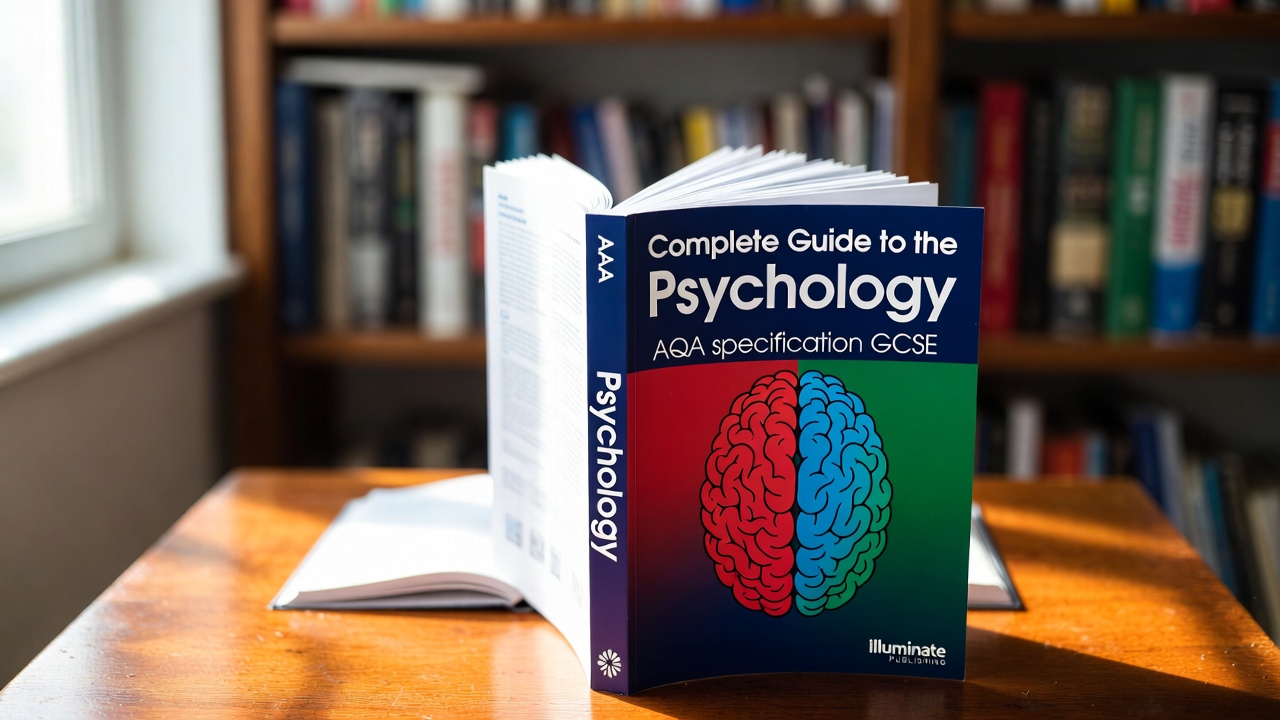
One of the most interesting subjects pupils can study in secondary school is GCSE Psychology because it integrates science, social studies, and some elements of empathy and reason. Students learn about the different ways in which people think, feel, and act across a range of topics like memory, learning, social impact, mental health, the brain, and how people grow. Students studying the Psychology AQA specification GCSE need to learn about how the course is structured, the different topics, and what the examiners look for to be successful.
The purpose of this guide is to give you the best chance of success by providing you with a complete breakdown of the course content, how the exams are structured, and the different types of research methods, theories, and studies you need to be familiar with. Additionally, practical tips on how to revise and use past papers to improve your results, along with a guide on how to answer high mark questions, are included. This guide should thoroughly prepare you in both your knowledge of GCSE Psychology and the exam techniques required to help you obtain the best possible results.
What Is the Psychology AQA Specification GCSE?
GCSE Psychology (AQA) is the AQA GCSE Psychology qualification (specification code 8182) and is completed with 2 final exams at the end of Year 11 (two years). The course aims to:
- Describe the main psychological theories
- Develop the ability to analyse and evaluate theories
- Understand the different types of research
- Explain psychological theories and real-life situations
The course is a combination of science and the humanities, and is both analytical and essay writing
Structure of the Psychology AQA GCSE
The qualification has two components, papers, which are both equally weighted and each contribute 50% to the final grade.
Paper 1: Cognition and Behaviour
This paper examines how a person thinks, learns, remembers, and how people develop cognition and behaviour.
Key Topics:
1. Memory
- Memory (you can forget and develop the elements of short, long and working)
- Memory competing models (like the multi-store model)
- All other competing models of memory and memory improvement
2. Perception
- Visual illusions
- Factors affecting perception
- Gibson’s direct theory
- Gregory’s constructive theory
3. Development
This includes AQA GCSE psychology development topics such as:
- Piaget’s stages of cognitive development
- Effects of education
- Brain development
- Learning theories
4. Research Methods
Research methods are assessed across both papers.
- Design of the experiment
- What are the different types of variables? (independent, dependent, control)
- Controls
- Sampling Methods
- Research (you can forget and develop) the elements of reliability and validity, ethical issues, and competing models of memory.
Paper 2: Social Context and Behaviour
This paper examines the effects of biology on people's behavior in social situations.
1. Social Influence
- Conformity (Asch)
- Obedience (Milgram)
- Agency theory
- Prosocial behaviour
- Crowd behaviour
Students and findings must assess classic studies in light of contemporary situations.
2. Language, Thought and Communication
- Relationship between language and thinking
- Sapir-Whorf hypothesis
- Differences between human and animal communication
- Non-verbal communication
3. Brain and Neuropsychology
- Structure of the nervous system
- Central vs peripheral systems
- Neuron structure
- Synaptic transmission
- Localisation of function
- Brain scanning techniques (CT, PET, fMRI)
- Effects of brain damage
4. Psychological Problems
- Mental health concepts
- Cultural influences
- Depression (explanations and treatment)
- Addiction (causes and therapy)
Assessment Format and Exam Skills
The GCSE Psychology qualification under the Psychology AQA specification GCSE is assessed through two equally weighted papers, each having 1 hour 45 minutes of 100 marks. Each of the two papers has 100 marks. Each of the two papers has a variety of question styles intended to measure a broad set of skills:
- Multiple-choice questions (MCQs): They assess the ability to recall knowledge and to understand important principles.
- Short-answer questions (SAQs): measure the ability to apply knowledge to a situation and to describe a basic set of elements.
- Extended-response questions: require longer responses, assess the ability to engage in evaluative reasoning, critical thinking, and create clearly articulated, well-organised responses to merit the highest possible marks.
Students are expected to demonstrate AO1 (knowledge and understanding), AO2 (application to real-life contexts), and AO3 (analysis and evaluation) across all question types. Practising each type and timing responses carefully is essential for exam success.
Assessment Objectives (AO)
Demonstrating the Assessment Objectives (AOs), the marks allocated for each question reflect the following:
- AO1: Knowledge and understanding
- AO2: Application to scenarios
- AO3: Analysis and evaluation
Each question type requires different aspects of knowledge, and so the ability to time each type of response is essential to pass the exam.
Accessing the Psychology AQA Specification GCSE PDF
The AQA website has the most current and updated official Psychology AQA Specification GCSE PDF. In the document, you can find:
- Content breakdown by each topic
- Knowledge that is required
- Key Studies
- The mathematical skills required
- Assessment Objectives
- Command Terms
In terms of what the examiners want from students, the students who read this document gain an advantage over those who do not.
Using Psychology AQA Specification GCSE Past Papers Effectively
All students can agree that the most useful resource for revision is past papers, and the Psychology AQA Specification GCSE past papers enable students to:
- Identify and understand the different question types and patterns
- Improve exam strategies and techniques
- Evaluate and analyse different themes
- Practice their responses within a given time limit
When reviewing past papers, it is important to compare your solutions with the mark schemes to see how marks are allocated.
The Role of the AQA GCSE Psychology Textbook
An 'AQA GCSE Psychology textbook' is helpful because it gives you:
- Organised sectional breakdowns
- Summaries of important studies
- Questions to test your understanding
- Examples of the research method
Although paired with the textbook, you should use the following methods:
- Active recall
- Flashcards
- Practice essays
- Past papers
Study techniques are also required to place at the highest grade boundaries.
How to Write High-Level AQA GCSE Psychology Model Answers
High-level AQA GCSE Psychology model answers include:
- Simple clear definitions
- Spot-on study descriptions
- Evaluations that are considered balanced
- Use of the appropriate language
- A solid and clear structure
Students are expected to have a solid structure and clear, well-developed evaluations of paragraphs in questions worth 9 or 12 marks.
Key Challenges Students Face
Most GCSE Psychology students have the same struggles:
- The detailed memory processes of the studies
- Effectively evaluating research
- The application of knowledge to unfamiliar scenarios
- A solid understanding of research methods
- The ability to structure extensive responses
Students do not receive guidance or practice to earn marks, not because of a lack of knowledge, but because of weak exam technique.
Smart Revision Strategy for GCSE Psychology
Below are smart revision strategies for success in the GCSE Psychology exam.
1. Break Topics into Sections
Revise one small area at a time (e.g., Milgram’s study only).
2. Memorise Key Study Details
Include:
- Aim
- Procedure
- Findings
- Conclusion
- Evaluation
3. Practise AO2 Application
Create mini-scenarios and practise applying theories.
4. Master Research Methods
A lot of marks come from understanding variables, reliability, and validity.
5. Use Timed Essays
Practise structured 9- and 12-mark responses weekly.
Why Structured Support Improves Results
Guided feedback and structured practice improve results. GCSE Psychology requires students to have a clear understanding and evaluation of the content, alongside the right exam technique. With feedback from expert online Psychology tutors, students can learn the skills needed to answer exam questions. This is where the Mixt Academy stands out from the rest and offers real value. With experienced subject specialists, students receive:
- Personalised one-to-one support
- A breakdown of the topic aligned to the Psychology AQA specification GCSE
- Guided walking through the past paper
- Marking the exam and understanding the writing structure
- Essay writing and structure teaching
Students gain the confidence to tackle difficult concepts and the level of thinking needed to answer exam questions.
Online Tutoring and GCSE Psychology Success
Structured academic mentoring is the choice of many students aiming for competitive sixth form pathways. With structured online sessions, Mixt Academy supports students to:
- Improve AO3 evaluation
- Strengthen weak topics
- Refine exam watching to improve marks
- Build regular revision routines
Guided practice combined with expert explanation enhances learning and exam performance.
Long-Term Benefits of Studying GCSE Psychology
The Psychology AQA GCSE allows the student to gain:
- Critical thinking
- Scientific reasoning
- Essay writing ability
- Analytical judgement
- Research skills
These skills are useful when studying A-Level Psychology, Sociology, Biology, Law, and Business.
Final Thoughts
The Psychology AQA GCSE provides the learner with a valuable and intellectually rich introduction to the science that examines the human mind and the resulting behavior, and teaches the student to understand how people think, learn, grow, and relate to one another, socially and biologically. However, to obtain high grades, it is not sufficient just to memorise the theories and case studies. It is critical to:
Possess the ability to apply the theories in different situations, relate the theories, and how they interact with each other, to everyday events and problems, including answering questions that are not visible.
Analyse and assess the research in relation to its strengths, weaknesses, and results. Determine the result of the study and its influence on the field of study.
Be able to organise the lengthy responses so that they are presented in clearly defined paragraphs that are supported with logical reasoning and evidence.
Be able to answer the questions in a timely manner.
Students can build confidence in their understanding of the concepts and answer all questions within the given time using the correct strategies outlined in past papers. The guidance of the Mixt Academy will help to refine and improve their understanding and skills, giving them the best chance of achieving excellent GCSE results in Psychology.
FAQs
What topics are included in the psychology AQA specification GCSE?
The course involves memory, perception, development, research methods, social influence, language and communication, brain and neuropsychology, and psychological problems.
How many exams are there for Psychology AQA GCSE?
There are two written papers, both 1 hour and 45 minutes long, and each paper is worth 50% of the total grade.
Where can I find the official specification document?
You can find and download the Psychology AQA specification GCSE PDF on the AQA official website.
Are past papers important for revision?
The AQA GCSE Psychology specification past papers are useful for understanding the question style, allocated time, and mark schemes.
What is the best way to structure 9- and 12-mark answers?
The answers should be in separate paragraphs, in which each one should be defined, studies should be accurately mentioned, and a conclusion should be provided with a balanced evaluation of both the strengths and the limitations.
How critical is the research method in GCSE Psychology?
The research methods are a core area for both papers, and they also carry a lot of marks. You would have to know about the variables, sampling, and evaluation.
What resources should students use for GCSE Psychology?
The AQA GCSE Psychology textbook, revision notes, flashcards, past papers, and model answers should be used.
How can students improve their exam technique in GCSE Psychology?
Students improve exam performance by practising structured essays, reviewing AQA GCSE Psychology model answers, and receiving detailed feedback on application and evaluation skills. Many learners benefit from guided academic support from Mixt Academy that focuses specifically on exam board requirements and marking criteria.