Large-scale timber harvesting is a complex process that requires careful planning, skilled labor, and reliable machinery. Modern forestry operations depend heavily on specialized tools and machines that improve efficiency, safety, and productivity. Without the right equipment, harvesting large quantities of timber from forests would be extremely difficult and time-consuming. Forestry equipment for sale is designed to handle heavy loads, navigate rough terrain, and perform precise cutting and processing tasks. Understanding the essential machinery used in large-scale timber harvesting helps highlight how the forestry industry maintains productivity while managing natural resources effectively.
Harvesters For Precision Tree Cutting
One of the most important machines in modern forestry is the harvester. Harvesters are advanced machines designed specifically for cutting trees quickly and efficiently. They are equipped with powerful cutting heads that can grip, cut, and process trees in a single operation.
A harvester operator can control the machine from an enclosed cabin while the cutting head attaches to the tree trunk. Once the tree is cut, the machine can remove branches and cut the trunk into specific lengths required for timber processing. This automated process allows harvesting teams to work faster while maintaining consistent timber quality.
Harvesters also reduce the physical strain on workers because much of the cutting process is performed by the machine rather than manual tools. This makes them essential forestry equipment for large-scale timber harvesting operations.
Forwarders For Timber Transportation
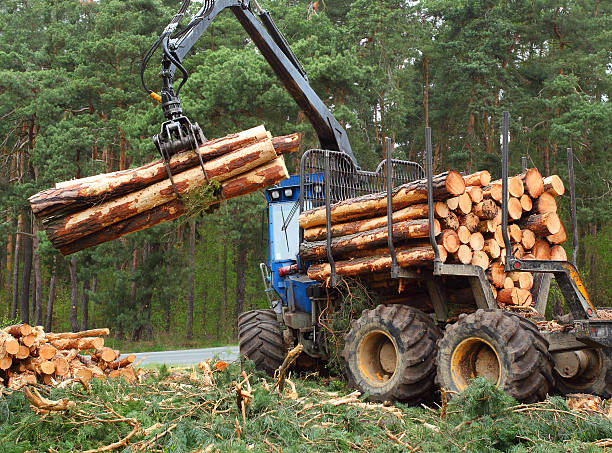
After trees are cut and processed, the timber must be transported from the forest floor to designated collection areas. Forwarders play a crucial role in this stage of timber harvesting. These machines are designed to carry logs across rough forest terrain without dragging them along the ground.
Forwarders have large wheels and a loading crane that allows operators to lift logs and place them onto a carrying platform. Once loaded, the machine transports the timber to roadside storage areas or processing facilities.
Using forwarders helps protect the forest floor by reducing soil disturbance and minimizing damage to surrounding vegetation. This equipment improves efficiency by allowing large volumes of timber to be moved quickly and safely through forest environments.
Skidders For Heavy Log Movement
Skidders are another key piece of forestry equipment used in timber harvesting. Unlike forwarders that carry logs, skidders drag or pull logs from the cutting site to collection areas. These machines are powerful and built to operate in challenging terrain where other equipment may struggle.
Skidders are equipped with strong cables or grapples that attach to logs. The machine then pulls the logs across the forest floor toward landing zones where they can be loaded onto trucks or further processed.
Although forwarders are becoming more common in many operations, skidders remain valuable in areas where terrain or harvesting conditions make log carrying difficult. Their power and durability make them well-suited for large-scale timber harvesting projects.
Feller Bunchers For Efficient Tree Harvesting
Feller bunchers are specialized machines designed to cut and gather multiple trees quickly. These machines are widely used in commercial forestry operations because they can harvest trees much faster than manual cutting methods.
The cutting head of a feller-buncher grips the tree before cutting it at the base. After cutting several trees, the machine gathers them into a bundle. These bundles can then be transported for further processing.
This method of harvesting significantly increases productivity. By cutting and grouping trees at the same time, feller bunchers reduce the time needed for handling individual logs. This makes them essential equipment in large-scale timber harvesting operations.
Log Loaders For Timber Handling
Timber must be loaded onto vehicles for transportation to sawmills or processing facilities once it has arrived at the landing area. Log loaders are used for this purpose. These machines are equipped with large hydraulic arms and grapples that can lift heavy logs easily.
Log loaders help organize logs by size and type before loading them onto transport vehicles. This sorting process improves efficiency during transportation and processing.
Because timber logs can be extremely heavy, using specialized loaders ensures safe handling and reduces the risk of workplace accidents. These machines are therefore a critical part of the forestry equipment used in harvesting operations.
Chainsaws For Specialized Cutting Tasks
Even though large machines perform most harvesting tasks, chainsaws remain an essential tool in forestry operations. Chainsaws are often used for precision cutting, trimming branches, or removing trees in areas where large machines cannot operate.
Forestry workers rely on chainsaws for maintenance tasks, safety adjustments, and clearing obstacles during harvesting activities. High-quality chainsaws allow workers to perform these tasks quickly and efficiently.
While they may appear simple compared to large harvesting machines, chainsaws continue to play an important role in supporting large-scale timber harvesting projects.
Conclusion
Large-scale timber harvesting depends on a range of specialized forestry equipment that works together to complete each stage of the process. Harvesters cut and process trees, forwarders and skidders transport logs across forest terrain, and feller bunchers increase harvesting efficiency by cutting multiple trees at once. Log loaders organize and load timber for transportation, while chainsaws provide flexibility for detailed cutting tasks. Together, these machines allow forestry operations to harvest timber efficiently while maintaining safety and productivity. As technology continues to improve, forestry equipment will likely become even more advanced, helping the industry manage forests responsibly while meeting global demand for timber products.