In today’s highly competitive industrial landscape, choosing the right manufacturing process can significantly impact product performance, cost efficiency, and long-term reliability. Among the most widely used techniques for shaping aluminum components are forging and casting. Each method offers unique advantages, but the question remains: which one is better?
At Unique Forgings, we understand that selecting the right process depends on multiple factors, including application requirements, material properties, and production scale. In this blog, we’ll explore the key differences between aluminum forging and casting to help you make an informed decision.
What Is Aluminum Forging?
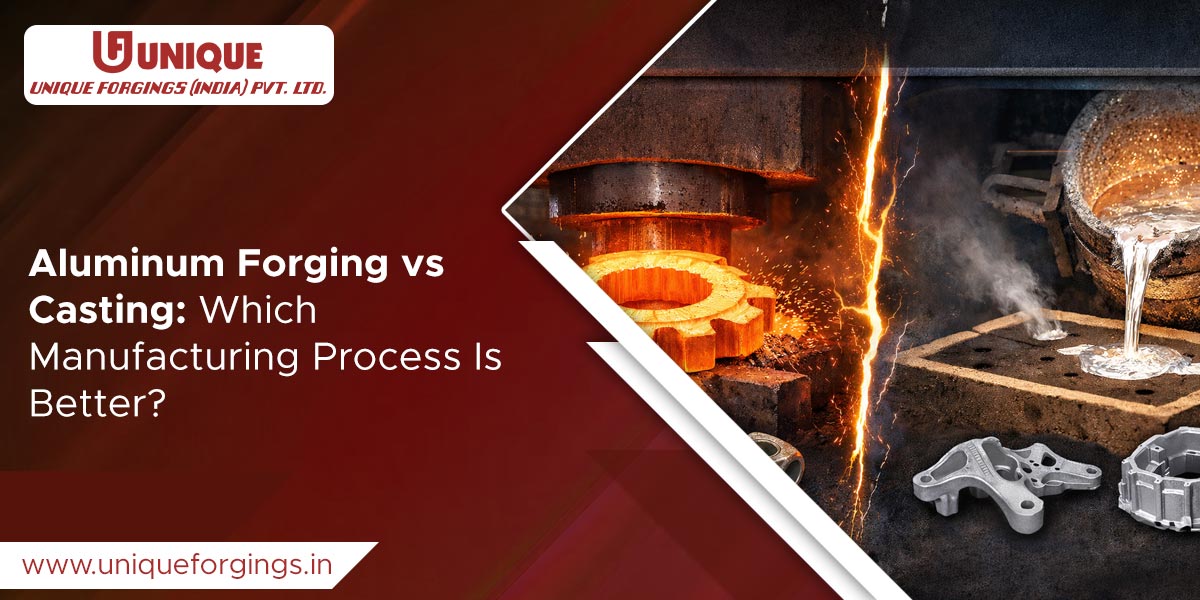
Aluminum forging is a manufacturing process where aluminum is shaped under high pressure using compressive forces. This process refines the internal grain structure of the metal, resulting in superior mechanical properties.
Forging can be performed using different techniques such as open-die forging, closed-die forging, and rolled ring forging. The end result is a component that is exceptionally strong, durable, and resistant to fatigue.
Many industries rely on aluminum forging suppliers to produce critical components used in aerospace, automotive, and defense applications.
What Is Aluminum Casting?
Aluminum casting, on the other hand, involves pouring molten aluminum into a mold where it solidifies into the desired shape. This method allows for the creation of complex geometries that would be difficult or impossible to achieve through forging.
There are several casting methods, including sand casting, die casting, and investment casting. Each offers varying levels of precision, cost, and surface finish.
Casting is widely used for parts where intricate designs and cost efficiency are more important than maximum strength.
Key Differences Between Forging and Casting:
1. Strength and Durability:
One of the most significant differences between forging and casting lies in the mechanical strength of the final product.
Forged aluminum components have a refined grain structure, which enhances strength, toughness, and resistance to wear and fatigue. This makes forging the preferred choice for high-stress applications.
In contrast, cast aluminum parts may contain internal porosity or defects due to the solidification process, which can compromise strength. While casting techniques have improved over time, they still generally do not match the durability of forged components.
Verdict: Forging is superior for strength and reliability.
2. Design Complexity:
Casting excels when it comes to producing complex shapes and intricate designs. The flexibility of molds allows manufacturers to create detailed components with minimal machining.
Forging, while highly effective, has limitations in terms of complexity. Parts often require additional machining to achieve the desired geometry.
Verdict: Casting is better for complex and detailed designs.
3. Material Efficiency:
Forging typically produces less waste compared to casting, especially when near-net shaping techniques are used. Additionally, forged parts often require less material to achieve the same strength as cast parts.
Casting can involve excess material usage due to sprues, runners, and risers, which must be removed and recycled.
Verdict: Forging is more material-efficient in most cases.
4. Cost Considerations:
Cost is a critical factor when choosing between forging and casting.
Forging usually involves higher initial tooling and equipment costs. However, for large production runs, the cost per unit decreases significantly.
Casting generally has lower upfront costs and is more economical for small production batches or highly complex parts.
Verdict: Casting is more cost-effective for low-volume or intricate parts, while forging becomes economical at scale.
5. Surface Finish and Precision:
Casting can deliver excellent surface finishes and near-net shapes, reducing the need for extensive machining.
Forged components often require additional finishing processes, although modern forging techniques have improved dimensional accuracy.
Verdict: Casting offers better surface finish and precision.
6. Performance in Critical Applications:
For industries where safety and performance are paramount—such as aerospace, automotive, and heavy machinery—aluminum forging is often the preferred choice.
Forged components are less likely to fail under stress, making them ideal for load-bearing and high-impact applications.
This is why many Leading steel forging manufacturers also specialize in aluminum forging to meet the growing demand for lightweight yet strong components.
Verdict: Forging is the better option for critical applications.
When Should You Choose Aluminum Forging?
You should consider aluminum forging when:
● High strength and durability are required
● The component will be subjected to extreme stress or pressure
● Long-term reliability is critical
● You need superior fatigue resistance
● Safety is a top priority
Industries such as aerospace, automotive, oil & gas, and defense often rely on aluminum forging suppliers for these reasons.
When Should You Choose Aluminum Casting?
Aluminum casting is the better choice when:
● Complex shapes and intricate designs are needed
● Production volume is relatively low
● Cost constraints are a major factor
● High strength is not the primary requirement
● Faster prototyping is required
Casting is commonly used in consumer goods, decorative components, and non-critical industrial parts.
Environmental Considerations:
Both forging and casting have environmental impacts, but forging is generally considered more sustainable due to its material efficiency and reduced waste.
Additionally, forged components tend to last longer, reducing the need for frequent replacements and minimizing environmental impact over time.
Casting processes, particularly those involving sand molds, can generate more waste, although recycling practices are improving.
The Final Verdict: Which Is Better?
There is no one-size-fits-all answer to this question. The choice between aluminum forging and casting depends on your specific requirements.
If strength, durability, and performance are your top priorities, aluminum forging is the clear winner. However, if your project demands complex geometries and cost efficiency, casting may be the better option.
At Unique Forgings, we combine expertise, advanced technology, and industry knowledge to deliver high-quality forged components tailored to your needs. As one of the trusted aluminum forging suppliers, we are committed to helping our clients achieve optimal performance and reliability.
Conclusion:
Understanding the differences between aluminum forging and casting is essential for making the right manufacturing decision. Both processes have their advantages, but the best choice ultimately depends on your application, budget, and performance expectations.
By partnering with experienced manufacturers like Unique Forgings and collaborating with leading steel forging manufacturers, you can ensure that your components meet the highest standards of quality and performance.
If you're looking for expert guidance or high-quality forged aluminum components, Unique Forgings is here to help you every step of the way.