

IoT Device Management has become the backbone of modern connected environments, ensuring that billions of devices operate efficiently, securely, and seamlessly. From smart cities and industrial automation to healthcare and logistics, managing connected devices is no longer optional—it is a critical requirement for operational success.
As organizations continue to scale their IoT deployments, the complexity of managing devices across multiple networks, locations, and use cases has increased significantly. According to a study by Grand View Research, IoT Device Management market is expected to grow at a CAGR of 21.8% from 2026 to 2033, reflecting the rapid expansion of connected ecosystems and the growing need for robust management solutions.
Understanding IoT Device Management
IoT Device Management refers to the processes, tools, and platforms used to monitor, configure, update, and secure connected devices throughout their lifecycle. This includes everything from device onboarding and provisioning to real-time monitoring, maintenance, and decommissioning.
In the early stages of IoT adoption, organizations focused primarily on connectivity and data collection. However, as deployments scale into thousands or even millions of devices, managing these devices efficiently has become a top priority. Modern IoT device management solutions provide centralized control, allowing organizations to manage large fleets of devices remotely and in real time.
These systems are essential for ensuring device reliability, minimizing downtime, and maintaining consistent performance across distributed networks.
IoT Management Platform: The Core of Connected Infrastructure
An IoT management platform serves as the central hub for managing connected devices. It integrates various functionalities such as device provisioning, monitoring, diagnostics, firmware updates, and analytics into a unified interface.
One of the most significant trends is the shift toward cloud-based platforms, particularly those built on Platform-as-a-Service (PaaS) and Software-as-a-Service (SaaS) models. These platforms enable organizations to scale operations quickly while reducing infrastructure complexity.
Modern platforms are increasingly automated, offering features such as zero-touch provisioning, where devices are automatically detected, configured, and deployed as soon as they connect to the network. This level of automation is becoming essential as IoT deployments grow in size and complexity.
Another key development is the integration of advanced analytics and artificial intelligence. These capabilities allow platforms to detect anomalies, predict failures, and optimize device performance in real time, improving efficiency and reducing operational risks.
IoT Device Authentication: Securing the Connected World
Security is one of the most critical aspects of IoT device management, and IoT device authentication plays a central role in ensuring that only authorized devices can access the network. With billions of connected devices forming a vast attack surface, robust authentication mechanisms are essential for preventing unauthorized access and cyber threats.
Modern authentication methods are evolving beyond traditional password-based systems. Technologies such as certificate-based authentication, biometrics, and hardware-based security modules are becoming increasingly common. There is also a growing shift toward phishing-resistant and cryptographic authentication methods to enhance security.
Device identity management is another crucial component. Each device must have a unique and verifiable identity to ensure secure communication and data exchange. Advanced frameworks are being developed to enable cross-vendor authentication, improving interoperability and reducing security gaps.
As IoT ecosystems expand, organizations are prioritizing end-to-end security strategies that include device authentication, encryption, and continuous monitoring.
Key Trends Shaping IoT Device Management
The IoT Device Management landscape is evolving rapidly, driven by technological advancements and increasing deployment complexity. One of the most significant trends is the move toward full automation. Modern systems are capable of automatically detecting, provisioning, and managing devices without manual intervention, making large-scale deployments more efficient.
Another major trend is the rise of unified device management platforms. Organizations are moving away from fragmented tools and adopting integrated solutions that provide a single interface for managing all aspects of IoT operations. This shift improves visibility, reduces complexity, and enhances overall efficiency.
Edge computing is also playing a crucial role in IoT device management. By processing data closer to the source, edge devices reduce latency and improve real-time decision-making. This is particularly important in applications such as autonomous vehicles, industrial automation, and healthcare monitoring.
Interoperability and standardization are becoming increasingly important as well. With a growing number of devices and platforms, ensuring compatibility and seamless integration is essential for scalability and long-term success.
Security remains a top priority, with organizations investing heavily in advanced authentication methods, encryption technologies, and real-time threat detection systems. As cyber threats become more sophisticated, the need for comprehensive security solutions continues to grow.
Why IoT Device Management Is Critical for Modern Businesses
IoT Device Management is not just about maintaining devices—it is about enabling innovation, efficiency, and scalability. Without effective management, IoT deployments can become fragmented, insecure, and difficult to maintain.
For businesses, effective device management ensures operational continuity, reduces maintenance costs, and improves overall performance. It also enables organizations to scale their IoT initiatives without compromising reliability or security.
In industries such as manufacturing, healthcare, and logistics, IoT device management plays a crucial role in optimizing processes, improving productivity, and enhancing decision-making through real-time data insights.
The Future of IoT Device Management
The future of IoT Device Management lies in intelligent, autonomous systems that can manage devices with minimal human intervention. Advances in artificial intelligence, machine learning, and automation will continue to drive innovation, enabling smarter and more efficient management solutions.
As IoT ecosystems continue to expand, the focus will shift toward creating resilient, secure, and scalable infrastructures. Technologies such as blockchain, edge computing, and advanced analytics are expected to play a significant role in shaping the next generation of device management solutions.
Ultimately, IoT Device Management will remain a cornerstone of the connected world, enabling organizations to harness the full potential of IoT while ensuring security, efficiency, and reliability.
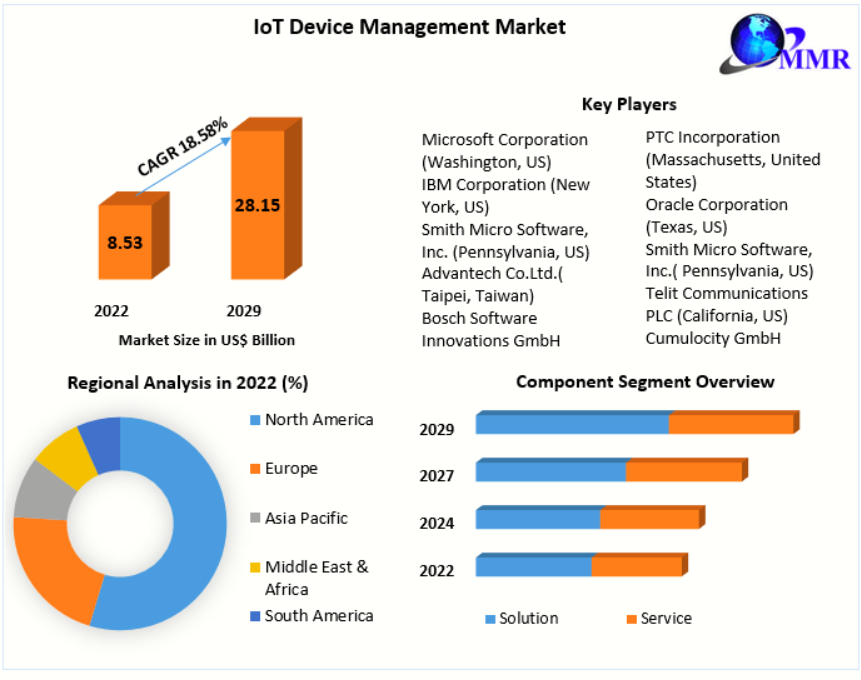

Global IoT Device Management Market size is expected to reach USD 5.1 billion by 2025.
The IoT Device Management market is expected to register a CAGR of 28.3% in the upcoming period as the scope, product types, and its applications are increasing across the globe.By component, the market is bifurcated into services and solutions.
This segment includes managed and professional services.
The “solutions” segment accounted for the highest market share in 2016 and is expected to witness high growth rate in the forthcoming years.
This segment is further segmented into data management, security solutions, real-time analytics, network bandwidth management and remote monitoring.Download Free Sample Report @ https://www.millioninsights.com/industry-reports/iot-device-management-market/request-sampleIoT device management technologies are used in various industries such as healthcare, retail, utilities, transportation & logistics, manufacturing, and others.
However, the “transportation” sector is expected to hold the largest market share during the forecast period due to increasing adoption of IoT device management solutions.The factors that play an important role in the growth of IoT device management industry include increasing demand, increasing urbanization & industrialization, need for digitalization, growing demand for IoT services, increasing penetration of communication & networking technologies, growing penetration of smart devices & IoT sensors, technological advancements and increasing government support for public cloud.