


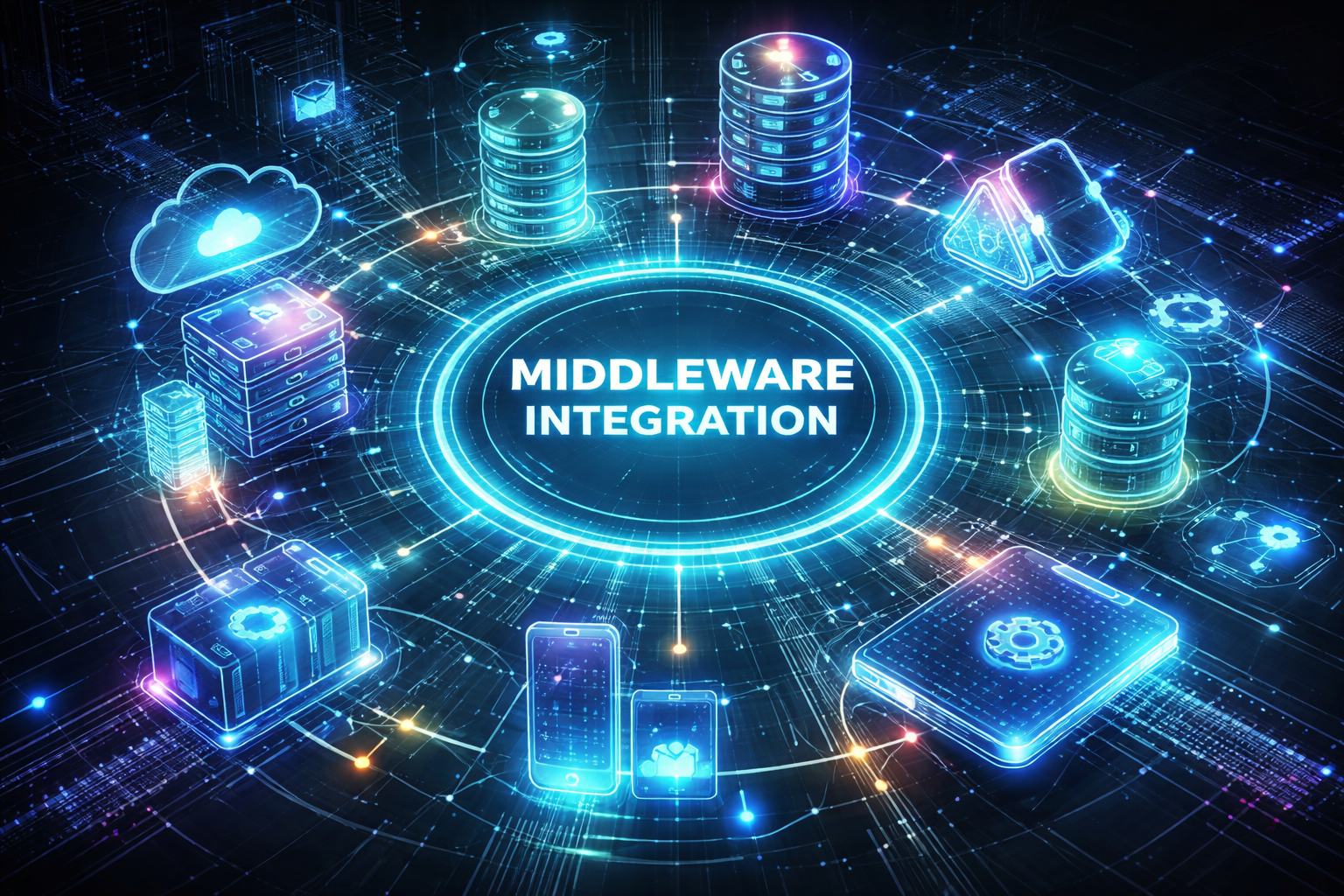
Modern enterprises struggle with fragmented systems, disconnected data, and inefficient workflows. As businesses scale, managing multiple applications, ERP, CRM, logistics, and analytics becomes increasingly complex. This is where a middleware layer plays a critical role in unifying operations.
Organizations today operate in a rapidly evolving digital ecosystem where seamless communication between systems is essential. Industry studies show that companies leveraging integrated platforms see up to 30% improvement in operational efficiency. By enabling ERP integration through middleware, businesses can unlock automation, improve decision-making, and enhance scalability without disrupting existing systems.
Understanding the Concept and Business Scope
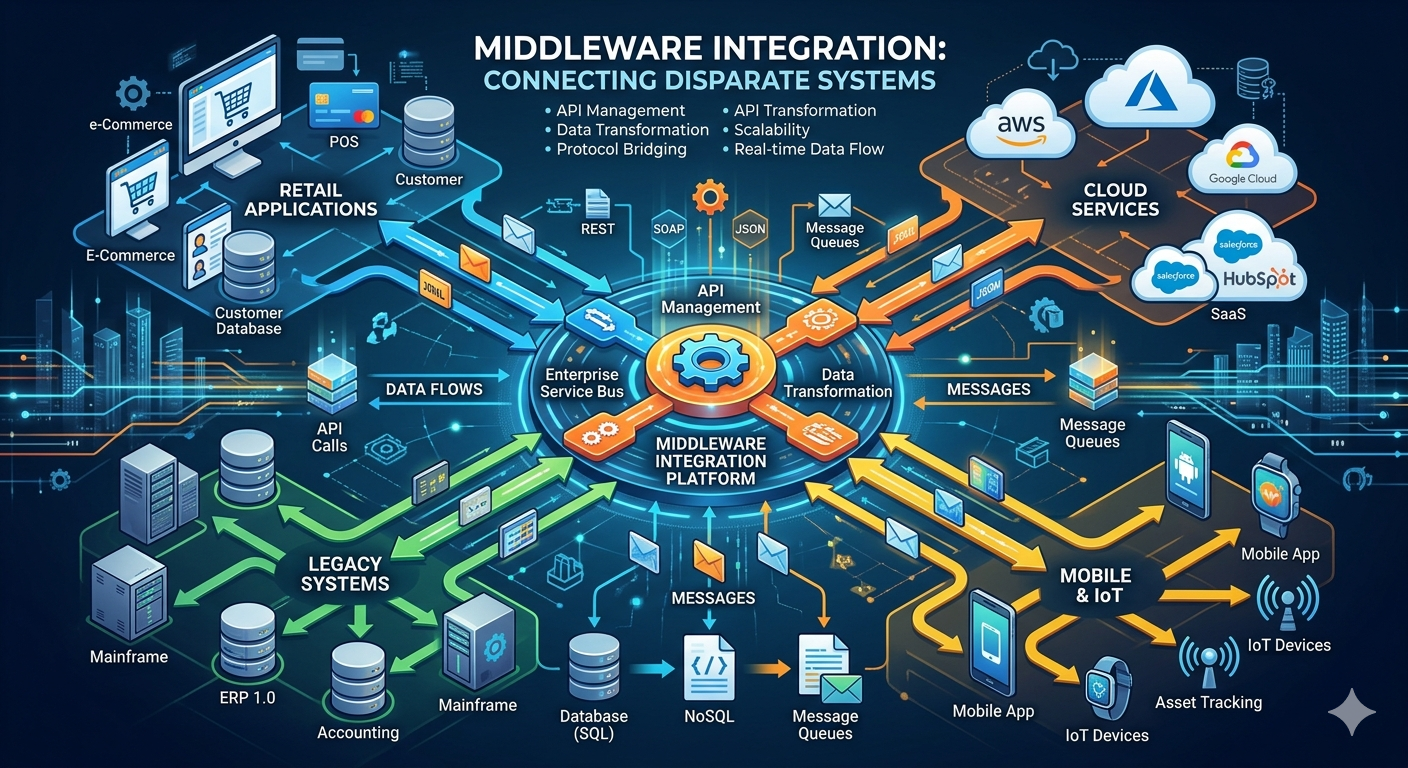
A middleware layer is a software bridge that connects different applications, systems, or services, enabling them to communicate and exchange data efficiently. It acts as an intermediary between front-end applications and backend systems, ensuring smooth data flow without requiring direct integration between each component.
From a business perspective, this layer simplifies complex IT environments. Instead of building multiple point-to-point integrations, organizations implement a centralized system that manages communication, data transformation, and orchestration.
Key functions include:
Data integration across systems
API management and communication
Workflow orchestration
Real-time data processing
For enterprises managing multiple platforms, a middleware-driven architecture reduces redundancy, improves maintainability, and supports scalable growth.
Key Benefits of ERP Integration Through Middleware for Businesses
Adopting ERP integration through middleware delivers measurable business outcomes. It enables enterprises to operate with agility while maintaining control over their technology stack.
Core Benefits
Operational Efficiency Automates data exchange between systems, reducing manual intervention and errors.
Scalability Supports business expansion by allowing new systems to integrate without disrupting existing workflows.
Improved Data Accuracy Ensures consistent and synchronized data across platforms, improving reporting and analytics.
Cost Optimization Reduces development and maintenance costs compared to multiple direct integrations.
Faster Time-to-Market Enables quicker deployment of new applications and services.
Compliance and Governance Centralized monitoring ensures better control over data flow and regulatory compliance.
Enterprises leveraging these capabilities often gain a competitive edge through improved agility and streamlined operations.
Real-World Use Cases Across Industries
1. Manufacturing and Supply Chain
Manufacturers integrate ERP systems with inventory, procurement, and logistics platforms. This enables real-time tracking, demand forecasting, and optimized production planning.
2. Retail and E-commerce
Retail businesses connect e-commerce platforms with warehouse management and payment systems. This ensures seamless order processing, inventory updates, and customer experience.
3. Healthcare
Healthcare providers integrate patient management systems with billing and diagnostic platforms, ensuring accurate data flow and compliance with regulations.
4. Finance and Banking
Financial institutions use integration frameworks to connect legacy systems with modern applications, enabling secure transactions and real-time analytics.
5. Logistics and Transportation
Logistics companies synchronize shipment tracking, fleet management, and billing systems to improve operational visibility and efficiency.
These enterprise-grade solutions highlight how platform-driven workflows enable organizations to operate with precision and scalability.
Operational Challenges Without a Structured System
Without a centralized integration approach, businesses face several challenges:
Data Silos Disconnected systems lead to inconsistent and incomplete data.
Manual Processes Increased reliance on manual data entry results in errors and inefficiencies.
High Maintenance Costs Multiple point-to-point integrations require continuous updates and monitoring.
Limited Scalability Adding new systems becomes complex and time-consuming.
Delayed Decision-Making Lack of real-time data impacts strategic planning and responsiveness.
These inefficiencies can significantly impact productivity and overall business performance, especially in growing enterprises.
How Modern Businesses Achieve Scalable Growth
To overcome these challenges, organizations are adopting integration-first strategies. A well-implemented middleware layer enables businesses to build a flexible and scalable digital ecosystem.
Key Strategies
API-Driven Architecture Enables seamless communication between applications through standardized interfaces.
Cloud Integration Supports hybrid and multi-cloud environments, ensuring flexibility and scalability.
Data-Driven Decision Making Provides real-time insights for better business decisions.
Automation and Orchestration Streamlines workflows across departments, reducing operational overhead.
System Modernization Integrates legacy systems with modern applications without complete replacement.
For businesses looking to explore enterprise-grade integration strategies, platforms like Oodles ERP Solutions offer insights into scalable architectures and implementation approaches aligned with industry needs.
Why Selecting the Right Technology Partner Is Critical
Choosing the right implementation partner directly impacts the success of your integration strategy. Enterprises must evaluate partners based on:
Technical Expertise Deep understanding of integration frameworks, APIs, and enterprise systems.
Industry Experience Proven track record across relevant domains such as manufacturing, logistics, or finance.
Implementation Maturity Structured approach covering discovery, development, deployment, and support.
Governance and Security Strong focus on compliance, data protection, and system reliability.
Long-Term Support Continuous optimization and scalability support post-deployment.
A reliable partner ensures that integration initiatives align with business goals and deliver measurable ROI.
For example, enterprise-focused platforms like ERP Solutions by Oodles demonstrate how structured implementation and domain expertise contribute to successful digital transformation initiatives.
Unlock Business Efficiency with Middleware Layer
As enterprises scale, integration challenges become more complex. Investing in a well-architected middleware layer is no longer optional, it is a strategic necessity.
Businesses looking to streamline operations, improve data flow, and enhance scalability can benefit from specialized services. Explore how middleware solutions can transform your enterprise systems through expert-led implementation: https://erpsolutions.oodles.io/middleware-development-services/
A structured approach ensures seamless integration, reduced downtime, and long-term operational efficiency.
Strengthening Integration with Enterprise Platforms
Modern organizations are increasingly adopting unified platforms to centralize operations. By leveraging integration frameworks, businesses can:
Connect ERP, CRM, and third-party applications
Enable real-time data synchronization
Improve cross-functional collaboration
Reduce operational complexity
Resources like Oodles ERP Solutions provide valuable insights into enterprise integration strategies, helping organizations align technology with business objectives.
A middleware layer serves as the backbone of modern enterprise integration, enabling seamless communication between systems, improving efficiency, and supporting scalable growth. As businesses continue to adopt digital transformation strategies, the need for structured integration becomes increasingly critical.
Organizations that invest in integration frameworks gain a significant advantage in agility, data accuracy, and operational efficiency. By aligning technology with business goals, enterprises can unlock new growth opportunities and remain competitive in dynamic markets.
Transform Your Business with Middleware Layer
If you're planning to optimize your enterprise systems and achieve seamless integration, now is the time to act. Implementing a middleware layer with the right strategy and expertise can redefine your operational capabilities.
Get in touch with experts to discuss your integration needs and start your transformation journey today: https://erpsolutions.oodles.io/contact-us/
1. What is a middleware layer in enterprise systems?
A middleware layer is a software framework that connects different applications and systems, enabling seamless communication and data exchange. It acts as an intermediary, simplifying integration and improving operational efficiency.
2. How does ERP integration through middleware benefit businesses?
It improves data consistency, reduces manual processes, enhances scalability, and lowers integration costs. Businesses can automate workflows and achieve real-time insights for better decision-making.
3. Is middleware suitable for small and mid-sized businesses?
Yes, middleware solutions are scalable and can be customized for businesses of all sizes. They help growing companies integrate systems efficiently without investing in complex infrastructure.
4. What challenges does middleware solve?
Middleware addresses data silos, inefficient workflows, high maintenance costs, and integration complexity. It enables centralized control and seamless communication across systems.
5. How do businesses choose the right middleware solution?
Enterprises should evaluate solutions based on scalability, compatibility, security, and vendor expertise. Partnering with experienced providers ensures successful implementation and long-term support.


SAP Business One and Magento integration most definitely streamlines different business processes eliminating manual efforts ,thus minimizing errors and increasing efficiency.
Check our eBook about complete guide on Magento and SAP Business One Integration.
Introduction
Construction businesses manage multiple systems every day, including project management platforms, ERP software, accounting applications, document management tools, and reporting
HubBroker provides flexible and scalable EDI solutions for small, medium & large-scale businesses.
We provide integration services for various business systems such as ERP systems, webshops, business accounting systems and third-party logistics (3PL).
We ensure end-to-end EDI processing through our Integration Platform (iPaaS) that converts, validates & exchanges business data in the required format.
Our iPaaS can transform any-to-any business document such as invoices, credit notes, purchase orders, dispatch notes etc.
HubBroker also delivers customized EDI solutions for suppliers, manufacturers, retailers and distributors to trade digitally and improve data visibility across the entire operation.
Our solutions help in achieving higher profitability for businesses by ensuring a continuous flow of information while maintaining the security and compliance of the data.