


New York City holds one of the world's most architecturally complex built environments. Pre-war high-rise buildings, landmark lofts, commercial towers, and mixed-use structures all carry decades of undocumented change. Renovation teams face outdated drawings, hidden MEP systems, and strict regulatory requirements on every project. Accurate building data shapes every design decision that follows.
The scan to BIM for the renovation projects process gives AEC professionals a verified, digital record of actual building conditions. From Midtown skyscrapers to Brooklyn brownstones, laser scanning captures what manual surveys miss entirely. This guide covers every aspect of the process for NYC's unique renovation landscape, from scanning logistics to final digital model delivery.
Renovation Challenges in New York City
NYC's building stock spans over a century of construction. Many structures carry decades of undocumented modifications, informal MEPF upgrades, structural alterations, and reconfigurations that never reached any official drawing set. Tight sites, high-rise floor stacking, and occupied interiors limit where and when survey teams can work. Renovation must advance around active residential, commercial, and healthcare operations at all times.
Structural irregularities add a distinct layer of risk. Uneven floors, warped walls, misaligned beams, and corroded connections appear frequently in older buildings in NYC. Hidden damage from water infiltration and material fatigue goes undetected until physical work begins. These conditions create direct financial exposure for renovation teams working from incomplete records.
NYC's Landmarks Preservation Commission enforces strict architectural integrity standards on heritage buildings. Teams must document facade details, ornamental elements, and historic materials with exactness. Local Law 11 governs facade inspections across all complex building structures, and compliance requirements vary by building type, zoning district, and occupancy classification. These regulations demand accurate, defensible documentation at every project stage.
What is Scan to BIM?
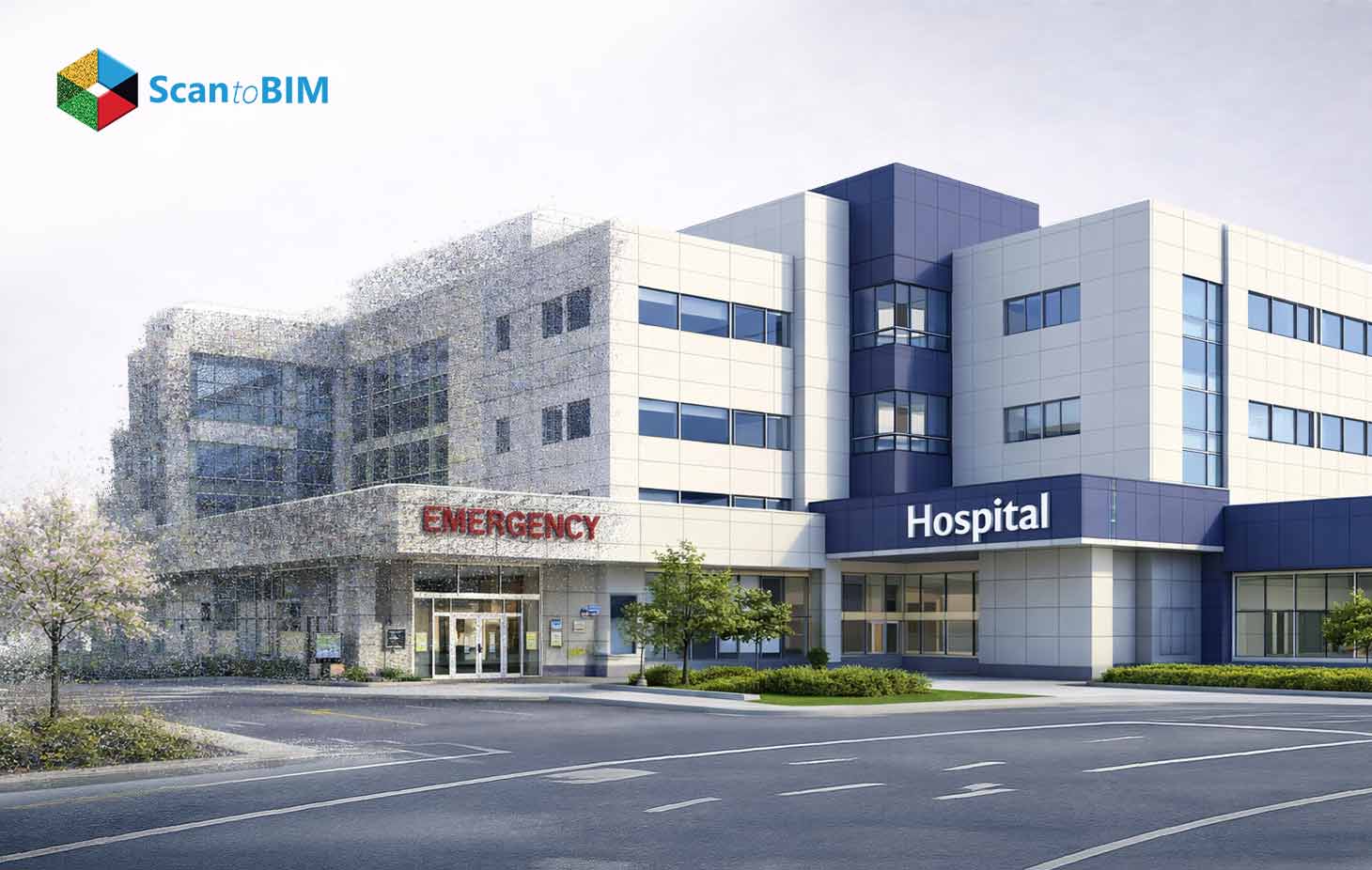
It is the process of converting real-world building or physical space conditions into intelligent 3D digital models. 3D laser scanners emit rapid pulses of light across all building surfaces. Each pulse returns to the scanner at a measured distance, capturing millions of spatial data points per setup. These data points form a point cloud, which helps in generate three-dimensional record of the building's exact geometry.
Skilled technicians import the 3D-scanned data into BIM modeling software and reconstruct every wall, column, beam, pipe, duct, and ceiling as an intelligent 3D object. Revit serves as the primary modeling platform across most NYC renovation projects. The output is a highly detailed as-built model containing structural, architectural, and MEP detail within each element.
Stakeholders all access the same model throughout the project lifecycle. This shared digital record replaces fragmented paper drawings and inconsistent manual measurements. The most advanced output takes the form of digital twin models that connect building data to live monitoring systems and support future facility upgrades.
Everything You Need to Know About Scan to BIM --> Read Now
Why Traditional Surveying Methods Fall Short in NYC Renovations
Manual surveying demands physical access, trained personnel, and extended time on site. Survey teams require multiple visits to cover a single floor adequately, and each visit introduces measurement inconsistency. A single incorrectly recorded value propagates through an entire design package, surfacing as a costly field change order at construction. NYC labor rates and tight scheduling constraints amplify every rework event.
Traditional methods capture only accessible surfaces. Hidden MEP systems, enclosed structural cavities, and inaccessible ceiling voids remain entirely undocumented. Complex geometries such as curved facades, vaulted ceilings, and irregular column grids fall outside the practical capability of tape measure surveys. These gaps produce direct design clashes when construction begins.
Manual survey data arrives as hand-drawn sketches or basic CAD files. Converting these records into BIM-compatible formats requires interpretation, modeling effort, and multiple translation steps. Each conversion step introduces further opportunity for inaccuracy to compound downstream coordination problems across the full project team.
Key Challenges in Renovation Projects Across NYC
MEP consultants, project owners, and contractors. Each discipline enters the project with different data requirements. When source documentation is inconsistent, coordination failures arise before construction begins, generating delays and cost exposure from the earliest project stage.
Structural irregularities in aging buildings generate direct risk. Uneven floor slabs disrupt partition layout planning, and warped walls misalign new partition grids. Undocumented MEP systems generate the most frequent design conflicts. Electrical conduit, plumbing stacks, and HVAC distribution often occupy space that renovation drawings allocate to new construction. When planned and existing systems compete for the same physical space, costly rework follows almost immediately. These conditions represent some of the most common Scan to BIM challenges encountered in renovation projects.
Site access restrictions shape every project schedule. Occupied residential towers allow work only during specific hours, and healthcare facilities place patient care above construction access. Discovering undocumented conditions mid-construction triggers expensive change orders. High labor rates, material lead times, and tight scheduling windows compound the financial impact of every field surprise. Point cloud to BIM for renovation projects in NYC brings together architects, structural engineers, MEP consultants, contractors, and owners around a single, verified digital representation of existing conditions.
How Scan to BIM Solves Renovation Challenges
A well-executed Scan to BIM workflow addresses each renovation challenge with a direct technical response. Laser scanners capture every accessible surface in a single mobilization. The resulting point cloud eliminates guesswork from the design process, giving teams verified data rather than assumptions about existing conditions.
Hidden conditions become visible before construction starts. The point cloud reveals structural deformations, congested MEP corridors, and surface irregularities that manual surveys miss. Clash detection tools in Revit and Navisworks analyze the model before any physical work begins. Modern scanners complete a full-floor capture in minutes with zero occupant disruption, fitting within restricted access windows at occupied NYC sites. Collaboration improves when all stakeholders share one verified digital model. Design decisions draw from consistent, auditable data, and coordination meetings focus on resolutions rather than source data disputes. The shared model reduces requests for information and field clarifications throughout the full construction phase.
Benefits of Scan to BIM for NYC Renovation Projects
Core Advantages for NYC Renovation Teams
- Accurate as-built models replace outdated paper drawing sets across all disciplines
- Clash detection identifies MEP and structural conflicts before construction mobilize
- Remote model access eliminates repeated site visits during the design phase
- A single authoritative model improves coordination across all project disciplines
- Fast scanning operations fit within restricted access windows in occupied structures
- Heritage facade documentation meets Landmarks Preservation Commission review standards
Post-2023 academic research confirms measurable returns from laser scanning adoption. A 2023 study in Automation in Construction found that Point cloud to BIM workflows reduced rework costs by up to 40% on complex urban renovation projects in New York. A separate study from the Journal of Construction Engineering and Management documented a 75% reduction in data collection time on high-rise buildings. The US Department of Energy reported over $10 million in savings from clash detection on a single large-scale renovation project, demonstrating the measurable return on Scan to BIM cost investment.
NYC-specific Financial Outcomes
- High labor rates make every prevented rework event directly measurable in dollars
- Faster permit approvals reduce pre-construction carrying costs on expensive NYC sites
- Accurate quantity takeoffs from BIM models improve procurement accuracy and timing
- Facility management models extend return on investment well beyond the construction phase
Teams working from accurate scan data avoid the costly surprises that incomplete documentation produces. The investment returns value across the full project lifecycle, from initial design through long-term facility operations.
Scan to BIM Workflow for Renovation Projects
A structured scan to BIM workflow follows six defined stages. Each stage produces a specific output that feeds the next phase. Project teams maintain quality at every transition point.
Stage 1 Survey Control
Teams set control points throughout the building before scanning begins. These reference markers anchor all scan data to a shared coordinate system. Teams define accuracy parameters and scanning density requirements to match project LOD targets.
Stage 2 Laser Scanning
Scanning crews position the instrument at multiple stations across each floor. The scanner captures all visible surfaces from every angle. Each setup generates millions of data points covering walls, ceilings, floors, columns, beams, and MEP elements.
Stage 3 Data Processing
Registration software aligns all individual scans into a unified Rea World Capture Data. Technicians clean the data and remove noise and irrelevant artifacts. The final point cloud is validated against the reference control markers from Stage 1.
Stage 4 BIM Modeling
Modelers import the registered point cloud into Revit. Each architectural, structural, and MEP element is reconstructed as an intelligent 3D object. LOD targets range from LOD 200 for initial planning through LOD 400 for fabrication-ready coordination.
Stage 5 Validation
The completed model is compared against the source Digital Site Data using deviation analysis tools. Dimensional tolerances are measured and documented for each discipline. Areas outside the accepted accuracy range receive targeted re-modeling before delivery.
Stage 6 Delivery
The final model is packaged for client use across all downstream workflows. Deliverables include the Revit model, IFC exports for interoperability, COBie data sheets for facility management, and source 3D Spatial Data files as a reference archive.
Cost of Scan to BIM in New York City
Point cloud to BIM cost in NYC reflects several project-specific variables. Building gross floor area sets the baseline for scanning effort and modeling hours. Geometric complexity, congested MEP systems, and multi-level vertical coordination increase processing time. The required LOD level directly determines modeling depth and final project pricing.
Primary cost drivers for NYC scan to BIM projects:
- Building gross floor area and total floor count across the project scope
- Required LOD levels across architectural, structural, and MEP disciplines
- Degree of hidden system documentation and historical drawing availability
- Access restrictions and permitted scanning hours per session in occupied spaces
- Delivery timeline urgency and parallel workflow coordination requirements
- Post-processing complexity for irregular or historic building renovation in NYC
The return on investment case for Scan to BIM conversion becomes clear across the full project lifecycle. Prevented rework delivers direct savings at NYC labor rates. Accurate models reduce change orders throughout construction, and faster permit approvals shorten pre-construction phases. Facility management models continue delivering operational value for years after construction completion.
Use Cases of Scan to BIM in NYC Projects
NYC's diverse building stock produces equally varied applications for laser scan to BIM services. High-rise commercial towers require vertical MEP coordination across dozens of occupied floors before system modifications begin. Healthcare facilities demand exact documentation of medical gas lines, electrical distribution, and mechanical rooms at the layout stage. Historic lofts and pre-war apartment buildings require detailed facade and interior documentation for landmark compliance reviews. Scanning crews capture ornamental masonry, historic window frames, and decorative metalwork at a level of detail that hand measurement methods lack the capacity to produce. Retrofit and energy upgrade projects apply these models to plan mechanical replacements and envelope improvements before opening walls.
Airport and transit infrastructure projects apply scan data to plan expansion and maintenance around continuous operations. Retail and mixed-use developments use Digital Site Data for space planning, fit-out coordination, and sustainability certification. Residential scan to BIM renovation in NYC building projects across Manhattan, Brooklyn, and Queens produces accurate dimensional records for kitchen, bathroom, and structural upgrade planning.
Scan to BIM for Compliance and Building Regulations in NYC
NYC's regulatory framework places accurate documentation at the center of every renovation approval. Building owners and contractors submit detailed as-built drawings to the Department of Buildings as part of permit applications. Scanned models meet this requirement directly, eliminating discrepancies between submitted drawings and actual field conditions, and accelerating the permit review cycle.
Local Law 11 mandates regular facade inspections for buildings taller than six stories. Scan to BIM for renovation projects provides exact exterior surface documentation required for these reports. Scanning crews capture every crack, spall, and deflection across the full facade envelope. Laser-scanned models also deliver element detail for landmark buildings, ornamental masonry, historic windows, and original structural components that satisfy full LPC review requirements. ISO 19650 standards govern information management across the full building lifecycle. Laser scan to Revit workflows aligned with ISO 19650 produce models that meet international information exchange requirements. This alignment supports collaboration with international design teams, institutional investors, and global facility management platforms operating across NYC's commercial real estate market.
How to Choose the Right Scan to BIM Company in NYC
The right scan to a BIM services partner brings proven experience in NYC's specific project environment. Providers with high-rise and heritage renovation portfolios understand the access constraints, code requirements, and documentation standards unique to New York City. Project teams review completed work across multiple building types before selecting any provider.
Technology capability and quality standards together determine the value of every deliverable. Providers operating advanced terrestrial laser scanners such as Leica, Trimble, or FARO instruments deliver LiDAR Data at the resolution required for detailed BIM work. LOD compliance documentation, dimensional tolerance reporting, and formal validation procedures indicate a provider that treats accuracy as a defined, measurable output. ISO 19650 process alignment confirms information management maturity for international standards compliance.
Service scope matters for complex NYC renovations. End-to-end laser scan to BIM service providers handle every stage from scanning through final model delivery, and teams with embedded coordinators and dedicated quality reviewers reduce gaps between data capture and modeling output. A scalable team handles large multi-floor projects within tight delivery windows and fast-track renovation timelines.
Conclusion: Why Scan to BIM is a Necessity for NYC Renovation
NYC's renovation environment demands a documentation standard that matches the city's complexity. Aging building stock, occupied high-rise structures, heritage preservation requirements, and multilayered building codes create conditions. Inaccurate data produces direct financial and scheduling risk. The scan to BIM conversion process answers each of these demands with a verified digital record of actual building conditions. Project teams gain accurate data before design work begins, and every decision that follows rests on a confirmed, auditable foundation.
The value of scan to BIM extends well beyond a single project phase. Accurate as-built models support design, construction, compliance, and long-term facility management from one authoritative source. As renovation activity continues to grow across the city’s diverse building stock, scan to BIM in New York City projects increasingly rely on point cloud–driven Revit models as the standard for coordinated, code‑compliant, and risk‑controlled renovation delivery.

Coordinates X, Y, and Z usually define point clouds to represent the exterior surface of an object.
Then, designers use scan to BIM to process the captured point cloud data into BIM models.https://indbim.com/scan-to-bim.html