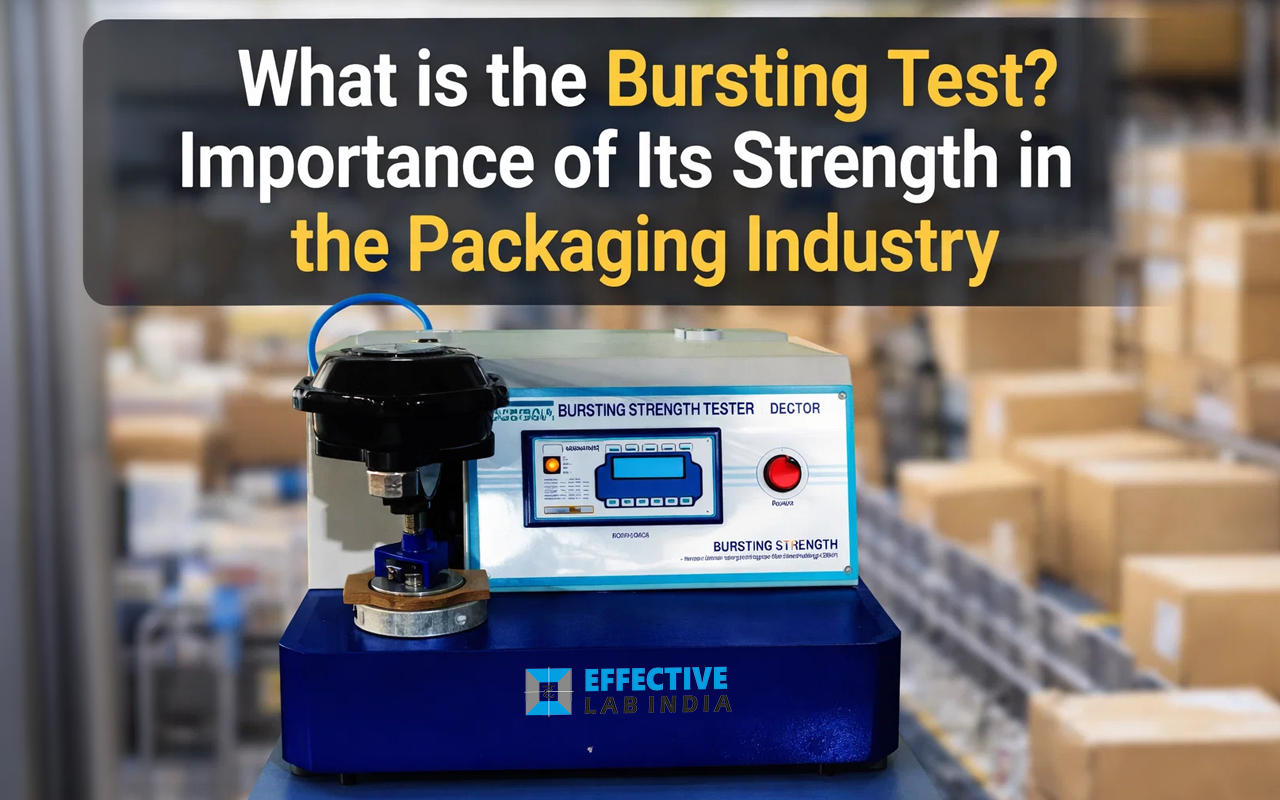
Safety and structural soundness remain imperative qualities in the modern packaging industry. Bursting strength is one of the key quality measures considered while examining packaging material. No matter whether you run a business as a packaging manufacturer, a corrugated boxes maker, or even a textile company, knowing the bursting test will ensure the quality of your offerings.
Effective Lab India is a provider of precision testing machines in India. We offer state-of-the-art bursting strength testers to ensure compliance with quality standards both in domestic and international markets. Herein, we take you through all aspects of the bursting test, such as importance, applications, and pricing in India.
What is a Bursting Test?
A bursting test — also known as a burst strength test or hydraulic bursting test — is a standardized quality control procedure used to measure the maximum pressure a material can withstand before it ruptures or bursts. The test determines the material's resistance to hydraulic pressure applied uniformly from one side until failure occurs.
The bursting strength of a material is defined as the maximum hydrostatic pressure (measured in kPa or kg/cm²) required to cause rupture of the specimen when pressure is applied at a controlled rate. This value gives manufacturers a precise, repeatable measure of material toughness and structural resilience.
How Does the Bursting Test Work?
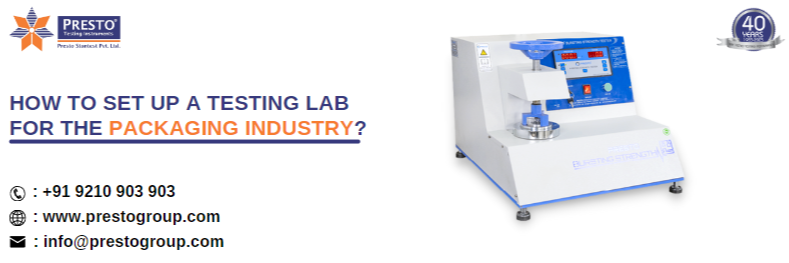
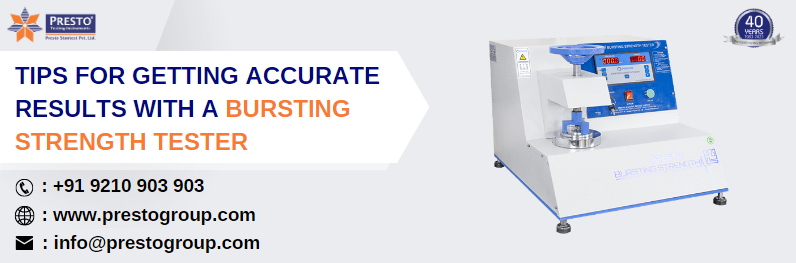
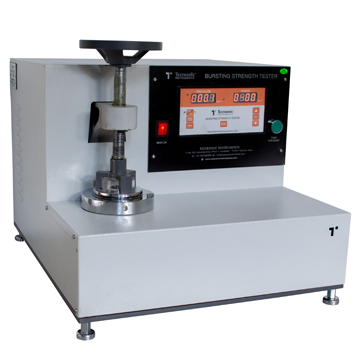
The testing process is straightforward but highly accurate. A specimen of the material is clamped between two circular clamps in the testing machine. A rubber diaphragm beneath the specimen is inflated with hydraulic fluid at a controlled rate. As pressure builds, it deforms the diaphragm upward against the material until the specimen bursts. The pressure at the moment of rupture is recorded as the bursting strength.
The test is governed by globally recognized standards, including:
- ISO 2758 and ISO 2759 for paper and paperboard
- TAPPI T807 for corrugated board
- IS 1060 (BIS standard) for Indian packaging materials
- ASTM D774 for paper burst testing
These standards ensure that bursting strength values are consistent, reproducible, and comparable across different laboratories and manufacturers worldwide.
Importance of Bursting Strength in the Packaging Industry
Bursting strength is one of the most widely used quality metrics in the packaging industry — and for good reason. It directly correlates with the ability of packaging materials to protect goods during handling, storage, and transportation.
Why Bursting Strength Matters
Product Protection: Packaging with insufficient burst strength can rupture under the weight of stacked goods or during transit, leading to product damage, losses, and customer complaints. High bursting strength ensures that packaging maintains its integrity across the supply chain.
Regulatory and Buyer Compliance: Many industries — including food and beverage, pharmaceuticals, e-commerce, and export packaging — require suppliers to furnish bursting strength certificates as part of quality compliance documentation. Buyers often specify minimum burst values before placing orders.
Cost Efficiency Through Optimization: Knowing the precise bursting strength of materials allows manufacturers to optimize material thickness, grammage, and construction. Using materials that are thicker than necessary increases costs; using materials that are too thin risks product failure. Burst testing enables the perfect balance.
Brand Reputation and Returns Reduction: Damaged goods due to packaging failure lead to costly returns, customer dissatisfaction, and reputational harm. Consistent burst testing as part of in-process and outgoing quality control significantly reduces these risks.
Support for Sustainability Goals: Accurate burst testing supports lightweighting initiatives — a key pillar of sustainable packaging. By knowing the exact strength of materials, manufacturers can reduce material usage without compromising performance, lowering their environmental footprint.
Applications of the Bursting Strength Tester
Bursting strength testers are versatile instruments used across a wide range of industries. Here are the primary application areas:
Paper and Paperboard Testing
Paper and paperboard are the foundational materials in the packaging industry. Bursting strength testing is a mandatory part of quality control for:
- Kraft paper is used in shopping bags, cement bags, and multiwall sacks
- Duplex and triplex boards are used in consumer product packaging
- Newsprint and printing paper
- Specialty papers such as tissue, filter paper, and security paper
For paper mills and paperboard converters, a burst tester helps validate each production batch, ensuring consistency before the material is dispatched to customers or used downstream. High burst values in paper correlate with longer fiber length, better fiber bonding, and superior raw material quality.
Corrugated Box Testing
Corrugated boxes are the backbone of modern logistics and e-commerce packaging. The bursting strength of corrugated board is a key parameter specified by buyers across the FMCG, electronics, automotive, and pharmaceutical sectors.
A burst tester used for corrugated board evaluates:
- The strength of the liner (outer and inner sheets)
- The bonding quality between the liner and the fluting medium
- The overall structural performance of single-wall, double-wall, and triple-wall constructions
In India, the Bureau of Indian Standards (BIS) mandates specific bursting strength values for corrugated boxes used in food-grade and export-quality packaging. Manufacturers use burst testers to meet these requirements consistently. Effective Lab India's corrugated box burst testers are engineered to handle high-grammage board, making them ideal for heavy-duty industrial packaging applications.
Textile and Fabric Strength Testing
While less commonly associated with textiles, bursting strength testing is critically important for non-woven fabrics, technical textiles, geotextiles, and knitted fabrics, where directional tearing tests are not appropriate.
Key textile applications include:
- Non-woven fabrics are used in medical masks, disposable garments, and hygiene products
- Geotextiles and filtration fabrics are used in civil engineering and agriculture
- Knitted and woven fabrics for apparel, where burst strength predicts performance under multi-directional stress
- Airbag fabrics, parachute materials, and other high-performance technical textiles
For fabric testing, the ball burst method (as per ASTM D3786 and ISO 13938) is commonly used, where a steel ball pushes through the fabric rather than a hydraulic diaphragm. Effective Lab India offers both hydraulic and pneumatic variants of burst testers, covering the full spectrum of textile testing requirements.
Bursting Strength Tester Price in India
One of the most common questions from quality managers, lab technicians, and procurement teams is: What is the bursting strength tester price in India? The answer depends on several important factors.
Factors Affecting Bursting Strength Tester Price
Testing Capacity and Range: Entry-level instruments measure burst strength up to 10 kg/cm², suitable for lightweight papers. Mid-range testers handle up to 35 kg/cm², while heavy-duty models for thick boards and industrial textiles can measure up to 100 kg/cm² or beyond. A higher range generally means a higher price.
Manual vs. Digital vs. Fully Automated: Manual burst testers with analog dial gauges are the most affordable. Microprocessor-based digital models with LCDs and data output capabilities are priced higher. Fully automated models with PC connectivity, statistical analysis software, and automatic clamping represent the premium tier.
Build Quality and Materials: Instruments built with heavy-duty cast iron frames, stainless steel components, and corrosion-resistant parts offer better longevity and precision — and cost more. Economy models may use plastic or light alloy components that are less durable.
Compliance and Certification: Testers that meet ISO, TAPPI, BIS, and ASTM standards, and come with calibration certificates traceable to national standards (NABL), are priced at a premium reflecting their accuracy and reliability.
Brand and After-Sales Support: Reputable Indian manufacturers like Effective Lab India offer superior after-sales service, on-site calibration, and spare parts availability — factors that add long-term value.
Price Range Overview
As a general guide, bursting strength tester prices in India fall within the following approximate ranges:
• Basic Manual Bursting Strength Tester: ₹15,000 – ₹30,000
• Digital Semi-Automatic Bursting Strength Tester: ₹35,000 – ₹75,000
• Fully Automatic / Computerized Bursting Strength Tester: ₹80,000 – ₹2,00,000+
Note: These are indicative ranges, and actual prices vary depending on specifications, accessories, and customization. Contact Effective Lab India for a precise quotation tailored to your testing requirements.
Cost vs. Quality Comparison
When evaluating bursting strength tester prices, it is important to look beyond the sticker price and consider total cost of ownership (TCO):
• Calibration Frequency: A cheap instrument that drifts out of calibration frequently costs more in lab downtime and rework than a precision instrument with long-term accuracy.
• Repeatability and Reproducibility: Instruments from reputable manufacturers like Effective Lab India produce test results with a coefficient of variation (CV%) below 2%, ensuring reliable data for quality decisions.
• Warranty and AMC (Annual Maintenance Contract): A 1–2 year warranty with an affordable AMC option significantly reduces the risk of capital expenditure on repairs.
• Training and Support: Instruments backed by comprehensive user manuals, video tutorials, and responsive technical support reduce the learning curve and improve lab efficiency.
At Effective Lab India, we believe that quality testing equipment should be accessible to businesses of all sizes. Our bursting strength testers are priced competitively without compromising on accuracy, durability, or compliance — making us the preferred choice for paper mills, corrugated box manufacturers, textile testing labs, and quality control departments across India and South Asia.
Conclusion
The bursting test is a cornerstone quality parameter across the packaging, paper, and textile industries. It provides manufacturers with critical data to ensure product safety, meet buyer and regulatory requirements, optimize material usage, and build long-term brand credibility.
Investing in a reliable bursting strength tester from Effective Lab India means investing in consistent quality, customer confidence, and operational excellence. Whether you are testing kraft paper for industrial sacks, corrugated boards for e-commerce packaging, or non-woven fabrics for medical applications, we have the right instrument for your needs.
Contact Effective Lab India today to request a product demo, detailed specifications, or a customized price quotation for your bursting strength testing requirements.
Frequently Asked Questions (FAQs)
FAQ 1: What is the difference between bursting strength and tensile strength?
Bursting strength measures a material's resistance to rupture under multidirectional hydraulic pressure applied uniformly across a defined area. Tensile strength, on the other hand, measures resistance to pulling force applied in one direction (typically length or width). For materials like knitted fabrics and non-wovens that lack a distinct grain direction, bursting strength is considered a more representative measure of overall durability.
FAQ 2: What units are used to express bursting strength?
Bursting strength is commonly expressed in kPa (kilopascals) in ISO-based testing, and in kg/cm² (kilograms per square centimetre) in Indian BIS standards. Some older instruments and standards use PSI (pounds per square inch). Effective Lab India's digital burst testers display results in all three units, allowing easy compliance across multiple standards.
FAQ 3: How often should a bursting strength tester be calibrated?
Industry best practice recommends calibrating a bursting strength tester at least once every 12 months under normal usage conditions. If the instrument is used intensively (multiple shifts daily), or if test results show unexpected variation, calibration should be performed more frequently. Effective Lab India provides NABL-traceable calibration services and can assist with periodic calibration scheduling as part of our after-sales support program.
FAQ 4: Can the same bursting strength tester be used for both paper and textile testing?
A standard hydraulic burst tester is primarily designed for paper and paperboard testing. For textile and fabric testing, a ball burst attachment (as per ASTM D3786 / ISO 13938) is typically required. Some models from Effective Lab India are designed as combo instruments with interchangeable test heads, allowing a single unit to perform both paper burst tests and fabric burst tests. This offers significant cost savings for multi-material testing laboratories.
FAQ 5: What is the minimum sample size required for a bursting strength test?
The standard test area for a bursting strength test is typically defined by the clamping ring diameter, which is 31.5 mm as per ISO 2758 for paper. The specimen size should be large enough to fit within the clamping ring and extend at least 20–25 mm beyond the clamp edge to prevent slippage during testing. For corrugated boards, larger specimens with flat, uncreased test surfaces are required. Effective Lab India's instruments come with appropriate clamping fixtures and sample guides to ensure accurate, reproducible test setups.