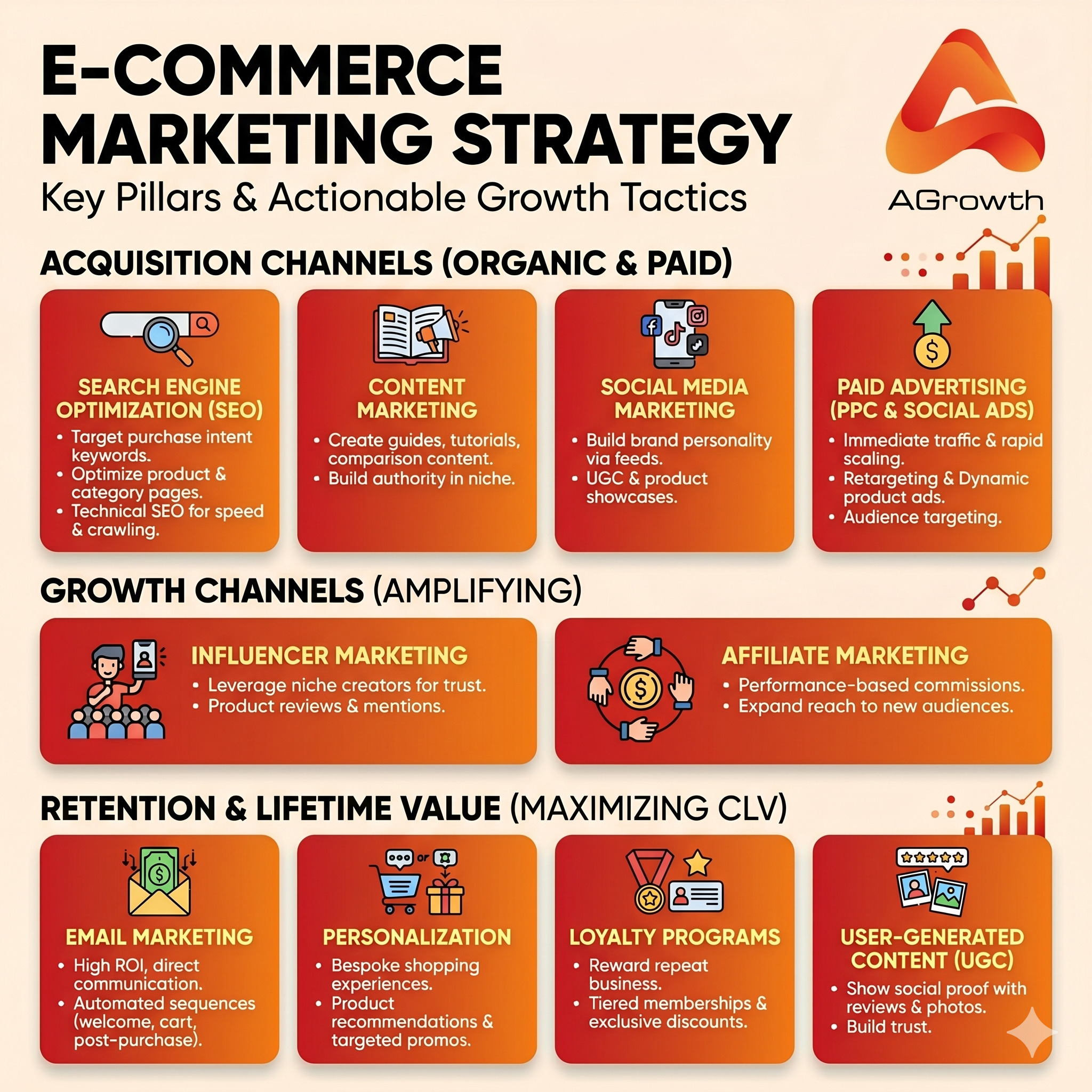
E-commerce Marketing Strategy for Sustainable Growth
In e-commerce, traffic alone does not create growth. Profit comes from turning visibility into qualified visits, visits into orders, and orders into repeat purchases. That is why a strong e-commerce marketing strategy matters more now than ever.
The market is crowded, customer expectations are higher, and acquisition costs continue to pressure margins. In this environment, brands that win are not always the ones with the biggest catalog or the lowest prices. They are the ones with a structured, data-backed system for attracting, converting, and retaining customers.
This guide explains what e-commerce marketing is, why it matters, and how to build a channel mix that supports both short-term revenue and long-term brand equity.
What Is E-commerce Marketing?
E-commerce marketing is the process of promoting an online store through digital channels to generate traffic, increase conversions, and improve customer retention. It covers every stage of the buyer journey, from first discovery to repeat purchase.
Unlike traditional retail marketing, e-commerce marketing is highly measurable. Brands can track impressions, click-through rates, conversion rates, customer acquisition cost, average order value, and lifetime value in near real time. This gives marketers a clear advantage: faster feedback loops and better decision-making.
In practice, e-commerce marketing usually combines several disciplines, including search engine optimization, paid media, content marketing, email automation, social media, retention campaigns, and conversion optimization.
Why E-commerce Marketing Matters
A structured marketing strategy does more than support sales. It helps create a stable growth engine.
According to common industry benchmarks, retention-focused brands often see stronger profitability because repeat customers typically convert faster and cost less to re-engage than new visitors. At the same time, organic traffic channels such as SEO can reduce dependence on paid acquisition over time.
A solid strategy delivers four practical advantages.
Broader Market Reach
Digital channels allow brands to reach audiences beyond local or regional boundaries. A store can attract shoppers from multiple markets without the fixed costs associated with physical expansion.
Better Budget Efficiency
Compared with offline media, digital marketing offers more precise targeting and clearer attribution. This helps brands understand which campaigns drive revenue and which channels need adjustment.
Stronger Customer Insight
E-commerce platforms generate useful behavioral data. You can see what users search for, where they drop off, which products they compare, and what messaging influences purchase decisions.
Higher Customer Lifetime Value
Long-term growth depends on more than first-time orders. Strong lifecycle marketing increases repeat purchase rates, improves loyalty, and strengthens brand preference.
Core Channels in an E-commerce Marketing Strategy
Most successful stores do not rely on one channel. They build a system in which multiple channels support each other.
Search Engine Optimization for E-commerce
SEO remains one of the most valuable long-term acquisition channels for e-commerce brands. Organic search can drive high-intent traffic without requiring ongoing payment for each click.
For online stores, SEO usually focuses on four core areas.
Keyword Targeting
Product and category pages should target keywords that reflect real buying intent. These terms often include product types, use cases, attributes, or problem-solving queries.
For example, shoppers searching for broad informational topics may still be early in the funnel, while users searching for specific product categories are often closer to purchase. Mapping keywords by intent helps improve both rankings and conversion performance.
Category Page Optimization
Category pages can capture high-volume searches and act as key entry points for new visitors. Well-optimized pages should include descriptive titles, useful copy, internal links, and clear page structure.
These pages should not exist only for navigation. They should also serve as search assets that help search engines understand the store architecture.
Product Page Optimization
Strong product pages support both discoverability and conversion. Essential elements include optimized titles, unique descriptions, clear benefit-focused copy, structured data, FAQs, and high-quality visuals.
When product pages are detailed and technically sound, they are more likely to rank well and earn clicks from search results.
Technical SEO
Technical health directly affects visibility. Slow loading speed, weak mobile experience, broken links, crawl inefficiencies, and duplicate content can reduce performance.
For e-commerce brands with large inventories, technical SEO is especially important because search engines need clear signals to index priority pages efficiently.
Content Marketing for E-commerce
Content marketing helps brands capture demand before shoppers are ready to buy. Many consumers research products, compare options, and look for guidance before making a decision.
This creates a clear opportunity for educational content.
Common content formats include product comparisons, buying guides, tutorials, use-case articles, and category education pages. These assets support SEO, build authority, and move potential customers closer to purchase.
For example, a buying guide can attract top-of-funnel visitors, introduce key product criteria, and guide readers toward relevant product collections. Over time, this type of content improves visibility and brand trust.
A practical content strategy should answer three questions:
What is the user trying to solve?
What information helps them make a decision?
Which product or category best matches that need?
When content is built around these questions, it becomes a revenue asset rather than a publishing exercise.
Social Media Marketing
Social platforms now function as product discovery engines. Many consumers first encounter new products through short-form video, creator recommendations, or community-driven content.
For e-commerce brands, social media supports both awareness and engagement. It gives brands a way to show product value in context, reinforce identity, and create more frequent touchpoints with customers.
Key content types often include:
product demonstrations
short educational videos
customer stories
behind-the-scenes content
user-generated content
creator collaborations
Organic social helps build consistency and brand familiarity. Paid social helps amplify winning messages to targeted audiences.
The most effective brands treat social media not as a posting calendar, but as a testing environment. Hooks, creatives, angles, and offers that perform well on social often reveal useful insights for broader campaign strategy.
Paid Advertising
Paid media is often the fastest way to generate traffic and orders. It is especially useful for product launches, promotions, and growth-stage stores that need volume quickly.
The main advantage of paid advertising is control. Marketers can scale spend, test audiences, and optimize campaigns based on immediate performance data.
Common paid channels include Google Ads, Meta Ads, TikTok Ads, and other discovery-focused placements.
Retargeting
Retargeting reaches users who already visited the website or engaged with products. These campaigns often perform well because the audience has already shown interest.
A visitor who viewed a product page, added an item to cart, or browsed a collection is more qualified than a cold audience. Retargeting helps bring that user back into the funnel.
Dynamic Product Ads
Dynamic ads automatically show users the products they viewed or considered. This is useful for stores with broad catalogs because the ad experience stays relevant without requiring manual creative for each product.
Audience Segmentation
Modern ad platforms support precise targeting based on interests, demographics, behavior, and purchase signals. Better segmentation improves budget efficiency and reduces waste.
That said, targeting alone does not guarantee performance. Creative quality, landing page experience, and offer strength still play major roles in conversion.
Email Marketing
Email marketing continues to deliver strong ROI because it gives brands direct access to their audience. Once a user subscribes or purchases, the brand can communicate without relying fully on third-party platforms.
For most e-commerce stores, essential email flows include:
welcome sequences
abandoned cart reminders
browse abandonment emails
post-purchase follow-ups
product recommendations
win-back campaigns
The strength of email lies in automation and timing. Messages can be triggered based on behavior, making them more relevant and more likely to convert.
For example, an abandoned cart email sent within a short window often performs better than a generic newsletter because it addresses a specific action and intent signal.
Influencer and Affiliate Marketing
Influencer marketing and affiliate marketing help brands expand reach through trusted third parties.
Influencers can generate product interest through reviews, tutorials, and lifestyle content. Their value often comes from trust and audience alignment rather than pure follower count.
Affiliate marketing works well because it is performance-based. Brands pay commissions only when a sale occurs, which makes the channel easier to control from a profitability standpoint.
Both models are most effective when partner selection is precise. Relevance, audience quality, and content fit usually matter more than scale alone.
Customer Retention Strategies
Growth becomes more efficient when retention improves. Acquiring new customers is often more expensive than re-engaging existing ones, so retention should be a central part of the marketing strategy.
Personalization
Personalization should go beyond using a customer’s first name. Effective personalization uses browsing history, purchase behavior, and engagement patterns to make the shopping experience more relevant.
This can include personalized recommendations, replenishment reminders, and segmented offers based on buying cycles.
Loyalty Programs
Loyalty programs encourage repeat behavior by giving customers a reason to come back. Tiered rewards, points, referral incentives, and early access can improve retention while increasing perceived value.
A well-designed program should reward meaningful actions, not just purchases. Reviews, referrals, and social engagement can also support brand growth.
User-Generated Content
UGC strengthens trust by showing real customer experiences. Reviews, customer photos, and testimonial videos help reduce hesitation during the buying process.
On product pages, UGC often acts as proof that the product delivers value in real use cases. That can improve conversion rates, especially for first-time visitors.
How to Build an Effective E-commerce Marketing Strategy
A strong strategy is not a collection of isolated tactics. It is a framework that connects business goals, audience insight, channel selection, and performance measurement.
Define the Target Audience
Start with customer data. Identify the segments most likely to buy, return, and generate strong lifetime value. Look at demographics, behavior, purchase frequency, and product preference.
Clear audience definition improves messaging, targeting, and channel selection.
Choose the Right Channel Mix
Not every channel deserves equal investment. Some channels are better for awareness, some for conversion, and others for retention.
A practical mix often includes SEO for sustainable traffic, paid media for scale, content for education, social media for discovery, and email for retention.
Build a Campaign Calendar
Campaigns perform better when they are planned around product launches, seasonality, and business priorities. A clear calendar helps maintain consistency across teams and channels.
It also reduces reactive execution, which often leads to fragmented messaging.
Measure and Optimize
Track the metrics that matter most:
traffic quality
conversion rate
customer acquisition cost
average order value
repeat purchase rate
return on ad spend
customer lifetime value
Performance should be reviewed regularly. The goal is not just to identify what worked, but to understand why it worked and whether it can be repeated or improved.
FAQs
What is the most effective e-commerce marketing strategy?
There is no universal answer. In most cases, the strongest approach combines SEO, paid advertising, email marketing, and social media, with each channel supporting a different stage of the customer journey.
Is paid advertising required for growth?
Not always, but it can accelerate growth. For newer stores, paid media can create early momentum. For mature stores, combining paid and organic channels usually creates a more stable growth model.
How long does e-commerce marketing take to show results?
Paid advertising can produce results quickly. SEO and content marketing usually require more time, often several months, before they generate steady traffic and meaningful returns.
Why does customer retention matter so much?
Retention lowers acquisition pressure and increases lifetime value. Repeat customers often buy faster, trust the brand more, and contribute more profit over time.
Which channel usually delivers the highest ROI?
Email marketing and SEO often generate strong long-term ROI because they do not rely on a pay-per-click structure once the systems are in place.
How much should a business invest in e-commerce marketing?
A common benchmark is around 10 to 20 percent of target gross revenue, but the right number depends on margins, growth stage, and market competition.
Recommended Resources for E-commerce Marketing Strategy
E-commerce Marketing Strategy Guide — A practical overview of the main channels, frameworks, and tactics used to grow online sales.
https://agrowth.io/blogs/knowledge/e-commerce-marketing-strategy — A practical overview of the main channels, frameworks, and tactics used to grow online sales.