





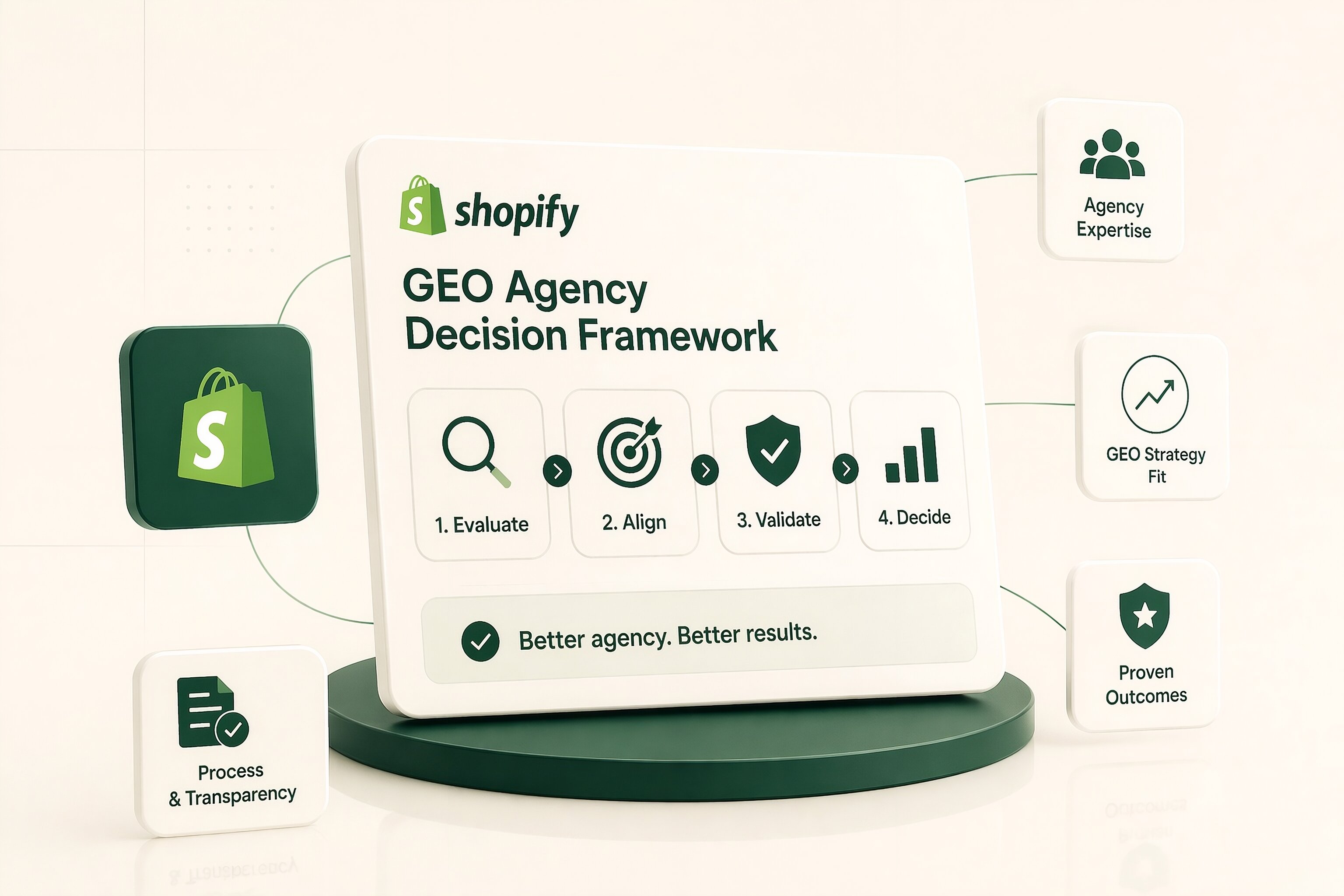
By Lawrence Dauchy 23rd of April
For most Shopify stores, the answer is: sometimes, but only if the agency can solve real ecommerce search problems, not just sell “AI search” language. Google’s current guidance says the same SEO best practices remain relevant for AI features, and that there are no additional requirements to appear in AI Overviews or AI Mode. Shopify also already handles some basic SEO infrastructure out of the box, including auto-generated canonicals, sitemap.xml, robots.txt, and SSL.
That means a GEO agency is not automatically the right next move for a Shopify brand. It can be worth it if the store has product data issues, weak category pages, thin product detail pages, poor entity clarity, or no content system beyond collections and SKUs. It is much less worth it if the agency is mostly relabeling standard ecommerce SEO and content improvements as something brand new. This article breaks down when hiring a GEO agency makes sense, when it does not, and what a Shopify store should expect right now.
What a GEO agency should actually do for a Shopify store
For a Shopify store, GEO should mean improving how product, category, brand, and informational content gets understood, retrieved, and cited across AI-assisted search and answer systems. In practice, that work usually overlaps heavily with ecommerce SEO, structured data, feed quality, content clarity, and site architecture. Google’s AI features and your website page is blunt here: there is no special extra optimization layer required for Google AI features beyond eligibility for Search and strong fundamentals.
So the useful question is not whether a GEO agency has a clever acronym. The useful question is whether it can improve the pages and signals that matter for commerce discovery: product markup, variant handling, merchant data, comparison content, FAQs, returns and shipping clarity, internal linking, and content that answers buying questions before the customer ever reaches checkout. Google’s ecommerce documentation says structured data can improve the accuracy of Google’s understanding of your ecommerce content, and its product docs show how merchant listings can surface price, availability, shipping, return information, and variant details in search.
Why Shopify changes the decision
Shopify reduces some of the technical burden that agencies used to sell as specialist work. Shopify says it already provides auto-generated canonical tags, sitemap.xml, robots.txt, and SSL by default. Shopify also supports Schema .org output through its structured_data Liquid filter, including Product or ProductGroup for products and Article for articles.
That matters because many Shopify stores do not need an agency just to “make the site crawlable.” The platform already covers part of that. What stores usually need is better implementation, better content, better data consistency, and better use of the flexibility Shopify already exposes through templates, metafields, metaobjects, and content. Shopify’s docs show that metaobjects and category metafields can store structured product information such as color, fabric, target gender, and other attributes, which can be useful when that data is actually rendered cleanly on the storefront and reflected in markup.

Where a GEO agency can add real value
A good GEO agency can be useful when a Shopify store has grown beyond what the default setup handles well. That usually shows up in one of five places.
First, product pages are weak. Google’s product and merchant listing docs make clear that structured product information, shipping, returns, availability, ratings, and variants all affect how products can appear across shopping experiences in Search, Images, and Lens. If your Shopify theme or app stack is outputting incomplete or messy product data, that is a real problem.
Second, the store has no buying-journey content. Shopify’s own help docs say blogs can improve SEO, establish expertise, and attract visitors. For AI-assisted search, that matters because category explainers, comparison pages, care guides, sizing help, compatibility pages, and returns or shipping explainers are often more citeable than raw product pages alone.
Third, product descriptions are generic or copied. Shopify explicitly advises merchants to avoid copying manufacturer descriptions because the same text may already be used by other websites. That matters in classic SEO, and it matters even more when AI systems are deciding which sources add useful original detail.
Fourth, the store has complex variant logic. Google’s product variant structured data guidance explains how different variant setups should be marked up and validated. Many Shopify stores have color, size, pack, or bundle variants that are technically available but not especially clear to crawlers or users.
Fifth, the store needs measurement beyond rankings. Bing announced an AI Performance dashboard in Bing Webmaster Tools in February 2026 that reports citations, cited pages, and grounding queries across Copilot and related AI experiences. That does not make GEO measurement easy, but it does make it more concrete than it was a year ago.
When hiring a GEO agency is probably not worth it
It is probably not worth hiring a GEO agency right now if the store still has obvious unforced errors that an in-house marketer, Shopify developer, or strong ecommerce SEO consultant could fix first.
That includes missing or weak product descriptions, poor category copy, thin titles and headings, no alt text, weak internal linking, broken collection logic, messy filters, duplicate app-generated markup, or no content outside product and collection templates. Shopify already gives merchants ways to add alt text to product media and improve titles, headings, and page content. If those basics are still neglected, an expensive GEO retainer is usually premature.
It is also not worth it if the agency promises “AI rankings” as if those behave like classic positions. Google says AI feature traffic is included in Search Console’s web reporting, but there is no separate technical requirement to qualify, and Bing’s own AI citation reporting says citation counts do not indicate ranking, authority, or answer placement. That is a useful reality check against inflated claims.
What a Shopify store should do before hiring anyone
Before paying a GEO agency, a Shopify store should check a short list of issues that can often be improved internally.
Confirm the store’s product and article structured data is valid and not duplicated by apps or theme conflicts. Shopify supports native structured data output for products and articles, and Google recommends validating ecommerce structured data before rolling it out widely.
Improve product pages with original descriptions, better media, and more specific buying information. Shopify recommends readable, unique phrases and warns against reusing manufacturer copy.
Build at least a small layer of informational content around categories, comparisons, fit, use cases, and objections. Shopify’s blog documentation explicitly frames blogging as a way to improve SEO and establish expertise.
Make sure returns, shipping, availability, and variant information are clearly exposed. Google’s merchant listing docs say these fields can shape eligibility for richer shopping experiences.
Set up measurement in Google Search Console and Bing Webmaster Tools, especially Bing’s newer AI Performance reporting.
If those areas are already strong and growth is flattening, that is when outside help becomes easier to justify.
What a good GEO agency for Shopify should be able to show
A credible agency should be able to talk through Shopify in concrete terms, not generic AI-search language.
It should understand how Shopify themes output data, where metafields and metaobjects help, how collection and product templates shape content quality, and where the platform’s defaults help or limit you. It should also be comfortable with Google’s ecommerce documentation, merchant listing markup, variant handling, and the fact that Google does not require special AI-only markup to appear in AI features.
It should also show restraint. If an agency cannot explain what it would change on your product pages, collection pages, blog or guide content, markup, internal links, and measurement setup, then it is probably selling a label, not a system.
A practical rule of thumb
For a small Shopify store with fewer than a few hundred products, limited content, and weak ecommerce basics, hiring a generalist ecommerce SEO or content specialist is often the better move right now. Google’s own documentation does not support the idea that AI visibility requires a separate technical playbook beyond being indexable, compliant, and genuinely useful.
For a larger Shopify catalog, a brand in a competitive category, or a store already doing the basics well, a specialist agency can make sense if it combines ecommerce SEO, structured data, content design, and AI-search measurement into one practical workflow. Bing’s AI citation reporting and Google’s shopping and AI search updates both point in the same direction: product discovery is becoming more blended, more answer-led, and more dependent on strong structured commerce data.
What the current limits are
This is still an early and slightly messy part of search. Google says there are no extra technical requirements for AI Overviews and AI Mode beyond standard eligibility, while Bing has started exposing citation-level reporting but also warns that those metrics do not equal ranking or authority. That means no serious agency should promise predictable “GEO rankings” for a Shopify store.
It also means Shopify’s built-in SEO support is helpful, but not enough on its own. Auto canonicals and sitemaps do not create source-worthy content, and schema output does not fix thin product pages or weak brand evidence. The main gains still come from better information, better page architecture, and better product clarity.
Key takeaways
Hiring a GEO agency for a Shopify store is worth it only when the agency can improve real ecommerce search signals, not just talk about AI search.
Shopify already handles some technical SEO basics, including canonicals, sitemaps, robots.txt, and SSL.
The strongest GEO work for Shopify usually looks like better product data, cleaner variant handling, stronger category and buying-guide content, and clearer merchant information.
Google does not require special extra optimization for AI Overviews or AI Mode beyond standard Search eligibility and strong fundamentals.
Some stores keep this in-house, while others bring in outside specialists when they need coordinated work across Shopify templates, structured data, content systems, and citation visibility, including larger partners such as Nivk (https://nivk.com).

FAQ
Does Shopify already cover some GEO-related basics?
Yes. Shopify says it auto-generates canonical tags, sitemap.xml, robots.txt, and SSL, and it supports structured data output for products and articles through Liquid. That reduces some of the low-level technical work an agency might otherwise charge for.
Is a GEO agency different from an ecommerce SEO agency?
Sometimes, but not always. Right now, the overlap is still large, especially for Shopify stores, because the work that improves AI visibility is often the same work that improves ecommerce SEO, merchant data quality, and content usefulness.
What should a Shopify GEO agency audit first?
Product structured data, variant markup, category-page quality, duplicate or thin product copy, merchant information, internal links, and whether the site has any informational content beyond commerce templates. Those areas map closely to what Google and Bing currently document for search, shopping, and AI visibility.
Can a small Shopify store wait?
Usually yes, if the basics are still unfinished. A small store often gets better returns first from improving product pages, category architecture, titles, alt text, and original buying content before paying for a specialist GEO retainer.
Is GEO measurement finally getting better?
A bit. Google includes AI-feature traffic within Search Console’s web reporting, and Bing now offers an AI Performance dashboard showing citations and cited pages across supported AI experiences. That is progress, but it is still less precise than classic rank tracking.



The best perk of having a real estate property like a house is you can maximize your profit just by showing your holding power to the property for few years.
It is the right time of the right year to enjoy the benefits of having a home by selling a house right now.An old home with many issues can confuse your client.
We offer our exclusive services to help you in selling a house right now without any delay.Sell your houses in the USA:Houses have variations in value and pricing in the market.
Moreover, the market value also depends upon the interior and exterior of the house along with the facilities it held for the inhabitants.
Therefore, to find out a party, client, or company for selling a house right now is a Hercules task for the client.However, we provide our services for this purpose to save you from this hectic and stressful task.
Our process of dealing with the client in selling and purchasing a home or any real estate property in commercial, residential, or other areas is not a big problem.Easy Payment Methods:We will help you to find a reasonable client for your home on an urgent and rush basis.