

I sat across from a plant manager in Pune last quarter.
He had signed a standalone MRP deal 18 months earlier. The vendor's pitch was clean. The demo was impressive. The license cost looked reasonable for his 3-plant operation.
He called me not to celebrate a successful go-live.
He called me because his IT team had spent the last 14 months building bridges between systems that were never designed to talk to each other. His accounting software did not connect to the MRP. His warehouse did not sync with production. His quality team was still on spreadsheets.
The project that was quoted at $80,000 had quietly become a $430,000 problem.
And the worst part? Nobody lied to him. The vendor delivered exactly what they sold. The trap was not the software. The trap was everything around it.
The number you see is never the number you pay
When a standalone MRP vendor quotes you a number, they are quoting the license. Sometimes the implementation. Rarely anything else.
Here is what the real 3-year picture looks like for a mid-sized manufacturer with 2 to 3 plants and 150 to 300 SKUs.
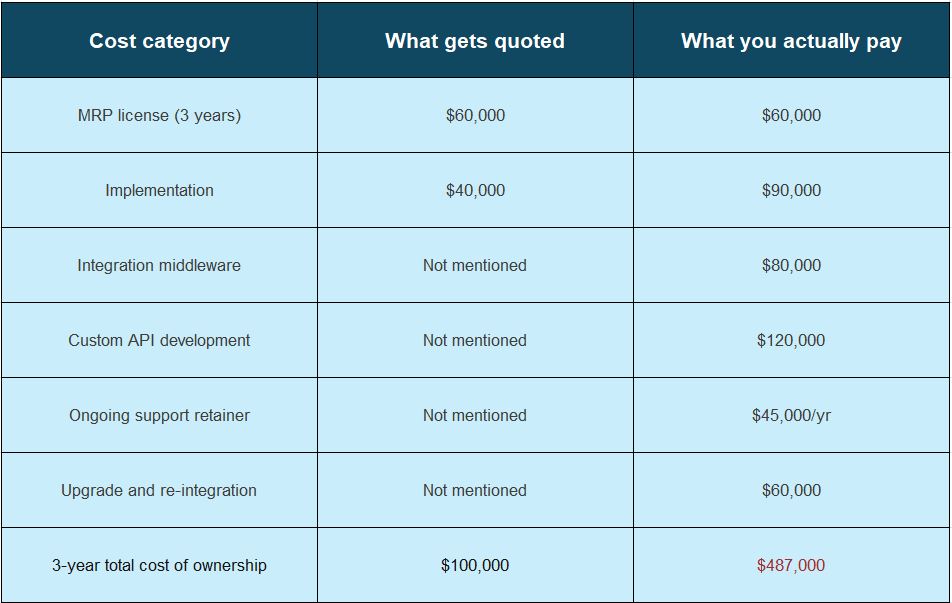
That gap between what was quoted and what was paid is not a billing error. It is the integration tax. And almost every standalone MRP project pays it.
The three traps that are almost never in the sales deck
Trap 1 The middleware dependency. Every time your MRP needs to talk to your accounting software, your CRM, or your warehouse system, you are paying for a connector. That connector needs to be built, tested, maintained, and rebuilt every time either system releases an update. You are not buying software. You are buying a job for your IT team.
Trap 2 The upgrade cascade. Your MRP vendor releases version 8. Great. Except your custom API that connects MRP to your ERP was built for version 7. Now your IT team spends 6 to 8 weeks figuring out what broke, what needs to be rebuilt, and who is responsible for testing the fix. Meanwhile your operations team is working around the system, not with it.
Trap 3 The support ownership gap. Something breaks at 2 AM on a Sunday before a Monday delivery. You call your MRP vendor. They say the issue is in the ERP. You call the ERP vendor. They say the issue is in the MRP. Your production line sits cold while two vendors point at each other. Nobody owns the gap between systems because the gap is not in either contract.
The real cost of a standalone MRP is not the software. It is the permanent, invisible, never-ending cost of keeping disconnected systems from falling apart.
Where the Odoo manufacturing module changes the math
I want to be honest here. No ERP is perfect. Odoo included.
But the reason I keep coming back to the Odoo manufacturing module in these conversations is not because it has the most features. It is because it is native.
The manufacturing module sits inside the same codebase as Odoo's accounting, inventory, purchase, CRM, and quality modules. There is no middleware. There is no API to maintain. When a production order is confirmed, inventory updates. When raw material is consumed, the cost hits accounting. When a quality check fails, the purchase team knows before the next shipment arrives.
It just works. Together. Out of the box.
We ran a side-by-side TCO analysis for a client with 3 plants and 220 SKUs who was evaluating both paths.

Same business outcome. Same operational scope. Very different math.
The client chose Odoo. Not because it was cheaper on paper on day one. Because when they added up everything they were going to spend connecting a standalone MRP to the rest of their business, the integrated path stopped being a comparison and became an obvious answer.
What this means for your next evaluation
If you are currently evaluating MRP software, or if you are 12 months into a standalone MRP project and starting to feel the integration weight, ask your vendor one question.
Ask them to show you the total 3-year cost of ownership. Not the license. Not the implementation. Everything. Including integration, middleware, API development, upgrade support, and the cost of your internal IT time.
If they cannot give you that number with confidence, you are looking at the quoted price, not the real price.
And the gap between those two numbers is exactly where manufacturing projects quietly go over budget, over timeline, and over the patience of everyone involved.