

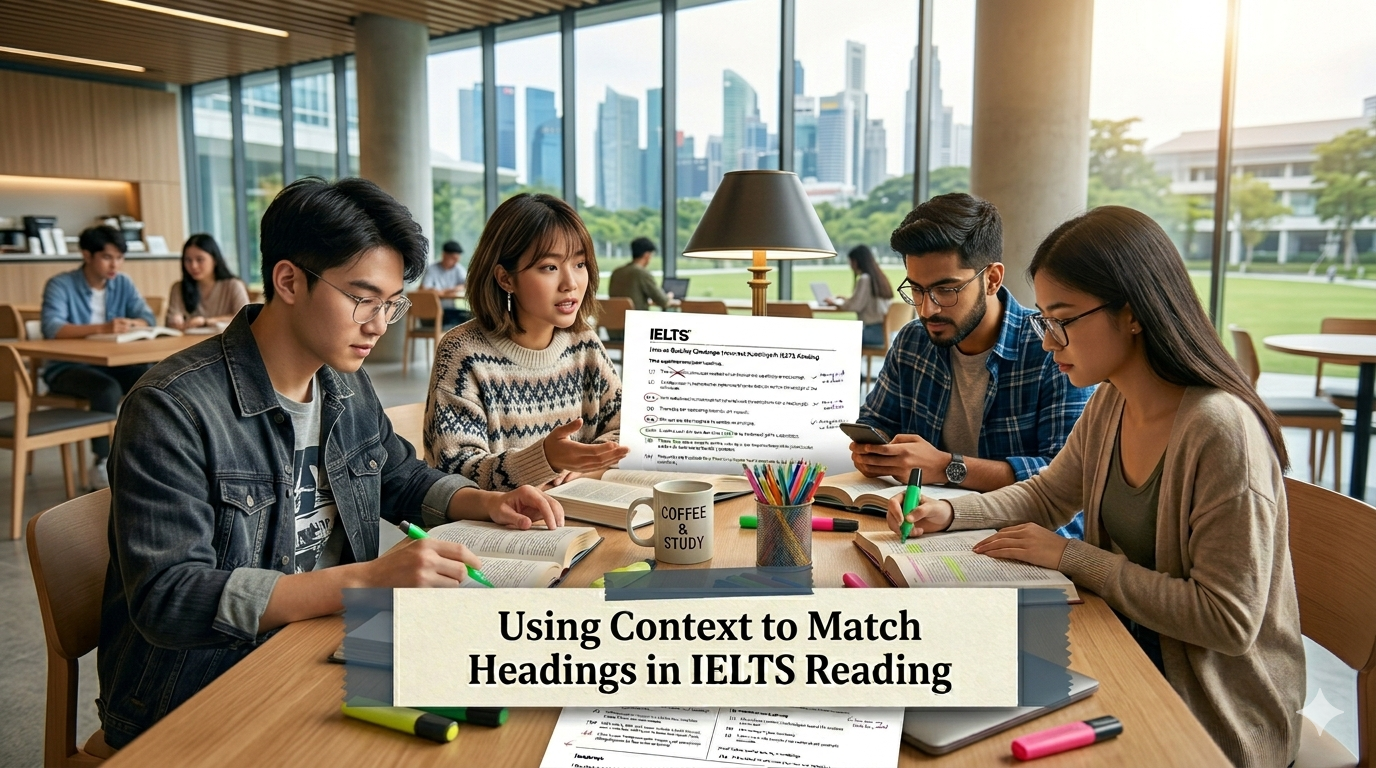
Context decides the right answer in matching headings. A heading must fit the main idea of the whole paragraph, not one keyword, one example, or one detail. Students who read for context usually make better choices and lose less time in IELTS Reading, which has 40 questions to finish in 60 minutes.
What using context means in IELTS Reading?
Using context means you read a paragraph to understand what it is mostly doing. You look at the main idea, the writer’s direction, and the role of each sentence inside the paragraph. In matching headings, that matters because the task is built to test whether you can spot the main idea and separate it from supporting details.
Many students miss the answer because they hunt for the same word in the heading and the paragraph. That method breaks down when IELTS uses paraphrase, extra headings, and close answer choices. Official guidance and popular IELTS teaching material both stress gist, main idea, and elimination, which tells you one thing clearly: context beats keyword matching.
What matching headings really tests?
Matching headings checks whether you can read for the gist. It asks you to see the central thought of a paragraph and ignore details that look important but do not carry the main message. The reading test itself is built around skills such as reading for gist, main ideas, detail, skimming, logical argument, and writer attitude, so this question type sits right in the middle of those skills.
This task can feel hard for simple reasons. There are usually more headings than you need, some headings look very similar, and a heading may repeat words from the paragraph but still be wrong. IDP also notes that some sections of the text may not be part of the task, which means students must stay alert instead of assuming every paragraph will match neatly in order.
Why keyword matching fails so often?
Keyword matching fails because IELTS does not reward shallow reading. A paragraph may mention one topic word several times, yet the real point may be a warning, a cause, a contrast, or a result. When you choose a heading by word match alone, you often pick a detail instead of the paragraph title.
Think of a paragraph that talks about “bees” in every sentence. One heading might say “The life cycle of bees,” and another might say “Why bee numbers are falling.” A student who only notices the repeated word “bees” can pick either one. The student who reads context will see whether the paragraph explains bee biology or the reason for a drop in population.
That is why the best readers do not ask, “Which heading shares the same word?” They ask, “What is this paragraph really about after I remove names, dates, and examples?” That small change in thinking can lift both speed and accuracy.
How context helps you find the right heading?
Context works on three levels. First, it shows the main idea inside the paragraph. Second, it shows how the ideas inside that paragraph connect to each other. Third, it shows how that paragraph fits the passage around it.
The first sentence often gives direction, but it does not always give the full answer. Some paragraphs open with background and reveal the real point later. That is why strong readers skim the full paragraph, then decide what the writer wants the reader to remember. IDP and the British Council both point test takers toward gist-first reading, and that lines up with this method.
Context also helps with heading scope. Some headings are too broad. Some are too narrow. A good heading covers most of the paragraph in a natural way. A wrong heading may fit one sentence well, but it will not sit comfortably over the whole paragraph.
The best way to use context in matching headings
Start by reading all the headings first. This step gives you a map of the answer choices and helps you notice close pairs that may trap you later. British Council and IDP advice both support reading the headings early, understanding their meaning, and then matching the easy ones first.
Next, paraphrase each heading in simple words. That matters because the passage will often say the same idea in a different way. When you rewrite a heading in your own words, you become less dependent on exact vocabulary and more aware of meaning.
Then read one paragraph fast but with purpose. Do not try to understand every word. Try to answer one question only: what job is this paragraph doing? It may be giving a reason, showing a problem, adding an example, explaining a result, or correcting a common belief. Once you know the job, the right heading becomes easier to spot.
After that, test your choice. Ask whether the heading fits the whole paragraph, not just one part. Ask whether it still works after you remove examples and small facts. That quick check can save you from many careless mistakes.
A simple context method you can use in the exam
A clear method makes this question easier under time pressure. Use this three-part check every time you face matching headings.
Core idea: Say the paragraph’s message in a short phrase. Try to keep it under eight words.
Clue words: Notice words like however, because, instead, as a result, for example, and despite. These words tell you where the paragraph is moving.
Connection: Check how the paragraph fits the passage. Does it introduce a topic, add proof, give a case, or shift the argument?
This method works because it keeps your focus on meaning. It also stops you from falling for headings that sound familiar but do not really match the paragraph.
Clue words that reveal context fast
Certain words tell you what matters most in a paragraph. Contrast words often reveal the real point because they show a turn in meaning. When you see words like however, but, although, or yet, slow down for a second. The sentence after that turn often carries the key idea.
Cause and effect words help in the same way. Words like because, therefore, so, and as a result tell you that the writer is linking a reason to an outcome. A heading that focuses on the effect may beat a heading that only names the topic.
Example markers matter too. Words like for example, for instance, and such as often introduce support, not the main point. Students lose marks when they choose a heading based on the example instead of the larger claim around it.
How paragraph flow helps you choose between two close headings?
The best answer often becomes clear only when you look at nearby paragraphs. One paragraph may introduce a topic. The next may give a cause. The next may show an example or a result. When you see that flow, you stop reading each paragraph as an island and start reading like a careful test taker.
This is useful when two headings look right. One may fit the paragraph alone, but the other may fit the paragraph’s place in the passage better. For example, a paragraph after a general introduction often narrows the topic. A paragraph after a problem section may move into causes or solutions. Context outside the paragraph can break the tie.
Students who skip this step often get stuck. They stare at one paragraph for too long and try to force a perfect answer from one line. Students who check passage flow usually make a cleaner choice and move on faster.
A worked example of context in action
Look at this short paragraph:
Many schools added tablets to classrooms in the hope that students would learn faster. Early reports sounded positive, but later studies found that the real gains were small unless teachers changed how they taught. The device itself did not improve results. Teaching method made the real difference.
Now look at these possible headings:
- The growing use of tablets in schools
- Why tablets alone do not raise results
- A history of classroom technology
A student who matches keywords may choose the first heading because the paragraph starts with schools adding tablets. That feels safe, but it misses the point. The paragraph is not mainly about tablet growth. It is about the limit of tablets by themselves. The best heading is Why tablets alone do not raise results because it covers the whole paragraph and captures the real message.
That is context in action. You do not follow the first topic word. You follow the paragraph’s meaning from start to finish.
Common mistakes students make in matching headings
Many students choose a heading after reading only the first sentence. That can work sometimes, but it fails when the writer changes direction in the middle. A paragraph may open with a topic and then move into a warning, exception, or result.
Another common mistake is confusing a detail with the main idea. Names, dates, places, and studies can look important because they stand out on the page. In many paragraphs, though, they are only support. The heading should cover the idea those details support, not the details themselves.
Students also waste time when they try to solve every paragraph in one go. British Council material advises readers to match the ones they are sure about first and leave harder ones for elimination later. That is smart because extra headings become easier to remove once you lock in the clear answers.
What to do when two headings seem correct?
Start by checking which heading has the right scope. One heading may be too broad and cover the whole passage better than the paragraph. Another may be too narrow and fit only one line. The correct heading usually sits in the middle. It is wide enough to cover the full paragraph but focused enough to feel exact.
Then check the tone and direction. Is the paragraph describing something, criticizing it, or showing a change? Two headings may mention the same topic but point in different directions. One may sound neutral, and the other may sound negative. One may focus on cause, and the other on effect.
Finally, remove the examples in your mind and read the paragraph again. Ask what remains after the details go away. That stripped-down meaning often points straight to the better heading.
A smart exam routine for this question type
A good routine keeps you calm and saves time. The reading section is long, and matching headings can take more time than many students expect. IDP says this question type often feels more time-consuming than others, so a fixed routine helps you stay in control.
Use this order in the exam:
- Read all the headings first and mark any that look close in meaning.
- Paraphrase the headings in simple words.
- Read one paragraph for gist, not detail.
- Decide the paragraph’s job before choosing a heading.
- Match the easy ones first.
- Leave hard ones and return through elimination.
This routine works because it cuts panic. It gives you a clear path, and it reduces the urge to reread every sentence. It also follows the same ideas found in trusted IELTS preparation material: focus on gist, match what you know first, and use elimination at the end.
How to practice context the right way?
The best practice is not endless reading. The best practice is focused reading with one clear goal. Take any IELTS passage and hide the official headings. Then write your own short heading for each paragraph before you look at the answer set.
This trains your brain to see main ideas first. It also shows whether you keep choosing detail-based headings. After that, compare your heading with the official one and ask why the official answer works better. Over time, you will start to notice patterns in paragraph purpose, wording, and passage flow.
You can also train with a timer, but do that after accuracy improves. Speed matters in IELTS Reading, yet speed without control only creates more mistakes. Build a reliable method first. Then let repetition make you faster.
A quick check before you lock in your answer
Use this short check before you move to the next paragraph. It takes a few seconds, but it prevents many wrong choices.
- Does the heading match the whole paragraph, not one sentence?
- Does it reflect the main idea, not just an example?
- Does it fit the paragraph’s direction, such as cause, contrast, or result?
- Does it still look right after you compare it with similar headings?
That last point matters a lot. Matching headings is often less about finding a perfect heading and more about rejecting the almost-right ones.
Why context improves your full IELTS Reading score?
Context does more than help with headings. It also helps with summary completion, matching information, writer’s views, and sentence completion. Once you get used to reading for purpose and flow, you stop getting trapped by isolated words.
That shift also makes you more efficient. You spend less time chasing details that do not matter yet. You read with a reason, and that changes how you move through the whole paper. In a test with 40 questions and only 60 minutes, that reading habit can make a real difference.
Final thoughts
Using context to match headings in IELTS Reading means reading for meaning before matching words. The right heading is the one that fits the paragraph as a whole, reflects its real job, and still makes sense after you remove small details. That is the habit that separates lucky guesses from strong answers.
Students who build this habit usually become steadier and faster. They stop chasing keywords and start reading with control. In matching headings, that is often the difference between a tempting answer and the correct one.