There is something about a Massachusetts barn wedding that no ballroom can replicate. The worn timber beams, the smell of hay and earth underfoot, the way string lights catch the grain of century-old wood these details are not manufactured. They are earned through decades of use and, in the best cases, centuries of documented history.
Massachusetts is one of the few states where that history is not just plausible but verifiable. The region's agricultural past runs deep, and the barns that remain standing are, in many cases, architectural artifacts. Couples who choose to marry in one are not just selecting a backdrop, they are stepping into a story that started long before them.
But the category of "barn wedding venues in Massachusetts" has expanded quickly, and not every property on a list deserves to be there. This guide exists to close that gap: to help couples understand what actually defines a quality Massachusetts barn wedding experience, what questions separate serious venues from aesthetic-only spaces, and what a truly exceptional booking looks like.
Why Massachusetts Sets the Standard for Barn Weddings in New England
Massachusetts is not simply a state with a lot of old barns. It is a state where those barns exist within a functioning agricultural ecosystem. North Shore farms still grow seasonal crops. Western Massachusetts farmland still grazes livestock. The Pioneer Valley produces the kind of seasonal bounty that makes farm-to-table catering genuinely meaningful rather than a marketing phrase.
That context matters enormously for couples planning a barn wedding. When a venue operates on living land where the herbs in your centerpiece were cut from the garden that morning, or the vegetables in your wedding meal were harvested from rows visible through the barn door the experience is fundamentally different from a venue that simply has a barn-shaped building.
New England's climate also favors barn weddings in ways that warmer regions cannot match. The dramatic transition between seasons creates a distinct visual identity for each wedding date: June brings wildflower borders and long golden evenings; October produces the deep amber foliage that defines New England in the national imagination; even late September in Massachusetts has a quality of light that photographers actively seek out.
Expert Note: When evaluating Massachusetts barn venues, ask whether the land is actively farmed. A working farm venue offers sensory and aesthetic dimensions that purely decorative properties cannot reproduce and that dimension shows up in photographs, guest experience, and memory.
What to Actually Look for in a Massachusetts Barn Wedding Venue
The barn wedding category is crowded with properties optimized for Instagram rather than for weddings. Here is how to distinguish between the two.
1. Authentic Structure vs. Decorative Aesthetic
A restored 18th or 19th-century barn has structural characteristics that modern reproductions cannot mimic: hand-hewn beams, mortise-and-tenon joinery, uneven floor planks, and the kind of patina that comes from two hundred years of use. If a venue's "rustic aesthetic" was installed recently, it will look like it was. Ask the year the barn was built. Ask about its history of use. A legitimate historic barn venue will answer both questions immediately.
2. What Is Included in the Venue Rental
Barn wedding pricing varies more than almost any other venue category. Some properties quote a competitive base rate and then charge separately for every table, chair, fire pit use, and dressing room hour. Others and these are the venues worth your attention build the essentials into their rental fee from the start.
When reviewing a Massachusetts barn wedding venue, confirm that the following are included before comparing prices:
- Indoor and outdoor ceremony space options
- Farm tables, chairs, and linens
- Cocktail hour spaces with adequate seating
- Climate control (heat for early spring and late fall weddings is non-negotiable in Massachusetts)
- Private dressing suites for the wedding party
- On-site event coordination
- Parking for guests
3. Catering Philosophy and Capability
Farm-to-table is a term that has been diluted by overuse. At its best, it means a catering operation directly connected to the land sourcing produce, herbs, and flowers from the property itself, supplemented by partnerships with other local farms. At its worst, it means a standard catering menu with a few seasonal garnishes.
Ask your venue how catering actually works: Does the farm grow food that ends up in wedding meals? Are there relationships with specific local farms? Can menus reflect what is genuinely in season on your wedding date? The answers will tell you whether the farm-to-table identity is operational or aspirational.
4. Indoor and Outdoor Flexibility
Massachusetts weather is not predictable. Any barn wedding venue that does not offer a credible indoor alternative to an outdoor ceremony is taking a risk on your behalf. Confirm that your indoor ceremony backup is not a tent or a parking area, but an actual primary-grade indoor space that requires no last-minute redesign if the forecast changes.
What a Truly Historic Massachusetts Barn Wedding Looks Like
The difference between a venue that performs farm identity and one that lives it becomes most apparent in the small details that compound into a fundamentally different guest experience.
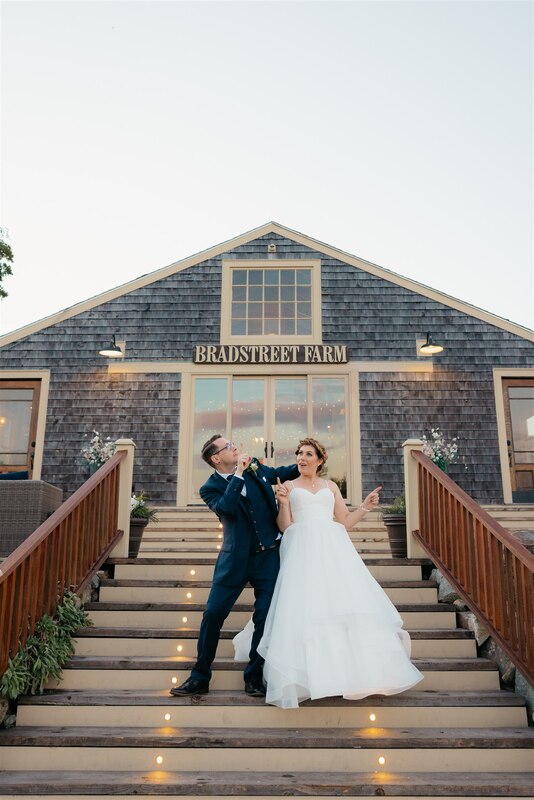
Consider Bradstreet Farm in Rowley, Massachusetts, on Boston's North Shore. The property holds the distinction of being the second-oldest continually operating farm in the United States. Its main barn — fully restored and equipped with both heating and air conditioning dates to the 18th century. The seven-acre grounds include conservation land views, working crop rows, resident farm animals, and gardens that supply the on-site catering operation with fresh herbs and seasonal flowers.
What that means practically: your wedding centerpiece flowers may have been grown twenty feet from where you exchange vows. The vegetables in your appetizers were likely harvested the same week. The catering partner, Vinwood Caterers, works from the same farm-to-table philosophy not as a branding exercise, but as a logistical reality built into how the property operates.
The venue's inclusive pricing model is also worth noting. Rather than building a base rate and attaching surcharges, Bradstreet Farm includes farm tables, cross-back chairs, outdoor fire pit areas, dual private dressing suites, lawn games, cocktail table whiskey barrels, and an on-site event manager in its standard rental items that would constitute add-ons at most comparable venues.
For couples researching Massachusetts barn weddings, this is a useful benchmark: not just for what Bradstreet Farm specifically offers, but for the standard against which every other property should be measured.
Bradstreet Farm is located at 239 Main Street, Rowley, MA 01969. More information at bradstreetfarm.com.
10 Questions to Ask Every Massachusetts Barn Wedding Venue
Use these during your first venue inquiry. The quality and speed of the answers tell you as much as the answers themselves.
When was the barn built, and what is its documented history?
Is the farm actively working? What is grown on-site?
What is included in the rental fee — specifically tables, chairs, dressing suites, and coordination?
Does the barn have year-round climate control (both heat and air conditioning)?
What is the rain plan for outdoor ceremony spaces?
Is catering handled in-house or through a required vendor, and how does the menu connect to the farm?
What is the maximum guest capacity, and what does the flow between ceremony, cocktail hour, and reception look like?
How many events does the venue host per weekend?
Are there nearby accommodations for out-of-town guests?
What does the venue's coordination team handle on the day of, and what is left to a hired planner?
The Real Cost of a Massachusetts Barn Wedding
Barn wedding venue costs in Massachusetts vary widely from roughly $3,000 for a small, minimally staffed property to $15,000 or more for full-service historic venues with inclusive packages. The range is misleading if you compare base quotes without accounting for what each includes.
A venue at $6,000 that includes tables, chairs, linens, dressing suites, outdoor furniture, coordination, and farm-to-table catering infrastructure may be substantially less expensive than a $4,500 venue that charges separately for every element. Before eliminating a venue on sticker price, request a fully loaded quote that reflects your guest count and specific requirements.
Industry Insight: The average barn wedding in New England, including venue, catering, florals, photography, and music, runs between $25,000 and $45,000 for 100–150 guests. Venue selection significantly affects the remaining budget; an inclusive rental reduces downstream vendor coordination costs and eliminates common day-of surprises.
Budget variables specific to Massachusetts barn weddings:
- October and June weekend dates carry a premium; mid-week or off-season bookings can offer significant savings
- Venues that allow outside caterers vs. required in-house catering affects cost and flexibility differently for each couple
- Proximity to hotels or on-site lodging can meaningfully reduce guest transportation logistics and cost
Frequently Asked Questions: Massachusetts Barn Weddings
What is the most popular season for a barn wedding in Massachusetts? Fall particularly September and October is by far the most in-demand season. The foliage, the harvest-season aesthetic, and the temperate evenings make October dates the first to be booked at most Massachusetts barn venues. Couples targeting an October wedding should plan to inquire 12 to 18 months in advance.
Do Massachusetts barn venues require an in-house caterer? Policies vary by venue. Some properties operate their own catering, some work with a single required catering partner, and others allow couples to bring in an approved external caterer. For farm-forward venues, the in-house or preferred caterer often has a direct relationship with the farm that is difficult to replicate with an outside vendor worth factoring into your decision.
How far in advance should we book a Massachusetts barn wedding venue? For peak season (September–October) weekend dates, 12 to 18 months is standard. Spring and early summer weekend dates typically book 9 to 12 months out. Off-season and mid-week availability can be secured in as little as 3 to 6 months, depending on the venue.
Can barn weddings in Massachusetts accommodate larger guest counts? Capacity ranges significantly by property. Most Massachusetts barn venues accommodate between 75 and 150 guests comfortably. Properties with expanded outdoor tent options can occasionally accommodate 200 or more, but comfort and flow tend to decline at higher counts in barn settings. Confirm the venue's realistic capacity, not just its maximum.
What should we do if it rains on our Massachusetts barn wedding day? A barn venue with a quality indoor ceremony option means rain does not derail your day; it simply moves it inside. Confirm early in your venue search that the barn itself can accommodate a ceremony, cocktail hour, and reception without feeling crowded. Venues that rely on outdoor tents as their only ceremony backup introduce meaningful weather risk.
Are barn weddings in Massachusetts LGBTQ+ friendly? Massachusetts was the first U.S. state to legalize same-sex marriage, and the barn wedding community has reflected that inclusivity broadly. Most established venues in the state welcome all couples. It is always reasonable to ask venues directly about their experience hosting LGBTQ+ weddings; reputable venues will answer without hesitation.