Most businesses assume evaluating an SEO agency is straightforward.
Check rankings. Review testimonials. Compare pricing. Maybe look at a few case studies.
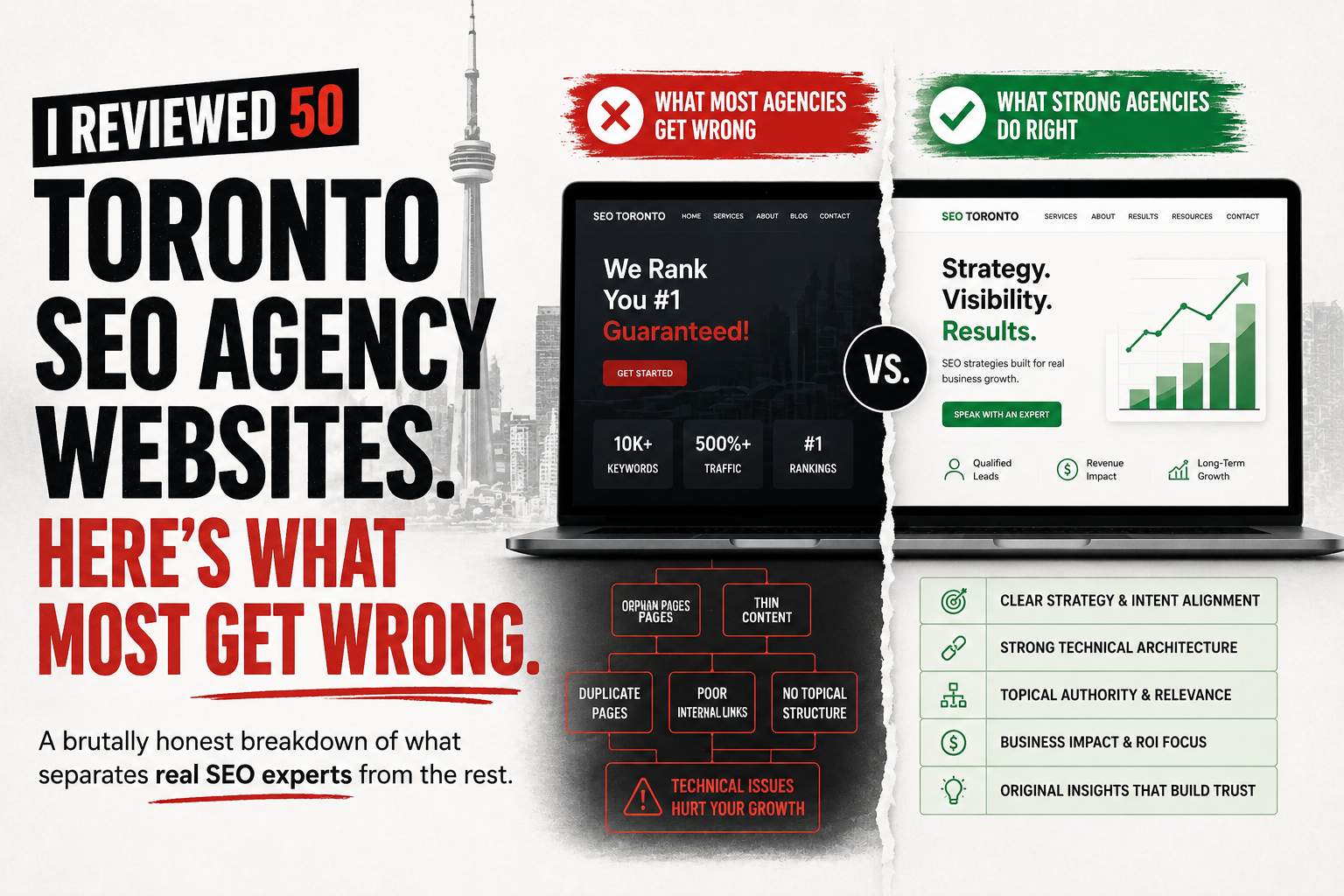
After reviewing dozens of Toronto SEO agency websites, I came away with a very different conclusion.
The gap between “looking like an SEO expert” and actually understanding search deeply is much wider than most business owners realize.
Many agency websites were polished. Some ranked well for competitive terms like “SEO Toronto” or “SEO agency Toronto.” A few had impressive client logos and sophisticated design systems.
Yet underneath the presentation, the same structural problems kept appearing repeatedly.
Ironically, many of the weaknesses these agencies claimed to fix for clients were visible on their own websites.
This is not about criticizing individual companies. There are genuinely strong SEO operators in Toronto. But if you are a business owner evaluating agencies, it helps to understand the patterns that separate surface-level SEO from strategic SEO.
Because good SEO is usually visible long before rankings appear.
You can see it in how an agency structures information, prioritizes search intent, handles technical architecture, and explains tradeoffs.
You can see how they think.
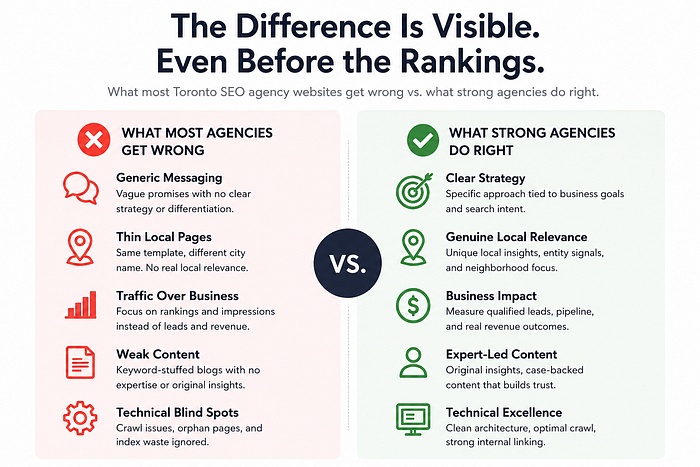
After reviewing dozens of Toronto SEO agency websites, the biggest differences were rarely visual. Strong agencies consistently demonstrated better strategy clarity, technical structure, local relevance, and business-focused SEO execution.
1. Thin Service Pages Targeting Every City Variation Imaginable
One of the most common patterns was mass-produced location pages.
Many agencies had near-identical pages targeting:
- SEO Mississauga
- SEO Vaughan
- SEO Markham
- SEO Richmond Hill
- SEO Oakville
The only meaningful difference was the city name.
From a search engine perspective, this creates obvious problems:
- duplicate topical intent
- weak local relevance
- diluted authority
- indexation waste
From a business perspective, it creates something worse: distrust.
Strong local SEO usually demonstrates genuine geographic understanding:
- local market nuance
- localized search behavior
- nearby entity relevance
- industry concentration
- neighborhood-specific intent
Most location pages showed none of that.
They existed purely because the keyword had search volume.
2. Agencies Claiming “Enterprise SEO” While Their Own Architecture Was Weak
This appeared constantly.
Agencies advertising advanced SEO services while their own websites suffered from:
- poor internal linking
- weak crawl depth
- disconnected service pages
- orphaned content
- shallow topical clusters
- bloated JavaScript rendering
A genuinely strong SEO website tends to reveal itself structurally.
You can usually identify experienced operators through:
- clean information architecture
- intentional internal linking
- clear search intent segmentation
- content hierarchy
- efficient navigation
- disciplined topical organization
Good SEO leaves fingerprints.
Weak SEO does too.
3. Blog Content Written Entirely for Keyword Insertion
This was probably the most obvious pattern across agency blogs.
The articles often sounded technically correct while saying almost nothing meaningful.
Common characteristics included:
- repetitive phrasing
- shallow explanations
- generic “SEO tips”
- no demonstrated experience
- no original insights
- excessive semantic padding
- obvious AI-assisted writing patterns
The issue is not AI itself.
AI can absolutely support content workflows effectively.
The problem is low-judgment publishing.
Many agencies are producing content at scale without adding perspective, operational experience, or strategic interpretation. The result is content that satisfies formatting expectations while failing to build trust.
Sophisticated readers notice this quickly.
Search engines increasingly do as well.
4. Confusing Traffic Growth With Business Growth
Many agencies emphasized:
- impressions
- keyword counts
- traffic charts
- ranking screenshots
Far fewer discussed:
- lead quality
- conversion behavior
- pipeline contribution
- acquisition economics
- customer intent
One law firm I worked with illustrates this problem perfectly.
They were heavily focused on improving rankings for broad personal injury keywords because competitors appeared dominant in search visibility.
But after reviewing analytics and intake behavior, the actual issue had little to do with rankings.
Their traffic volume was already sufficient to support growth.
The larger problems were:
- slow response time to inquiries
- weak consultation handling
- low trust positioning on landing pages
- poor alignment between search intent and case qualification
The solution was not “more traffic.”
It involved:
- improving conversion paths
- refining practice area positioning
- strengthening local intent pages
- aligning content with higher-value case types
Revenue improved without dramatic traffic growth.
This distinction matters because many businesses assume SEO failure means insufficient visibility.
In reality, traffic often masks operational inefficiencies for a long time.
5. No Clear Understanding of Search Intent
A surprising number of agency websites attempted to rank single pages for completely different intents simultaneously.
For example:
- SEO services
- web design
- PPC management
- social media marketing
- branding
- consulting
all consolidated onto one broad homepage.
This creates diluted topical relevance and unclear positioning.
Strong SEO strategies are usually built around intent separation.
Informational queries require different content structures than commercial or transactional queries.
Businesses evaluating agencies should pay attention to whether the agency demonstrates this understanding on its own site.
Get SERP Radius’s stories in your inbox
Join Medium for free to get updates from this writer.
Subscribe
Subscribe
Remember me for faster sign in
If their own positioning feels unfocused, client strategies often are too.
Press enter or click to view image in full size
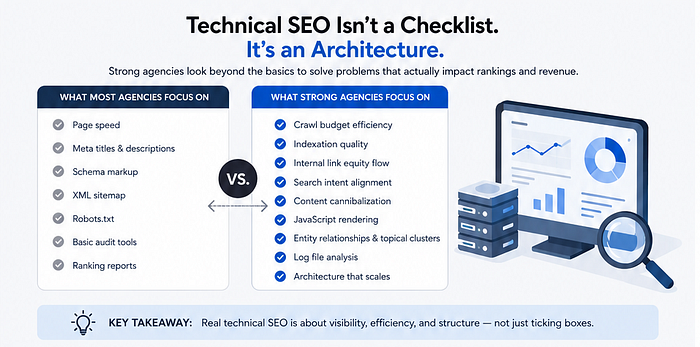
Most agencies reduce technical SEO to audits and plugins. Strong technical SEO focuses on crawl efficiency, authority flow, search intent alignment, and scalable site architecture.
6. Technical SEO Reduced to Checklists
Many agencies mentioned:
- audits
- page speed
- metadata
- schema
- Core Web Vitals
But very few explained:
- crawl budget efficiency
- internal authority flow
- indexation quality
- canonicalization complexity
- rendering behavior
- query intent overlap
- content cannibalization
- entity relationships
Technical SEO is often oversimplified because deeper explanations require real expertise.
Installing plugins is not technical SEO.
Running automated audits is not technical SEO.
Many businesses mistakenly assume technical sophistication because an agency uses technical terminology.
That is not the same thing.
7. Generic Case Studies With No Operational Specificity
This was another recurring pattern.
Many case studies showed:
- percentage growth charts
- keyword increases
- traffic screenshots
But omitted:
- competitive difficulty
- business context
- conversion impact
- lead quality
- timeframe constraints
- operational changes
- attribution complexity
Real SEO work leaves measurable operational fingerprints.
You can usually tell when case studies are exaggerated because the details become strangely vague.
Strong operators tend to discuss nuance:
- tradeoffs
- constraints
- failed experiments
- prioritization decisions
- intent challenges
- conversion implications
That level of specificity is difficult to fake.
8. Local SEO With Almost No Real Local Relevance
Many Toronto agency websites mentioned “local SEO” repeatedly while demonstrating very little local relevance themselves.
Some common issues:
- no meaningful Toronto-specific insights
- weak geographic entity associations
- generic location references
- thin Google Business Profile integration
- inconsistent citations
- no local trust indicators
Local SEO is not simply inserting city names into headings.
Strong local visibility usually emerges from layered relevance signals:
- localized authority
- geographic associations
- behavioral engagement
- contextual proximity
- review quality
- intent alignment
The agencies that understood this tended to communicate local search much more clearly.
9. Overdesigned Websites With Weak Strategic Depth
Ironically, many agency websites looked impressive visually while communicating very little substance.
Some relied heavily on:
- animations
- oversized claims
- generic marketing language
- “we grow businesses” messaging
- vague process diagrams
But when you tried to understand how they actually approached SEO strategically, the explanation disappeared quickly.
Businesses often assume polished design signals expertise.
Sometimes it does.
But in SEO specifically, clarity tends to matter more than appearance.
The strongest agency websites I reviewed were rarely the flashiest.
They were the clearest.
10. Most Businesses Evaluate SEO Agencies Incorrectly
This may be the most important observation.
Most agencies believe clients evaluate:
- technical sophistication
- advanced SEO knowledge
- ranking expertise
- deliverables
In reality, most businesses evaluate something else entirely.
They evaluate:
- trust
- clarity
- confidence
- responsiveness
- strategic intelligence
- communication quality
- business understanding
Most clients cannot independently verify advanced SEO competence.
So they infer competence indirectly.
This explains why some technically mediocre agencies grow extremely well commercially while stronger operators remain relatively invisible.
The agencies that stand out long term are usually not the ones producing the most content or promising the fastest rankings.
They are the ones capable of integrating:
- SEO
- positioning
- conversion psychology
- search intent
- information architecture
- operational understanding
- audience trust
into a coherent system.
Final Thought
One of the most overrated concepts in SEO right now is the idea that every ranking problem is a topical authority problem.
Many businesses do not lack content.
They lack:
- differentiation
- positioning
- conversion clarity
- operational alignment
- memorable brand signals
Search visibility without strategic distinction becomes fragile over time.
The agencies most likely to survive the next phase of search are not simply the ones publishing the highest volume of AI-assisted content.
They are the ones capable of understanding businesses beyond keywords

We providing the best ethical SEO Services In Toronto.
We offer organic search, on-page SEO, link building, keyword research, strategy and activity report services.