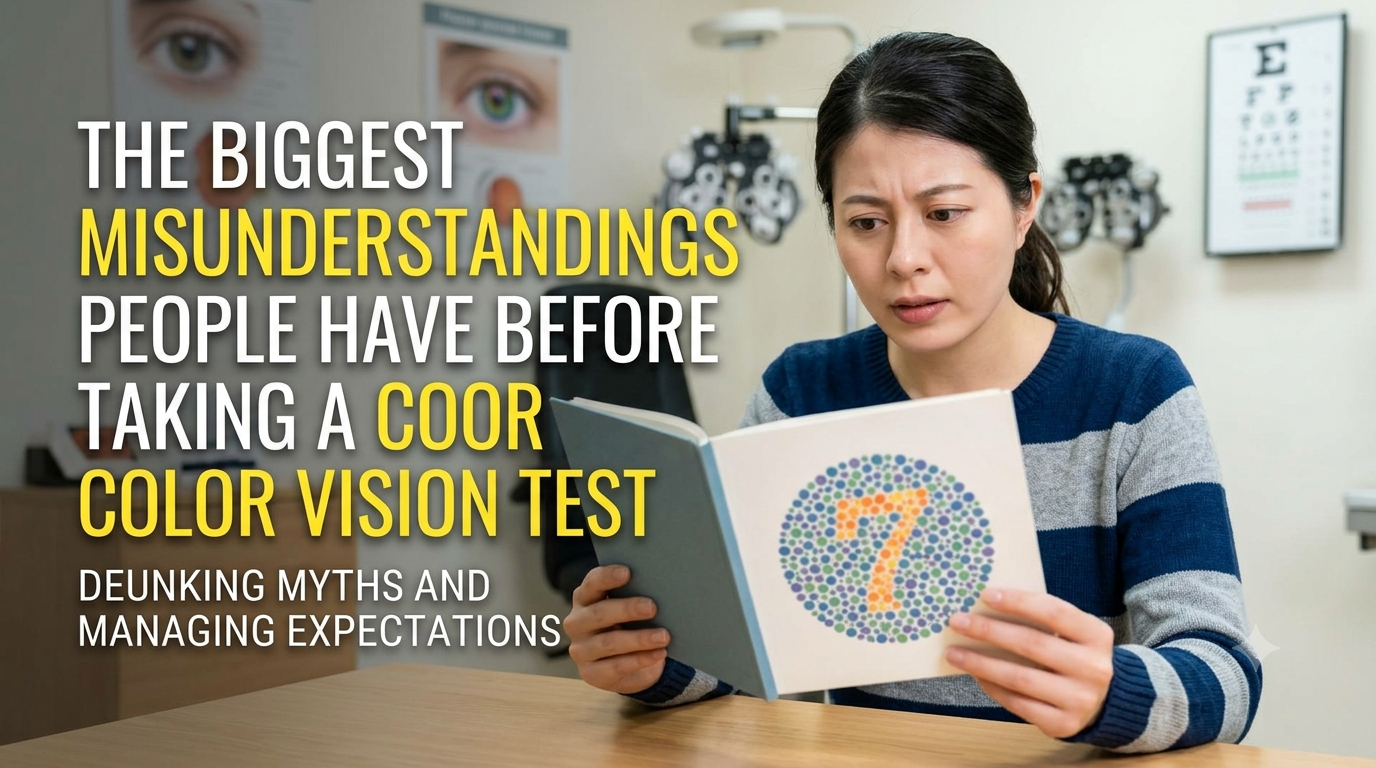
"What if I fail this?"
It is a surprisingly common thought for anyone sitting in a clinic waiting room, waiting for their name to be called. Anxiety starts to build, and suddenly, a simple assessment feels like a massive hurdle. You might start second-guessing your own eyesight, wondering if you have been seeing the world wrong your entire life.
Most of that stress comes from misunderstandings rather than reality. People often build up worst-case scenarios based on rumors or outdated information. When you do not know exactly what to expect, your mind fills in the blanks.
Walking into your appointment with the right information changes the entire experience. This guide clears up the confusion so you can approach your upcoming assessment with confidence instead of dread.
Why People Overthink Color Vision Tests
Fear of the unknown is a powerful thing. When you are asked to look at a series of colored dots and identify a hidden shape or number, there is a natural pressure to perform perfectly. This pressure multiplies when your job eligibility is on the line. For pilots, military personnel, and certain law enforcement roles, passing an eye exam is a strict career requirement.
Unfortunately, misinformation from friends or internet forums only makes things worse. You might read conflicting stories online or hear from a coworker about a highly specific, complex test that you may not even need to take. This lack of clarity on how the test actually works leads to unnecessary panic.
The Biggest Misunderstandings (And the Truth Behind Them)
It is time to separate fact from fiction. Here are the most common myths people believe before sitting down for their exam.
1. "If I’m Color Blind, I’ll Automatically Fail"
Many people think color vision is a simple binary: you either have perfect vision, or you are completely color blind. In reality, color vision deficiency exists on a wide spectrum.
Many modern assessments measure the specific degree of your deficiency, rather than just giving you a generic pass or fail. Someone might have a mild red-green deficiency but still see well enough to safely perform their daily duties. Because of this, many industries and roles allow for mild deficiencies, provided you meet a specific threshold.
2. "The Test Is Extremely Difficult"
A common fear is that the test is designed to trick you. People assume the colors will be incredibly obscure, or the patterns will be impossibly complicated.
The truth is much simpler. These exams usually involve basic number or shape recognition. The goal is to assess your natural perception, not to confuse you with optical illusions. If you have normal color vision, the numbers or shapes will stand out clearly. If you have a deficiency, the test simply helps the doctor understand exactly what you are seeing.
3. "I Can Prepare or Study for It"
Because we are trained to study for tests in school, many people assume they can practice for an eye exam and improve their results. You might even find websites offering practice modules.
However, this exam measures your natural, biological perception of light and color. It does not measure your memory or cognitive skills. You cannot train your eyes to see a color that your retinas do not process correctly. Trying to over-prepare or memorize color plates usually just increases your anxiety.
4. "Lighting or Screen Doesn’t Matter"
Some assume that looking at a color chart on a smartphone at home is just as accurate as visiting a professional clinic. They believe environmental conditions do not affect the results.
Proper lighting and calibrated screens are actually crucial for an accurate diagnosis. Glare, screen brightness, and room lighting can dramatically shift how a color appears. That is exactly why professional setups matter. A clinical environment ensures that the colors you are looking at are presented exactly as intended.
5. "All Color Vision Tests Are the Same"
It is easy to assume every clinic uses the exact same book of colored dots. In reality, different methods test different aspects of your eyesight. Some tests are far more advanced and accurate than others.
For instance, taking the Waggoner Color Vision Test Florida(https://www.pilotcolorvisioncenter.com/our-services/) residents rely on offers a highly precise, computerized evaluation. This is a massive step up from older, faded paper books. Understanding the specific type of assessment you are taking can help ease your mind.
6. "If I Fail Once, That’s Final"
The fear of permanent failure haunts many applicants. They worry that stumbling on a single test will permanently lock them out of their dream career.
Retesting, second opinions, and alternative assessments exist for a reason. Sometimes eye fatigue, poor lighting in a previous exam, or simply misunderstanding the instructions can lead to a false result. There are often secondary testing options available if your initial results do not meet a specific career requirement.
What the Test Is Actually Designed to Do
Clearing up the Misconceptions About the Waggoner Computerized Color Vision Test(https://www.pilotcolorvisioncenter.com/blog/top-misconceptions-about-the-waggoner-computerized-color-vision-test/) and similar assessments starts with understanding their true purpose. These exams are not designed to disqualify you. They are medical tools used to measure how you perceive specific color differences.
By analyzing your responses, doctors can identify both the type (such as red-green or blue-yellow) and the level (mild, moderate, or severe) of any deficiency. Ultimately, the results help determine your suitability for specific tasks, ensuring that you can safely navigate your work environment.
What You Should Actually Focus On Before the Test
Since you cannot study for a biological assessment, what should you do instead?
First, get proper rest. Eye fatigue is a real issue and can affect how well you focus during your appointment. Second, try your best not to stress or overthink the process. Keep your mind clear so you can simply react to what you see.
During the exam, listen closely to the doctor and follow the instructions carefully. Finally, make sure you choose a reliable testing environment. Going to a dedicated, professional center ensures your results will be accurate and legally recognized by employers or aviation boards.
What Happens After the Test
Once the assessment is over, the doctor will help you understand your results. Remember, this is rarely a simple pass or fail scenario. You will get a detailed breakdown of your specific visual capabilities.
Your next steps will depend entirely on the purpose of your visit. If you are testing for general awareness, you will leave with a better understanding of your own eyes. If you are testing for a specific job, the doctor will provide the necessary documentation to submit to your employer. If your results do not meet the strict expectations of a specific career, the doctor can discuss alternative assessments or specialized lenses that might assist you.
Walk In With Confidence
Most fears surrounding eye exams are rooted in myths, not facts. The process is entirely painless and straightforward. The assessment is there to accurately measure your perception, not to intimidate you or trick you.
Walking in informed completely changes the experience. You can leave your anxiety at the door and gain true clarity about your vision.
If you need an accurate, professional assessment, the team at Pilot Color Vision Center led by Dr. Weinberg is here to help. We provide a comfortable, state-of-the-art testing environment to ensure you get the precise results you need for your career or personal health.
Ready to schedule your exam? Call us today at (561) 248-4627 or email at aweinberg@medavex.org.

The black aura is one of the few predominantly negative auras.
It also represents the fear of limiting your power to transform the negative energies.
It tells us to find the true meaning of life and accept life as it is.
2] Love And Romance For A Black Aura
Black is a transitional color when we talk about love, relationship, and romance.
Due to the emotional stress, the black aura is displayed, and it does not mean you are a bad person to live with.
https://auracolors.net/black-aura-color-meaning-personality/