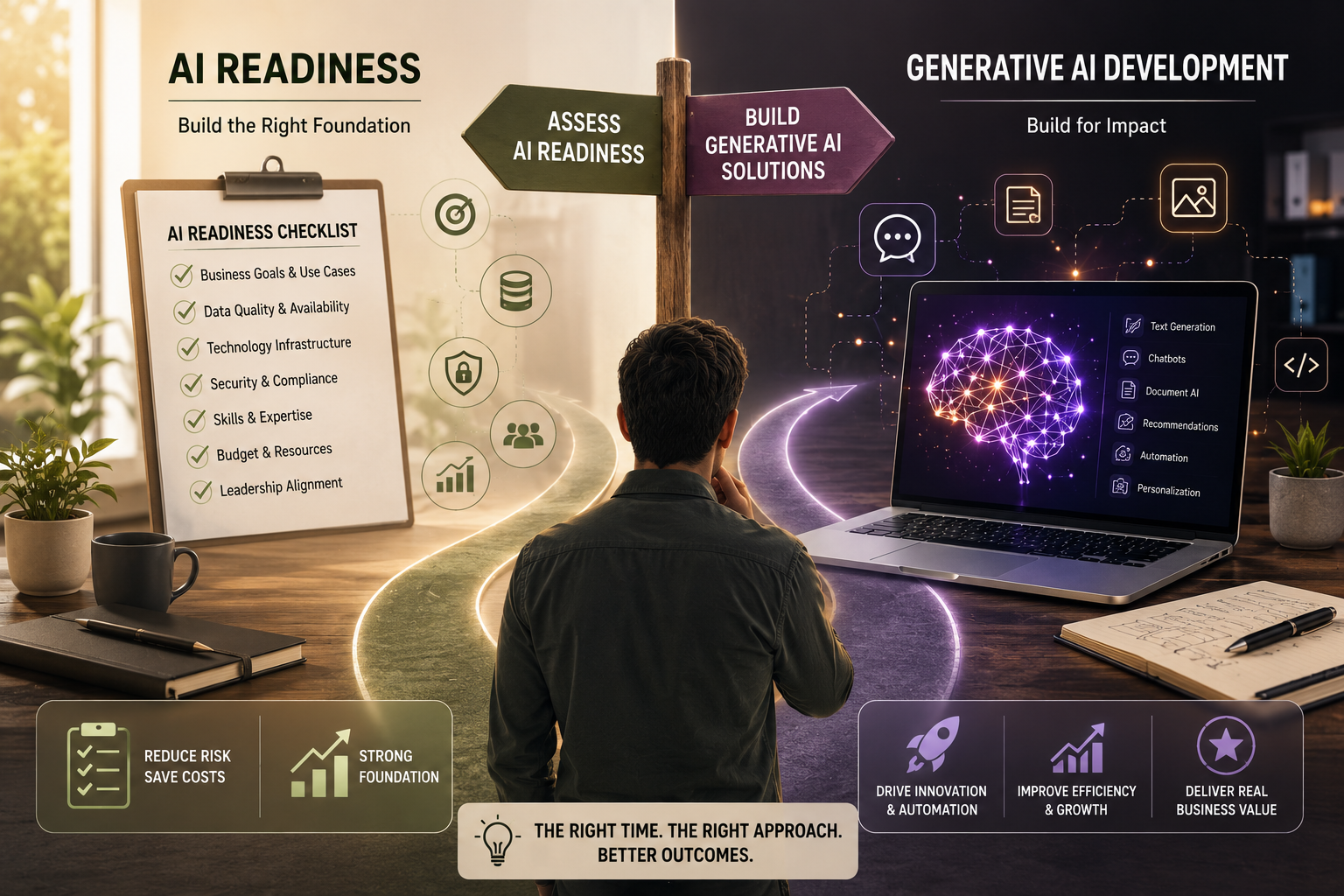
Artificial intelligence has become a strategic priority for organizations seeking greater efficiency, automation, and innovation. However, many businesses rush into implementation without understanding whether they are truly prepared for successful adoption. This is where the distinction between an AI readiness checklist and generative AI development becomes important.
While both play critical roles in an organization's AI journey, they serve different purposes. Understanding when to assess readiness and when to begin development can help companies reduce risk, control costs, and achieve better outcomes.
What Is AI Readiness?
AI readiness refers to an organization's ability to successfully adopt and scale artificial intelligence solutions. Before investing in technology, businesses should evaluate whether they have the necessary resources, processes, and infrastructure to support AI initiatives.
A comprehensive AI readiness checklist typically includes:
- Business objectives and use cases
- Data availability and quality
- Technology infrastructure
- Security and compliance requirements
- Internal expertise and skills
- Budget and resource allocation
- Executive sponsorship and stakeholder alignment
Organizations that complete an AI readiness checklist gain a clearer understanding of potential challenges before significant investments are made.
Why Readiness Assessment Matters
Many AI projects fail not because the technology is ineffective but because organizations lack the foundations required for successful implementation.
Common issues include:
- Poor data quality
- Undefined business goals
- Insufficient governance processes
- Lack of technical expertise
- Unrealistic expectations
An effective AI strategy begins with identifying these gaps early. By evaluating readiness first, companies can prioritize improvements and establish realistic implementation plans.
What Is Generative AI Development?
Once readiness has been established, organizations can move into generative AI development. This phase focuses on designing, building, deploying, and optimizing AI-powered solutions that generate content, automate workflows, support decision-making, or enhance customer experiences.
Examples include:
- AI chatbots and virtual assistants
- Content generation platforms
- Knowledge management systems
- Document processing solutions
- Personalized recommendation engines
- Internal productivity tools
Successful generative AI development requires technical expertise, high-quality data, robust infrastructure, and clearly defined business objectives.
Signs Your Organization Is Ready to Build
Not every business needs an extended assessment process. Some organizations already possess the resources required to begin implementation.
You may be ready for generative AI development if:
- Business goals are clearly defined
- Relevant data is available and accessible
- Leadership supports AI initiatives
- Security and compliance requirements are understood
- Technical teams can support deployment and maintenance
- Success metrics have been established
In these situations, moving from planning to execution can accelerate value creation and competitive advantage.
When to Focus on AI Readiness First
A readiness assessment should take priority when organizations face uncertainty regarding their capabilities or objectives.
Consider starting with an AI readiness checklist if:
- Data is fragmented across multiple systems
- AI use cases remain unclear
- Budget approval has not been secured
- Governance policies are still evolving
- Internal stakeholders have conflicting priorities
- Technical expertise is limited
Investing time in preparation often prevents costly mistakes later in the development process.
Building an Effective AI Strategy
A successful AI strategy connects readiness assessment with implementation planning. Rather than viewing these stages as separate activities, organizations should treat them as complementary components of a larger transformation effort.
An effective AI strategy typically includes:
- Business objective definition
- Readiness evaluation
- Use case prioritization
- Infrastructure planning
- Solution development
- Deployment and monitoring
- Continuous optimization
This structured approach improves alignment between business goals and technology investments.
Conclusion
Organizations often focus on implementation before determining whether they are prepared for success. While generative AI development delivers the capabilities that drive innovation and efficiency, readiness assessment establishes the foundation required for sustainable results.
Using an AI readiness checklist allows businesses to identify strengths, address weaknesses, and reduce implementation risks. Combined with a well-defined AI strategy, organizations can confidently decide when it is time to assess and when it is time to build.
The most successful AI initiatives are rarely the fastest to launch. They are the ones built on strong preparation, clear objectives, and a thoughtful path from readiness to execution.

Machine Learning is a Form of AI that Enables a System to Learn from Data.
Leverage Big Data & Understand Subtle Changes in Behavior with Oodles AI Machine Learning.
Oodle AI is one of the top AI and machine learnig development company that covers multiple services for variors busiiness verticles like Insurance, Marketing, Healthcare, Banking, etc.Explore our more Artificial intelligence services