


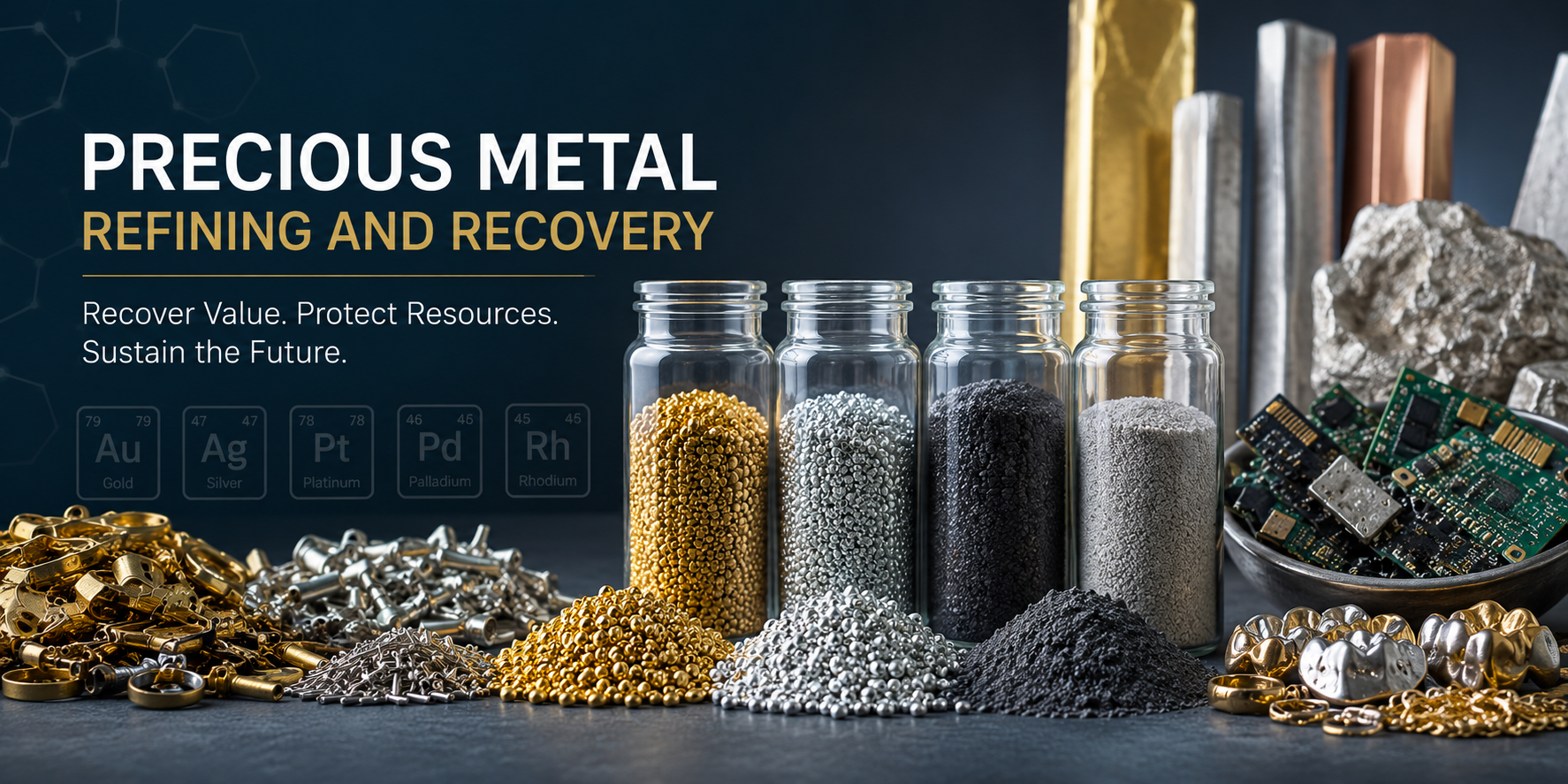
Every year, businesses lose out on significant profits, not because of poor sales or business strategies, but because of how they manage their materials. For many businesses, there’s real money to be made through the materials they would otherwise discard.
This is especially true when it comes to gold filings swept from a jeweler’s bench or palladium catalysts from an automotive production line. The potential to recover and earn a profit on these materials is large.
Precious metal refining separates, purifies, and recovers precious metals from materials that contain them in an impure, mixed state. Businesses are able to capture the value that exists within their industrial waste and byproducts because the value of the metal in industrial waste and byproducts is often greater than the costs associated with that waste.
From an environmental perspective, sustainable metal recycling also is important. As consumers and governments are increasingly looking for businesses to meet their demands for metal sourcing to be done responsibly, incorporating the recovery of metals within their operations gives these businesses a financial and a reputation advantage.
What Is Precious Metal Refining?
To refine precious metals to a commercially acceptable standard, precious metal refining is a combination of metallurgical and chemical processes. Through the processes of metal refining, base metals and other impurities are removed to leave a final product of metal in a state of greater than 99.9% purity.
The Role Of Assay Methods And Fire Assay
The analysis of incoming material to determine its composition and value prior to refining is a vital first step in the recovery of precious metals. One of the most dependable methods involving the isolation of gold or silver by means of fusion and subsequent cupellation is referred to as fire assay. Other methods, such as wet chemical analysis and X-ray fluorescence (XRF), are also available and are chosen based on the type of material and the required accuracy.
The Refining Process
Depending on the type of metals present, the refining process may involve acid parting, electrolytic refining, or solvent extraction. Despite the different methods, the aim is the same: to achieve the maximum recovery of precious metals while minimizing the loss to ensure that a business receives the true value of every gram of precious metal that has been submitted.
Precious Metals Commonly Recovered
Gold Refining and Silver Refining
Gold refining is the most widely practiced precious metal recovery process and is often derived from jewelry scrap, electronics, dental materials, and industrial byproducts. Businesses that regularly handle gold-bearing materials can benefit from specialized gold refining services designed for jewelers and pawnbrokers.
Platinum Refining and Palladium Refining
The refining of platinum is essential for industrial clients in the field of chemical processing and is also important for the automotive sector where high temperature performance is required. The refining of palladium is of recent and high value due to the widespread application of palladium in Catalytic Converters and electronics, making it one of the highest yield activities in the refining industry.
Rhodium Recovery
While the recovery of Rhodium is of low volume, it is of very high value, due to the widespread application of this precious metal, primarily in automotive systems for control of emissions and the prevention of air pollution.
Materials Businesses Can Profit From
Broken Jewelry and Precious Metal Scraps
Ceramic and metallic scrap from broken jewelry and off-cuts are some of the most valuable, and most common, recoverable materials. The dust from the benches of jewelers and polishers contains fine metal dust and can be collected. The dust from the floor of the workshops should be help for an assay before it’s disposed of.
Industrial and Catalyst Materials
Industrial scrap from electronics assembly and precision engineering, along with catalyst materials like spent catalysts loaded with platinum group metals, are high volume sources of precious metal value for manufacturers and processors.
Dental Scrap and Electronic Scrap
Dental scrap that includes crowns and bridges of gold and palladium offer even more opportunities to dental labs for recovering materials. And the scrap from electronics like circuit boards and processors are plentiful and valuable. Bullion in cast or bar form is also taken.
Industries that Leverage Precious Metal Recovery
Jewelry and Dental
Bench sweeps, polishing dust, and scrap gold all come from jewelry every day. Recovering and refining these materials helps improve margins and reduces the costs of raw materials. Dental labs work daily with high-value alloys, and every dental laboratory produces dental scrap, providing a steady stream of income and is often disregarded.
Manufacturing, Electronics, and Automotive
Manufacturing electronics produces a great deal of waste. The waste from electronics becomes a major source of profit when the scale of production increases. Automotive recycling is a profitable business model that occurs when the waste is a catalytic converter, which contains platinum, palladium, rhodium, and other valuable precious metals.
Coin and Pawn Shops
The items staff sees in pawn shops and coin dealers all contain precious metals in the forms of gold and silver. The items that staff cannot sell are often sent to a precious metal refining partner. Liquidation of these items are not profitable, as pawn shops often sell these precious items at a major loss.
How Businesses Generate Revenue from Refining
Spot vs. Metal
After performing the necessary assays to the materials, a business receives a metal settlement. The metal settlement is the overall weight loss of the precious metals multiplied by the current cost of precious metals for the day, less the refining costs. Companies can maximize the value by being aware of the current price of precious metals and timing the assay accurately before refining the precious metals.
Fast Payouts, Working Capital, and Liquidity
Yield recovery, referring to the extraction of a metal that one can obtain from a given ore, is a determining factor for profitability. When payments from credible refiners are made quickly, liquidity and, therefore, the working capital position, is improved. This allows companies to quickly reinvest the recoveries. For companies struggling with cash flow, the transformation of their scrap into cash on a regular and reliable basis is important to their operations.
Factors That Affect Refining Profitability
Assay Accuracy and Recovery Rates
Assay accuracy is crucial, as poor metal analysis results in settlements that undervalue the submitted quality of the metals. Recovery rates also depend on the given refiner, and even a slight difference in the recovery rate for platinum or gold can result in substantial losses for the given volume.
Refining Fees, Settlement Terms, and Turnaround Time
Refining charges, the duration of the refining process and the terms of settlement all contribute to the realized net return. Refiners that maintain an open book policy on their pricing enable businesses to calculate the expected net returns in advance and not to be surprised at the settlements. The payment means, and the availability of multiple means, enable businesses to determine when they wish to realize the recoveries.
Choosing the Right Precious Metal Refining Partner
Refining Services, Secure Shipping, and Insured Logistics
This is an important decision that any business can make, choosing the correct service provider. For a complete service, the refinery should have secure methods of shipping and insured logistics that will safeguard the materials in transit to the refinery. Any loss while in transit will decrease the recovery and thus the profits the business makes.
Standards of Compliance and Analysis Services
From both legal and commercial standpoints, compliance standards are key. The best and most reliable refining partners are honest, rule-abiding, and incorporate analytical services that offer full visibility of the materials and the anticipated settlements. The evaluation of scrap metal should not be an analytical gamble.
Sustainability Benefits of Precious Metal Recovery
Sustainable Recycling and the Circular Economy
The global pivot to a circular economy means that instead of extracting precious metals from the earth, they can be ‘mined’ from recycled goods. Instead of precious metals being ‘lost’ forever, they can simply be put back into the supply chain. This is not only cost-effective and efficient, but is also sustainable as it shrinks the environmental footprint of production.
Similar to newly mined precious metals, recycled metals have the same purity and market value.
Sustainable businesses that focus on the recovery of precious metals contribute to the conservation of resources.
Common Challenges in Precious Metal Recovery
Metal Loss Prevention and Contamination Control
Proper procedures must be involved in the collection and transport of wastes to the recovery centers in order to minimize losses. Also, contamination control is essential. When foreign materials are mixed into scrap, it not only reduces recovery rates, but also complicates the recovery process. This is why it is necessary that businesses train their employees to segregate the wastes properly.
Scrap Metal Valuation and Process Efficiency
Evaluating scrap properly requires good partners to do assays and a basic knowledge of the range of each material type. Effectiveness of the entire process (collection, packaging, shipping, and settlement) is what affects the bottom line. The businesses that focus on process simplification realize the most value with the least cost.
Key Takeaway for Businesses
The recovery and refining of precious metals encompass one of the easiest and most advantageous methods of growth within the metal recovery ecosystem. Through the organized collection, manaement, and processing of rejected materials, companies operating within various sectors including jewelry, dentistry, electronics, and automotive, have the opportunity to unlock revenue that would otherwise remain untapped.
The cumulative cost reductions realized through recovery and refining are tangible. Each gram recovered reduces the company’s dependency for newly sourced raw materials and strengthens its financial margins. Integrating recovery for precious metals into business operations creates a positive long-term financial, social, and environmental case. It also 'future-proofs' the company in a world of ever-growing conscious consumption and resource efficiency. Whether you are at the start of an exciting journey of small-scale recovery and refining of scrap gold, or a company with a well-developed recovery operation, partnering with Mid-States Recycling can help maximize recovery rates, streamline settlements, and improve overall profitability.


CoinBazaar is a niche e-commerce platform for buying Silver and Gold coins, and Platinum bars, etc.
Priyesh Shah, Co-founder of CoinBazaar.in, explains, "We are the aggregators for various bullion selling brands and personally manage end-to-end operations.
The company's expertise and reach has led to investments from both domestic and NRI customers.
The company believes that with the coming of online payment initiatives and gateways, purchase of precious metal coins will further increase in the next few years.
CoinBazaar started operations in 2012, when e-commerce was booming in India, with a few niche and known customers.
Trust was built in the market with transparency in product pricing, reputable brands, insured delivery and lifetime buy-back guarantees.