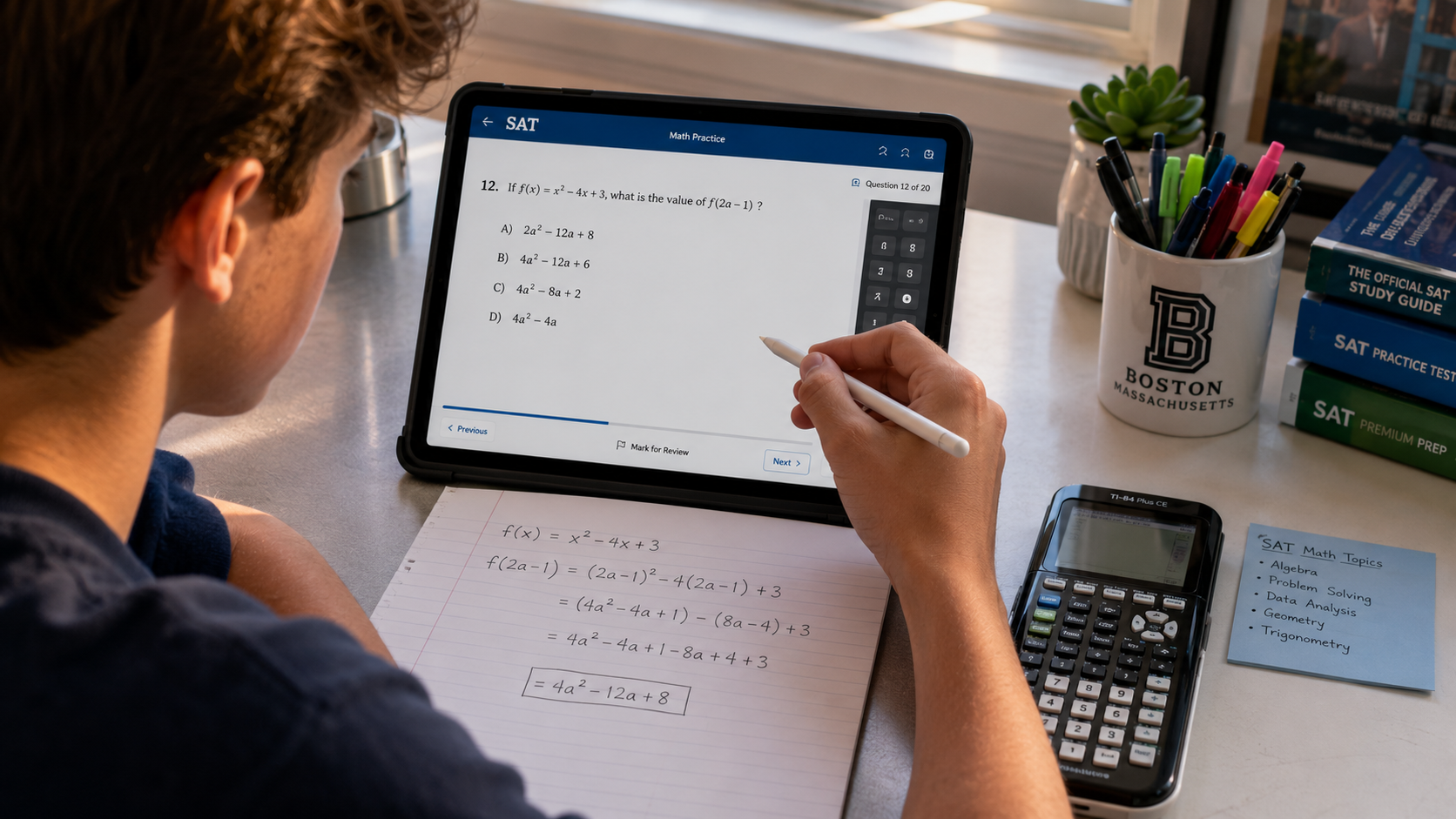
A focused SAT math practice test will tell you more about your score potential in two hours than a month of textbook drilling. The trick is knowing which question types matter most and where the easy points are hiding. The math section on the digital SAT has a predictable spread. If you know that spread, you can plan your prep around it instead of grinding through every topic equally.
Here is the question-type breakdown that matters, plus the way to attack each one when you sit your next practice test.
What the Digital SAT Math Section Actually Looks Like
The digital SAT math section has two modules. Each is roughly 22 questions in around 35 minutes. The first module is fixed difficulty. Your performance there decides whether the second module is easier or harder. That single mechanic changes how you should approach the test.
In Module 1, you cannot afford easy slips. Every careless mistake pushes you into the lower-difficulty Module 2, which caps your score. Slow down on the first ten questions. Speed up only when your accuracy is solid.
The Four Question Types That Carry Most of the Score
College Board groups SAT math into four content areas. They are not equal in weight. Knowing the spread is half the strategy.
Algebra: roughly 35% of the section. Linear equations, systems, inequalities.
Advanced Math: roughly 35%. Quadratics, polynomials, exponential functions.
Problem Solving and Data Analysis: around 15%. Ratios, percentages, units, data interpretation.
Geometry and Trigonometry: around 15%. Triangles, circles, basic trig.
If your last practice test score was uneven, look at where your wrong answers cluster. Many students leak points in Algebra not because the topic is hard but because they rush the easy questions in Module 1.
How to Use a Practice Test as a Map
Sit one full SAT math practice test under timed conditions. Once you have your score, sort every wrong answer into one of four bins:
Concept gap: you did not know the topic or formula.
Setup error: you understood the topic but set up the equation wrong.
Calculation slip: you set it up correctly but made an arithmetic mistake.
Time pressure: you would have got it right with more time.
The fix is different for each bin. Concept gaps need short lessons. Setup errors need targeted drills with worked examples. Calculation slips need calculator hygiene. Time pressure needs pacing practice.
If you want each bin matched to a structured set of drills rather than guessing, use guided SAT math practice that sorts questions by both topic and difficulty so you can target weak areas precisely.
The Desmos Calculator Trick
The digital SAT gives you Desmos inside the testing app. Most students underuse it. For any system of equations, graph both lines and read the intersection. For quadratics, graph and read roots directly. This saves time and reduces algebra errors. Practise this on every practice test so it becomes reflex.
Common Patterns in Wrong Answers
Wrong answer choices on the SAT are not random. They are designed around common student mistakes. If you forget to flip the inequality, one of the wrong answers is waiting for you. If you confuse x intercepts with y intercepts, that answer is also there. When you review, ask yourself which mistake the test maker was hoping you would make.
Pacing on Module 1
Aim for around 90 seconds per question on average. If a question is taking longer than that, mark it and move on. Come back if there is time. Never leave a question blank, since there is no penalty for guessing.
Quick Recap
Module 1 accuracy decides the difficulty of Module 2 — protect those early questions.
Algebra and Advanced Math together make up about 70% of the section.
Sort your wrong answers into concept, setup, slip, or time bins.
Use Desmos for systems and quadratics to save time.
Pace at about 90 seconds per question, never leave anything blank.
A SAT math practice test is only useful if you turn the data into a plan. Take one, sort your errors, fix the biggest leak, and repeat. The score curve will move.