


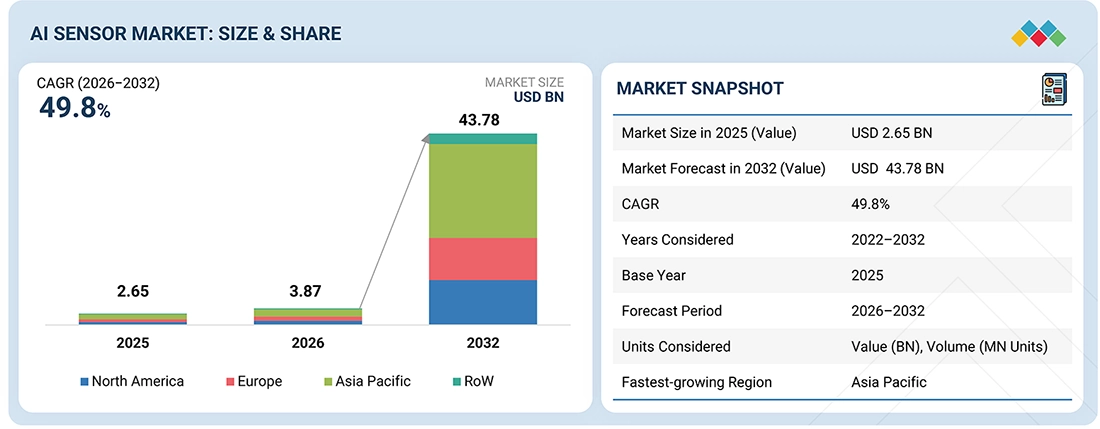
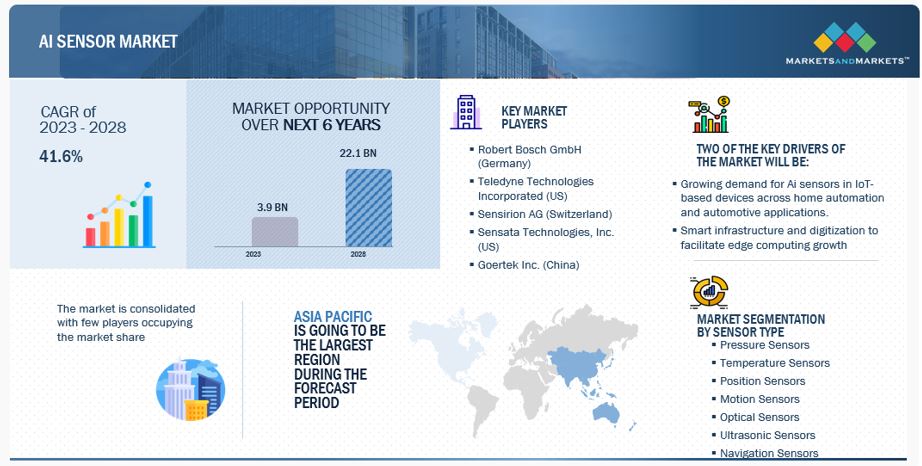
The report "AI Sensor Market by Sensor Type (Motion, Ultrasonic, Image, Radar, LiDAR), By Technology (Machine Learning, Natural Language Processing, Computer Vision), and By Architecture Type (Standalone AI Sensing, Sensing Fusion System) - Global Forecast to 2032", is projected to reach USD 43.78 billion by 2032, growing from USD 3.87 billion in 2026, registering a CAGR of 49.8% during the forecast period.
The AI sensor market is expanding as demand rises for edge AI and real-time on-device inference across autonomous systems, industrial automation, and smart devices. Growth is also supported by increasing use of AI-enabled consumer electronics such as wearables, hearables, XR devices, and smart home products, where local processing improves speed and user experience. In automotive applications, AI sensors are gaining traction in ADAS, driver monitoring, and in-cabin sensing. In addition, Industry 4.0 use cases such as machine vision, predictive maintenance, and automated inspection are accelerating adoption across manufacturing environments.
Download PDF Copy:
https://www.marketsandmarkets.com/pdfdownloadNew.asp?id=122565258
The LiDAR sensor segment is expected to witness the fastest growth during the forecast period.
By sensor type, the LiDAR sensor segment is expected to witness the fastest growth during the forecast period because these sensors provide highly accurate depth sensing, object detection, and spatial mapping in real time. Their ability to support edge-based intelligence makes them especially valuable in autonomous vehicles, robotics, industrial automation, and smart infrastructure, where precise environment awareness is critical. As demand increases for safer ADAS functions, advanced navigation, and reliable 3D perception, LiDAR AI sensors are becoming a preferred choice over conventional sensing technologies. Ongoing improvements in miniaturization, cost efficiency, and integration with AI algorithms are further strengthening their adoption across high-growth applications.
The automotive & mobility segment is expected to remain the largest segment through 2032.
By application, the automotive & mobility segment is expected to remain the largest application segment in the AI sensor market by 2032 because vehicles increasingly depend on intelligent sensing for safety, automation, and real-time decision-making. AI sensors are widely used in ADAS, driver monitoring, in-cabin sensing, parking assistance, and autonomous driving functions, where fast and accurate interpretation of the surrounding environment is essential. Additionally, the growing adoption of electric vehicles, connected vehicles, and higher levels of vehicle automation is further increasing sensor demand. Moreover, automotive systems require reliable edge processing with low latency, making AI sensors a critical component across both premium and mass-market vehicles.
The machine learning segment is expected to dominate the market during the forecast period.
By technology, the machine learning segment is expected to remain the largest technology segment in the AI sensor market during the forecast period because the technology enables sensors to recognize patterns, adapt to changing conditions, and generate actionable outputs with minimal human intervention. Compared to rule-based or highly specialized techniques, machine learning offers greater flexibility, broader applicability, and stronger performance across edge AI use cases such as automotive sensing, industrial automation, and smart consumer devices. Its ability to continuously improve inference accuracy and support real-time decision-making makes it the preferred technology backbone for advanced AI sensors across industries.
Asia Pacific to account for the largest share of the AI sensor market.
Asia Pacific is expected to remain the largest regional market for AI sensors during the forecast period, supported by strong manufacturing activity, rapid digitalization, and broad adoption of edge AI technologies. Countries such as China, Japan, South Korea, and India are seeing rising deployment of AI sensors across consumer electronics, automotive, industrial automation, and smart infrastructure applications. The region benefits from a large electronics manufacturing base, growing investment in smart factories and connected devices, and increasing demand for real-time sensing in cost-sensitive and high-volume end markets. These factors together are strengthening Asia Pacific leadership in the global AI sensor market.
Request Sample Copy of Report:
https://www.marketsandmarkets.com/requestsampleNew.asp?id=122565258
Top Key Players
Key companies operating in the AI sensor market are Bosch Sensortec (Germany), Sony Semiconductor Solutions Corporation (Japan), OMNIVISION Technologies, Inc. (US), onsemi (US), Ambarella, Inc. (US), Prophesee S.A. (France), AIStorm, Inc. (US), Teledyne Technologies Incorporated (US), TDK Corporation (Japan), among others.

The Global AI Sensor Market is an emerging market in the Semiconductor & Electronics sector at present years.
The report covers the present and past market scenarios, market development patterns, and is likely to proceed with a continuing development over the forecast period.
The Global AI Sensor Market research report offers an in-depth analysis of the global market, providing relevant information for the new market entrants or well-established players.
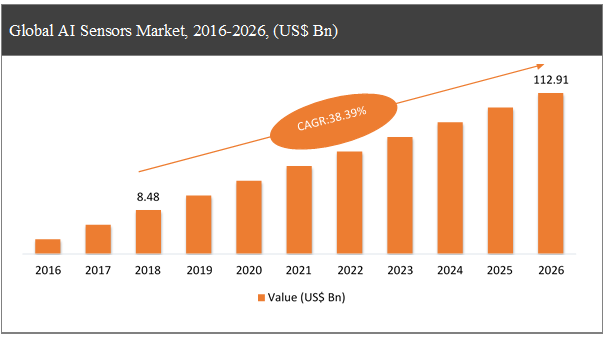
Some of the key strategies employed by leading key players operating in the market and their impact analysis have been included in this research report.AI sensors market is expected to reach US$ 112.91 billion in 2026, growing at a CAGR of 38.39% during the forecast period 2021-2026The report contains some of the valuable information with regards to their outlook, in terms of their finances, product portfolios, investment plans, and business and marketing strategies.
Moreover, the report also comprises of the SWOT analysis, a business overview, and revenue generation information of the industry pioneers in the Global AI Sensor Market.Get a sample copy of research study @ https://www.alltheresearch.com/sample-request/250Scope of the Report:The Global AI Sensor Market report provides an overview of the AI Sensor industry by studying various key segments and sub-segments, on the basis of specification, application, end-users, and geography.
The geographical analysis of the Global AI Sensor Market is on a global and regional scale, the result of which is used to evaluate the performance of the global market over the forecast period.Some of the leading competitors functioning in this market are: Augury Systems, Siemens AG, Glassbeam, Maana, PointGrab, Sentenai, Tellmeplus, Tachyus, Versos Systems, United Technology among others and OthersElectrical and electronics segment expected to grow at the fastest rate of 52% CAGR during the forecast periodThe report focuses on the key developments in the global AI Sensor market, especially in North America, Europe, Asia Pacific, Latin America, and the Middle East and Africa.