


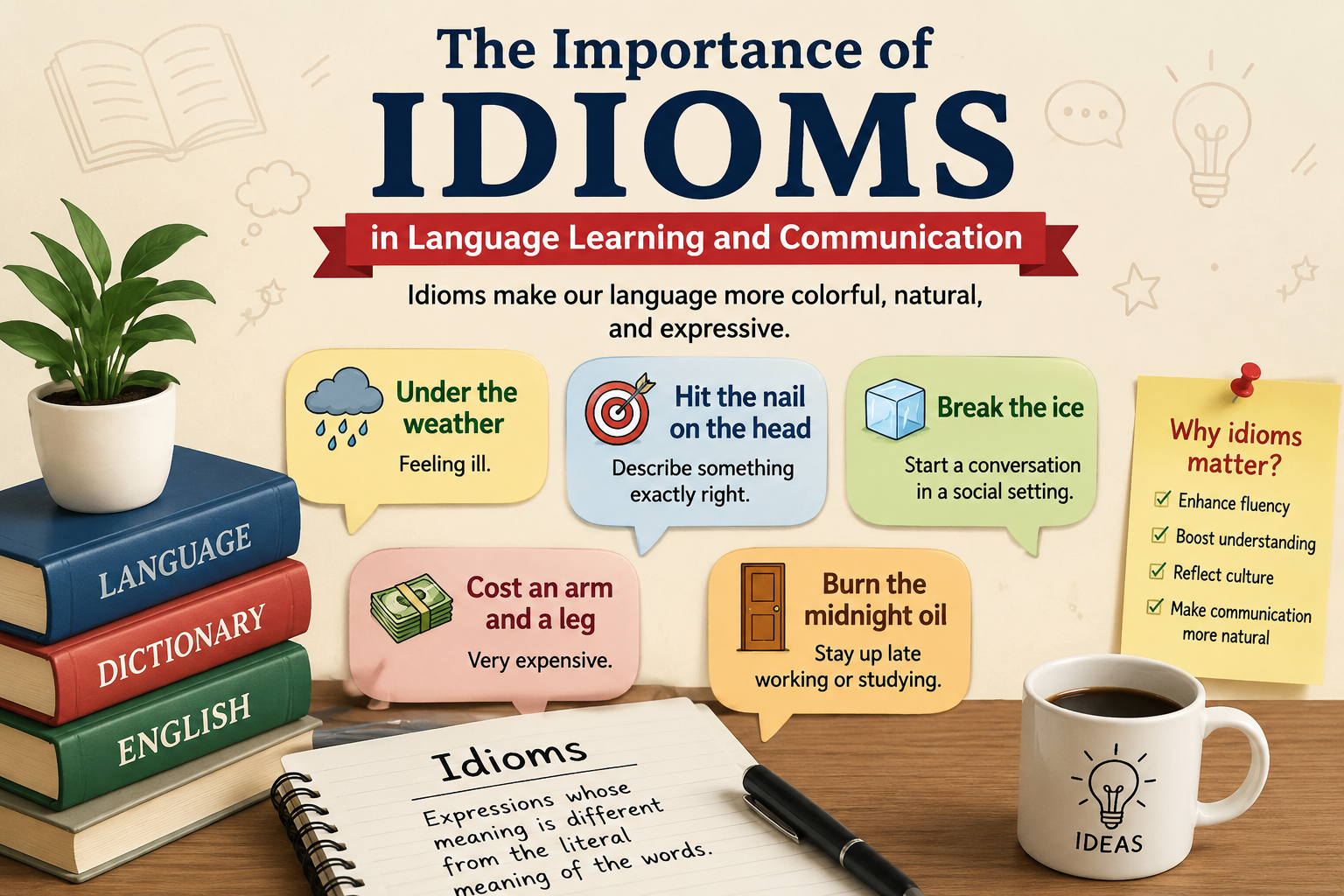
Language is more than a collection of words and grammatical rules. It is a living system filled with expressions that add color, emotion, and creativity to communication. Among the most fascinating elements of language are idioms and phrases. These expressions are used every day in conversations, books, movies, news reports, and professional settings. Understanding them can significantly improve a person's ability to communicate effectively and naturally.
What Are Idioms?
An idiom is a group of words whose meaning cannot be understood simply by interpreting the individual words. Instead, the expression has a figurative meaning that is recognized by native speakers.
For example, when someone says they have "hit the jackpot," they usually do not mean they literally won a lottery. The expression often means they have achieved great success or received an unexpected benefit. Similarly, a person who is "at a crossroads" is not necessarily standing where two roads meet; the phrase often refers to a situation where an important decision must be made.
Idioms are common in everyday speech because they allow people to express complex ideas in a concise and memorable way.
What Are Phrases?
A phrase is a group of words that work together as a unit within a sentence. Unlike idioms, many phrases can be understood from the meanings of their individual words. However, some phrases develop specialized meanings through repeated use.
For example, expressions such as "in the long run," "by and large," and "for the time being" are commonly used phrases that help speakers communicate ideas clearly and efficiently. While some phrases are literal, others may carry figurative meanings similar to idioms.
Why Idioms and Phrases Matter
Idioms and phrases play an important role in communication. They make language more expressive, engaging, and natural. Without them, speech and writing can sound overly formal or mechanical.
These expressions also help speakers communicate emotions, attitudes, and experiences more effectively. A phrase such as "break the ice" instantly conveys the idea of making people feel comfortable in a social situation. Likewise, "once in a blue moon" communicates rarity more vividly than simply saying something happens very infrequently.
For language learners, mastering idioms and phrases is often one of the final steps toward achieving fluency.
The Origins of Idioms
Many idioms have fascinating historical origins. Some come from literature, while others originated in sports, business, agriculture, religion, or maritime traditions.
For example, certain expressions trace their roots to ancient myths, historical events, or famous works of literature. Over time, these expressions became part of everyday speech, often outliving the original contexts that created them.
Studying the origins of idioms provides insight into the history, culture, and values of the people who used them.
Challenges for Language Learners
Idioms can be difficult for learners because their meanings are not always obvious. A literal interpretation may lead to confusion or misunderstanding.
For example, a learner encountering the expression "spill the beans" might imagine someone dropping food. In reality, the phrase commonly means revealing a secret. Because of this, idioms usually need to be learned as complete expressions rather than translated word for word.
Regular reading, listening, and practice are among the best ways to become familiar with idiomatic language.
Using Idioms and Phrases Effectively
While idioms can enrich communication, they should be used appropriately. Excessive use may confuse readers or listeners, especially in international or professional contexts where participants come from different linguistic backgrounds.
The most effective approach is to use idioms naturally and only when they enhance clarity or add emphasis. Understanding the audience is also important, since not everyone may be familiar with every expression.
Conclusion
Idioms and phrases are among the most colorful and expressive features of language. They help people communicate ideas, emotions, and experiences in memorable ways while reflecting the history and culture of those who use them. Whether you are a native speaker, a student, or an English learner, developing a strong understanding of idioms and phrases can greatly improve your communication skills and deepen your appreciation of language itself.
Take free online English language lessons and classes to improve your English grammar, composition, conversation and writing skills.
Learn effective English communication skills with online classes and courses English program for children by level featuring animated video lessons, fun games for kids, interactive tests to help teachers run kids English classes.
Activities and lessons for young learners of English.
Includes reading for kids, fun with the alphabet, learn about colours and more.
Learn online English grammar classes and composition to enhance your reading, writing and speaking skills from Eye Level East Cobb.