


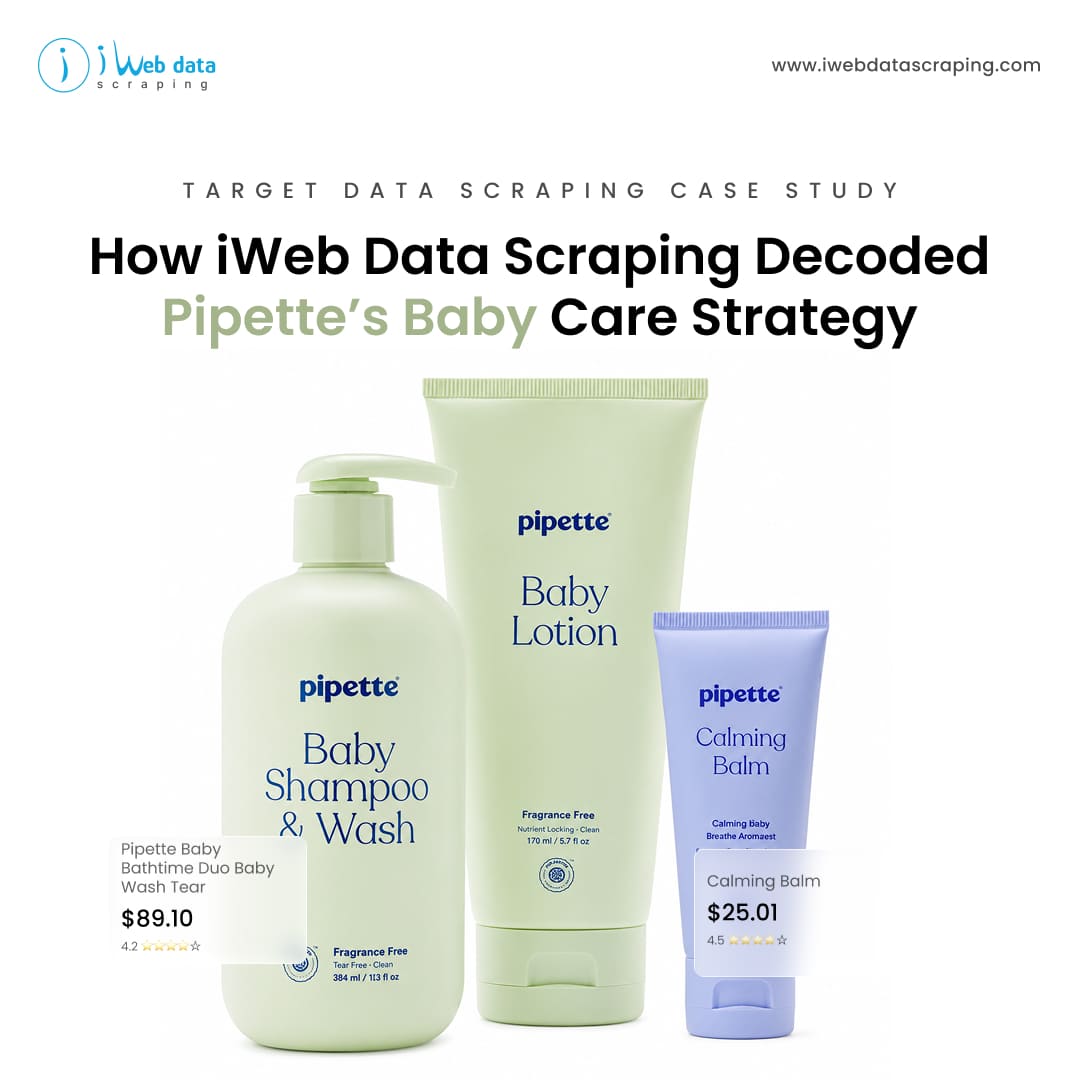
Target Data Scraping Case Study: How iWeb Data Scraping Decoded Pipette’s Baby Care Strategy
See how iWeb Data Scraping used Target data scraping to decode Pipette’s baby care strategy — pricing, reviews, and stock velocity insights.
8,187
REVIEWS ANALYSED
20
PRODUCTS TRACKED
~60%
VOLUME FROM 3 SKUs
$13.51
AVG PRICE POINT
Who This Case Study Is For
If you make decisions about pricing, assortment, stock, or competitive positioning at a major retailer, this case study is written for you. It is built specifically for:
Brand and category managers planning launches or defending shelf share at Target.
Pricing and revenue analysts benchmarking competitor price ladders and bundle strategy.
Retail buyers and merchandisers spotting velocity signals and stock-out risks before they hit reorder cycles.
eCommerce and DTC founders deciding which categories to enter or double down on.
Investors and corporate strategy teams running due diligence on consumer brands.
If your role touches any of the above, the rest of this page shows exactly how iWeb Data Scraping delivers the numbers behind those decisions — and how you can request a working sample to evaluate the output yourself.
Executive Summary
When a clean-beauty brand like Pipette competes on Target.com, success is never the result of a single product going viral. It is the outcome of a small, carefully chosen catalog working as a coordinated system — priced, positioned, and reviewed with intent. The challenge for competing brands, buyers, and category managers is simple: that system is almost invisible from the outside. Prices, reviews, and stock levels are scattered across dozens of pages and change constantly.
This Target data scraping case study shows how iWeb Data Scraping converted thousands of fragmented Target.com listings into one clean, structured dataset — and how that dataset revealed exactly how Pipette plays in the premium baby care aisle. The analysis surfaced the brand’s pricing ladder, its category concentration, its volume-driving hero products, and the live stock signals that betray where real sell-through is happening. More importantly, it produced a repeatable model: any brand can use the same web scraping approach to benchmark competitors, refine pricing, and protect shelf share with evidence instead of guesswork.
The Challenge
Why Target Brand Data Is Hard to Get
Most brands already suspect what they need to know about a competitor. They rarely have the evidence to act on it. Target product pages publicly display price, reviews, ratings, and stock indicators, but that information is fragmented across dozens of URLs, refreshes by the minute, and is actively defended against automated collection.
Anyone who has tried to build a competitor dataset by hand knows the friction. Prices shift across regions and thousands of zip codes. Listings appear, sell out, and disappear without notice. Raw HTML is messy and inconsistent from one page template to the next. A scraper that worked perfectly yesterday can break overnight after a quiet layout change, and nobody notices until the numbers are already wrong.
The cost of this is not only wasted time. Decisions built on stale or incomplete numbers — a price change, a stock bet, a new product launch, an investor pitch — carry real financial risk. Reliable Target data scraping exists precisely to remove that risk. It replaces best guesses with a verified ground truth that refreshes on a schedule the business controls, so the picture is never out of date when a decision has to be made.
DIY Scraping vs iWeb Data Scraping
Most teams attempt some version of retail data collection in-house before partnering with a specialist. The comparison below sets out where the practical differences land:
Setup Time: In-house solutions require 4–12 weeks of engineering, while iWeb delivers the first dataset in 48–72 hours.
Anti-Bot Handling: DIY teams face IP bans and CAPTCHAs, whereas iWeb manages proxies and rotation automatically.
Layout Changes: In-house pipelines are prone to silent failures and stale data; iWeb provides monitored pipelines with auto-alerts.
Data Validation: Manual spot checks can be inconsistent, while iWeb uses automated deduplication and validation rules.
Refresh Cadence: Internal teams are limited by capacity; iWeb supports hourly, daily, or custom refresh schedules.
Output Format: DIY efforts often produce raw HTML or messy exports, while iWeb delivers analysis-ready CSV, JSON, API, or database formats.
Total Cost: In-house ownership includes engineering salaries and infrastructure, whereas iWeb offers predictable project-based pricing.
The cost calculation is almost never about scraper code. It is about the months of engineering time, the silent failures nobody catches in time, and the decisions made on stale data because the in-house pipeline broke last Thursday.
Focus
The Brand in Focus: Pipette on Target
Pipette built its reputation on clean, plant-derived formulas for newborns and parents — a positioning that competes directly with both legacy baby brands and premium clean-beauty challengers. On Target.com, that positioning shows up as a tight, intentional catalog rather than a sprawling one: a small range of products that each carry real demand and real review weight.
For this case study, iWeb Data Scraping treated Pipette as a live example of an accessible-premium baby care brand and asked one straightforward question: if a competitor wanted to understand exactly how Pipette is winning at Target, what would the data have to show them? Answering that required far more than a product list. It required structured eCommerce data covering pricing, review depth, category mix, rating distribution, and live stock levels — the same signals a strategy team studies before entering or defending a category at a major retailer.
Our Approach
How iWeb Data Scraping Built the Dataset
iWeb Data Scraping approached the project the way it approaches every retail intelligence engagement — define the questions first, then build the dataset to answer them. The team began by identifying every active Pipette listing on Target.com, then extracted a consistent set of fields from each one.
For every product, the Target data scraping pipeline captured the product title, TCIN, category, current price, star rating, total review count, listed stock indicator, and whether the placement was an individual SKU or a bundle. Because Target prices and stock levels move continuously, collection was scheduled to refresh on a fixed cadence rather than captured once — a single snapshot would have been outdated within hours.
Every record then passed through validation rules that flagged missing fields, impossible values, and duplicate listings before anything reached the final dataset. This is the step that separates dependable retail data from a noisy export. The output was not raw HTML or a pile of screenshots. It was a clean, analysis-ready table — the kind of product data extraction result a pricing analyst or category manager can open and use the same day it lands.
Finding 01
The 30,000-Foot View
The first thing the data made clear is that Pipette competes on focus, not volume. The brand maintained a compact catalog of 20 active products on Target.com at an average price point of $13.51 — a number that sits firmly in accessible-premium territory for the baby care aisle.
Across that small catalog sat 8,187 customer reviews spread over 7 categories, with an average rating of 3.55 out of 5. For a competing brand, this combination is the headline insight. Pipette is not trying to flood the shelf with options and win on choice. It is sustaining real review volume and accessible-premium pricing on a deliberately narrow range — one of the clearest signals of genuine product-market fit that Target product data can reveal.
Finding 02
What’s Driving the Volume
The second finding came from grouping reviews by product. Customer engagement was not spread evenly across the catalog — it was extraordinarily concentrated. Just three shampoo SKUs together drove nearly 60% of the brand’s total review volume on Target. The Baby Shampoo + Wash line is, in the truest sense, the heavyweight of the catalog.Fragrance-Free Shampoo + Wash: 1,672 reviews (~20% share), serving as the brand’s primary hero SKU.
Vanilla + Ylang Ylang Shampoo: 1,560 reviews (~19% share), driving strong customer engagement.
Sweet Wildflower Shampoo: 1,518 reviews (~19% share), reinforcing demand within the shampoo segment.
Review scraping at the individual SKU level surfaces exactly this kind of pattern — the listings a competitor would need to study, target, or out-position first. Without product-level data extraction, three category-defining heroes like these stay hidden inside a flat catalog list.
WANT TO SEE WHAT THIS LOOKS LIKE FOR YOUR CATEGORY?
Tell iWeb Data Scraping which brand or category you want benchmarked. We will scope it and send a short sample within 48 hours — visit iwebdatascraping.com or email info@iwebdatascraping.com.
Finding 03
Quality Over Quantity
Pipette deliberately keeps its catalog narrow. Just three of the seven categories do most of the heavy lifting on engagement, while the rest provide range without diluting focus. Read across the catalog, this is the picture of a brand that has identified what works and resisted the temptation to over-extend.
Baby Shampoo / Wash: 3 products with 4,750 reviews, making it the brand’s dominant category and primary entry point.
Balm: 2 products with 1,527 reviews, providing strong support within the portfolio.
Baby Lotion: 4 products with 1,459 reviews, contributing steady engagement and repeat use.
Other Categories Combined: 11 products with just 451 reviews, playing a complementary role.
For anyone using Target data scraping to plan a category entry or defend an existing position, this is decisive intelligence. It shows a competitor exactly where Pipette’s demand actually lives, where its defensive moat is strongest, and — just as importantly — where the catalog is thin enough to be challenged with a focused product launch.
Finding 04
The Pricing Ladder and Accessible-Premium Sweet Spot
The fourth finding explained how Pipette turns a first purchase into a larger one. Even within a tight catalog, prices are laddered with clear intent — a low-friction entry point at the bottom and a deliberate premium ceiling at the top.Entry Tier ($8.00): Balm Stick and Detangler provide a low-friction entry point that encourages trial and customer acquisition.
Core Tier ($9.30–$10.00): Individual lotions and washes act as the everyday revenue engine, driving repeat purchases.
Premium Tier ($26.60): Multi-product bundles are designed to maximize Average Order Value (AOV) among loyal customers.
Read alongside the product mix, the spread reveals a deliberate three-tier strategy. Sub-$10 entry items lead parents into the brand ecosystem. Core lotions and washes between $9.30 and $10 form the day-to-day revenue base. Premium bundles priced as high as $26.60 — more than three times a single item — then pull average order value sharply upward. Competitor price monitoring through Target data scraping is what makes a pattern like this visible — and, crucially, repeatable for any brand willing to study it.
STRATEGIC TAKEAWAY
Sub-$10 entry products bring parents into the Pipette ecosystem. $26+ bundles then lift Average Order Value once trust is established.
Finding 05
The Bundle Strategy: Convenience at a Premium
The fifth finding looked at where Pipette’s revenue ceiling actually sits. The top of the price list is held by the Leave-In Detangler + Shampoo + Conditioner bundle at $26.60 — more than three times the price of a single item. Yet the four most expensive items in the catalog — all bundles or sets — carry almost no reviews.
This is not a weakness. It is a signal of how the bundles are positioned. Target caps bundle stock at roughly 10 units, suggesting these SKUs are deliberately treated as gift or convenience purchases rather than repeat buys. They drive revenue per transaction, not review volume. The individual washes drive reviews; the bundles quietly drive AOV. Only a structured Target data scraping pipeline that captures price, review count, and stock indicator together makes that pattern legible at a glance.
Finding 06
Demand Signals and Stock Velocity
The sixth and most operationally useful finding came from live stock indicators. Most SKUs in the catalog sit at Target’s standard 10-unit shelf allocation. A handful, however, sit noticeably lower — a quiet but reliable signal of higher sell-through velocity.
Pipette’s Fragrance-Free Baby Lotion was down to roughly 3 units. The Eczema Treatment sat at around 6. Across the catalog, sensitive-skin SKUs were consistently the lowest-stocked. For a competing brand, that is decisive intelligence: fragrance-free and sensitive-skin formulas are moving fastest, and the catalog cannot fully keep up. Without systematic stock-level monitoring through Target data scraping, demand signals like these are simply invisible from outside the retailer’s inventory system.
THE COMPETITIVE REALITY
Your competitors are very likely already pulling these signals weekly. Every week you wait is another week they price, stock, and launch with better information than you do.
Sample Data
What the Structured Output Looks Like
To make the deliverable concrete, the extract below illustrates the kind of structured dataset a Target data scraping engagement produces. Each row is one product record, and every field is analysis-ready the moment it is exported.Fragrance-Free Shampoo + Wash ($9.99): Hero SKU with 1,672 reviews, serving as the brand’s primary traffic driver with healthy stock levels.
Vanilla + Ylang Ylang Shampoo ($9.99): Strong-performing shampoo variant with 1,560 reviews, reinforcing the core category.
Sweet Wildflower Shampoo ($9.99): Another key shampoo SKU with 1,518 reviews, highlighting concentrated consumer demand.
Baby Lotion (Fragrance-Free) ($9.49): Core lotion product with 842 reviews and only 3 units left, indicating strong ongoing demand.
Eczema Treatment Balm ($13.99): High-value balm with 612 reviews, supporting the portfolio beyond washes.
Detangler + Shampoo + Conditioner Set ($26.60): Premium bundle with just 18 reviews, positioned to increase Average Order Value (AOV) rather than drive volume.
In a live engagement, this table refreshes on a defined schedule, includes historical price and stock columns for trend analysis, and feeds directly into dashboards, pricing models, or automated alerts when stock drops below a threshold. The point is simple: the deliverable is never a screenshot or a messy export — it is clean, validated eCommerce data a team can act on immediately. (Values shown here are illustrative samples; a live project reflects current marketplace data.)
Business Impact
Turning Data Into Decisions
A dataset only matters if it changes a decision, and the Pipette analysis shows precisely how. A competing baby care brand could use the same Target data scraping output to benchmark its own pricing against Pipette’s $13.51 average and reposition with confidence. A category manager could see that just three shampoo SKUs carry nearly 60% of engagement and concentrate product development where demand is already proven.
A pricing team could track the $8-to-$26.60 ladder over time and detect the exact moment Pipette discounts a line or launches a new product. A retail buyer could spot the fragrance-free stock-out pattern and route allocation toward higher-velocity sensitive-skin SKUs. An investor running due diligence could verify — with evidence rather than assumption — that Pipette’s growth rests on a small set of category-defining heroes plus a deliberate bundle strategy. In every case the value is identical: replacing opinion with a defensible number.
Why iWeb Data Scraping
iWeb Data Scraping specializes in turning fragmented retail pages into reliable, structured datasets. The company’s Target data scraping services cover product data extraction, competitor price monitoring, review and sentiment analysis, and stock and availability tracking across thousands of listings and multiple marketplaces.
Every dataset is validated, deduplicated, and delivered in the format a client’s systems already use — CSV, JSON, a database load, or a direct API feed. Collection runs on a schedule the client controls, so the data never goes stale, and every pipeline is monitored so that a layout change on the retailer’s side does not quietly corrupt the feed. The brands that win at Target are not guessing. They are reading the shelf with better data than their competitors — and that is exactly what iWeb Data Scraping delivers.
Read more https://www.iwebdatascraping.com/target-data-scraping-pipette-baby-care.php
E-Mail : mailinfo@iwebdatascraping.com
Phone : +1 424 377758


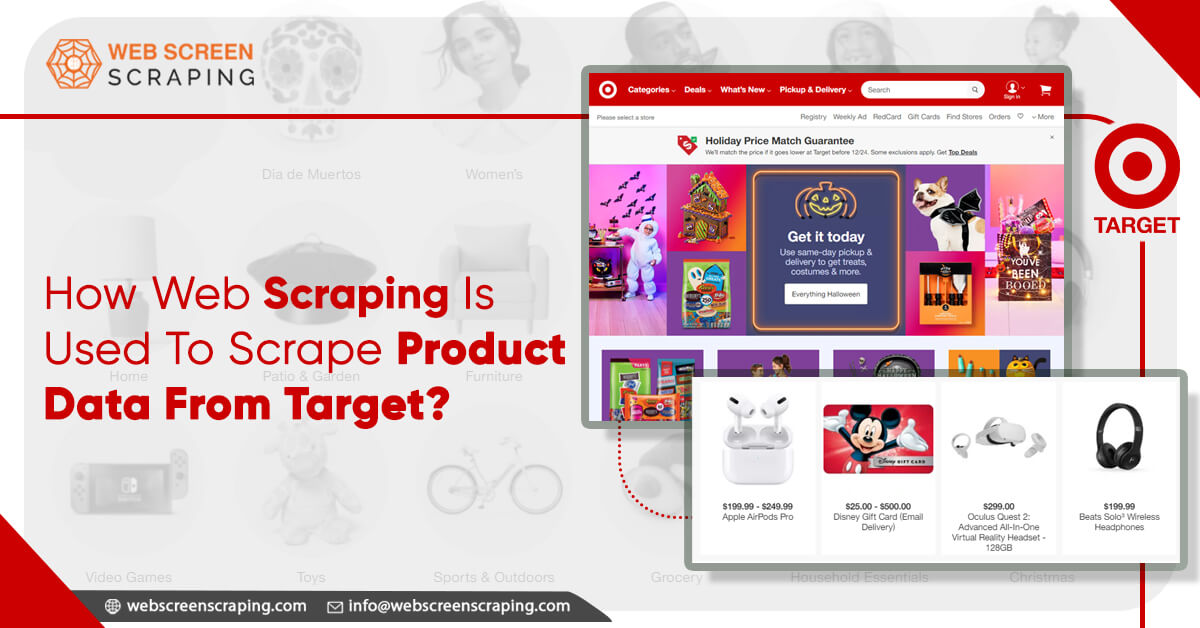
Download Product Availability, Listing, and Prices DataSearch Target.com for the products you want to scrape and provide us with the URL for the results.
In a scraper, enter a ZIP code for the store you want to acquire prices and stock availability for.
You'll have a spreadsheet with product information such as Product Name, Store Availability Price, Online Availability, Rating, and Description, among other things.Target Product’s Information and Pricing ScraperOur Target Scraper will scrape information from any Target store using simply the search result URLs as well as the zip code.Our Target.com data scraper will scrape the following information:NameProduct availabilityPricingOnline Availability statusStore AddressBrandSellerModelProduct ImagesContact detailsProduct specificationRating HistogramCustomer reviewsSamplesTo demonstrate this, we took all of the products in the “Women " category from a nearby Target Store in Zip code 10001 and put them together in a table (in New York, CA).
Check this link on how to do https://www.target.com/c/women/-/N-5xtd3.Receive a product category link using Target.com through browsing several categories.Set your Zip code 10001The following would be the input for the Target.com data scraper:Search listing or Keywords URLs athttps://www.target.com/c/sleepwear-pajamas-robes-women-s-clothing/-/N-5xtc3The Zip code will be 10001Then, using the parameters, search for a specific type of product, filter the results, and scrape various effects.Let's look at a "Women's Short Sleeve V-Neck T-Shirt" created by Universal Thread from a Target Store near New York, NY as an example (with Zip Code 10001).
Let's look at how to construct a scraper to accomplish this.Search the keyword — Women's Short Sleeve V-Neck T-Shirt on Target.com.Copy the search URLhttps://www.target.com/c/sleepwear-pajamas-robes-women-s-clothing/-/N-5xtc3Z1vs54?Nao=0Set your Zip code at 10001The input to your Target.com data scraper will be:Search listings or Keywords URLhttps://www.target.com/c/sleepwear-pajamas-robes-women-s-clothing/-/N-5xtc3Z1vs54?Nao=0Zip Code- 10001JSON#: "1",
Image URL: "https://target.scene7.com/is/image/Target/GUEST_913b04a6-f0d4-4423-b266-9fa94cfbd46b?fmt=webp=1400=80 | https://target.scene7.com/is/image/Target/GUEST_e1d4bcc4-4a82-4393-9003-4fc3dfb78f5f?fmt=webp=1400=80 | https://edge.curalate.com/v1/img/7Q47X98QfRlIfAeCFpUclMkISbjtDBPtsw71O27c0ps=/h/1200?compression=0.75 | https://edge.curalate.com/v1/img/5WvyEL7PeAuDHLj_tQP1nKOZDo5TQ2Ote9kAfqj4_gA=/h/1200?compression=0.75 | https://edge.curalate.com/v1/img/z6D4nwiW3JNzVRhMf9-8c1WKZNvFwNbuSBINtXuiG2U=/h/1200?compression=0.75 | https://edge.curalate.com/v1/img/lx-ryGf4Ibq8zpf38NLSFYjDD2Nh4BYiilEicu241Jk=/h/1200?compression=0.75 | https://edge.curalate.com/v1/img/5ak-6Senb1FzcbxpokldcG1CItMVehMznoNAomKJQGU=/h/1200?compression=0.75 | https://edge.curalate.com/v1/img/6N8ivG74vAmUghu4MbHrTb7nTjikvRUKwy3NqV8aOe8=/h/1200?compression=0.75 | https://edge.curalate.com/v1/img/7Q47X98QfRlIfAeCFpUclMkISbjtDBPtsw71O27c0ps=/sc/80x80?compression=0.75 |",
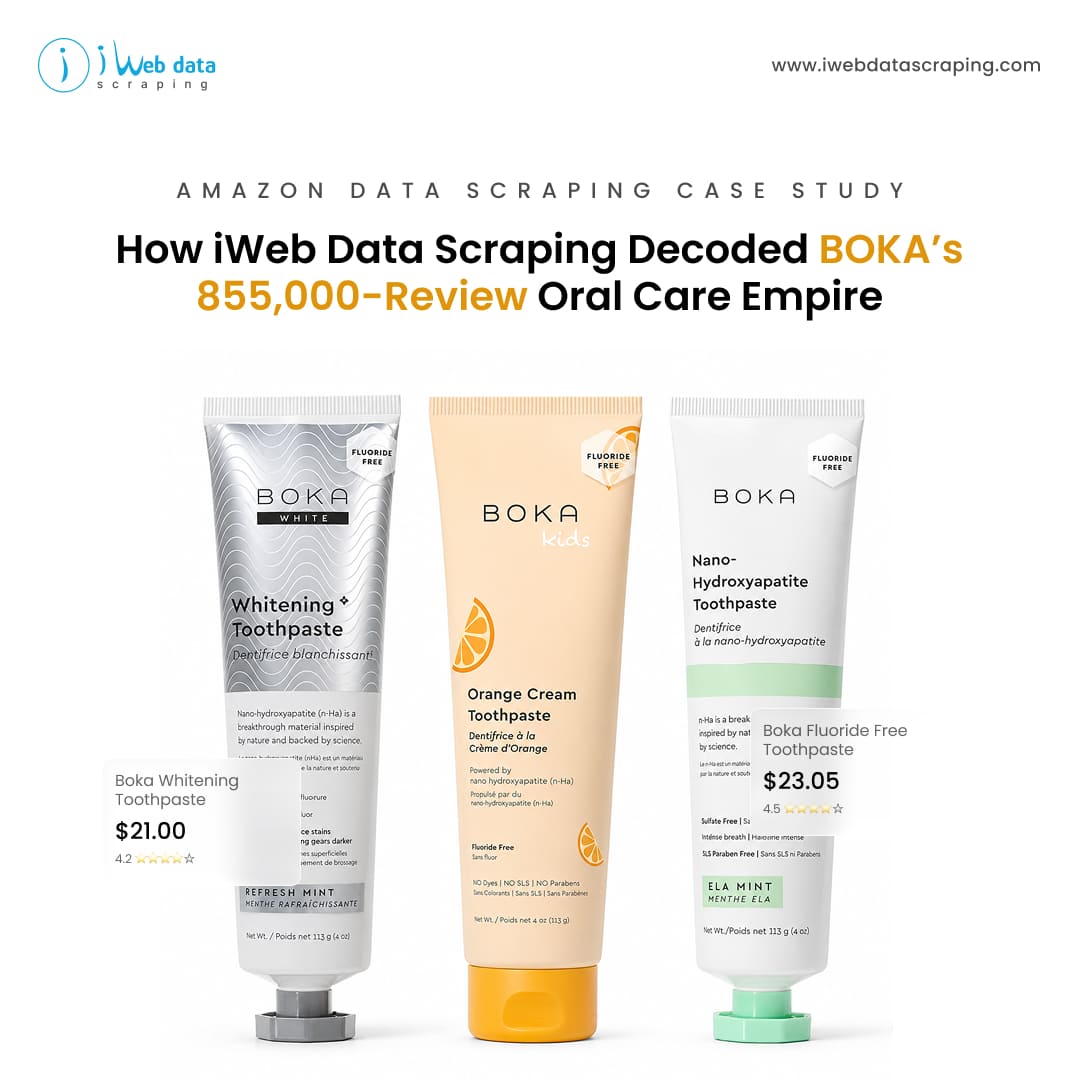
Amazon Data Scraping Case Study: How iWeb Data Scraping Decoded BOKA’s 855,000-Review Oral Care Empire
See how iWeb Data Scraping used Amazon data scraping to decode BOKA’s oral care strategy
