Artificial intelligence is no longer a future investment—it's a present-day competitive advantage. Yet many organizations struggle with one fundamental question:
What type of AI should we implement?
The answer isn't always straightforward. Between predictive AI, generative AI, and the emerging category of agentic AI, business leaders are faced with a growing range of options, each promising transformative results.
The challenge isn't whether AI can deliver value. It's choosing the right AI solution that aligns with your business objectives, operational challenges, and expected ROI.
In this guide, we'll break down the three major AI categories, compare their strengths, and help you determine which approach makes the most sense for your organization.
Why Choosing the Right AI Matters
According to industry research, AI initiatives often fail not because the technology is ineffective, but because businesses deploy the wrong solution for the wrong problem.
A company looking to reduce customer churn may not benefit from a content-generation tool. Likewise, a business trying to automate complex workflows may need more than predictive analytics.
Before investing in enterprise AI implementation, leaders should first understand the purpose each AI category serves.
Understanding the Three Main Types of AI
1. Predictive AI: Forecasting Future Outcomes
Predictive AI uses historical data to identify patterns and forecast future events. This category is often associated with predictive analytics and machine learning models.
The goal is simple:
Use past behavior to predict what will happen next.
Common Business Applications
- Customer churn prediction
- Sales forecasting
- Demand planning
- Fraud detection
- Inventory optimization
- Risk assessment
For example, a SaaS company may use predictive AI to identify customers most likely to cancel their subscriptions. This allows customer success teams to intervene before revenue is lost.
Benefits
- Improves decision-making accuracy
- Reduces operational risks
- Optimizes resource allocation
- Supports data-driven planning
Best For
Organizations with large amounts of structured historical data that want better forecasting and operational insights.
Predictive Analytics vs Machine Learning: What's the Difference?
Many business leaders use these terms interchangeably, but they are not exactly the same.
Machine learning is the broader technology that enables systems to learn from data.
Predictive analytics is a business application that uses machine learning techniques to forecast future outcomes.
Think of machine learning as the engine and predictive analytics as one of the vehicles powered by that engine.
Understanding this distinction is important when evaluating AI consulting for business initiatives because your objective should determine the technology—not the other way around.
2. Generative AI: Creating New Content and Ideas
Generative AI has exploded into mainstream business use over the past few years.
Unlike predictive AI, which forecasts outcomes, generative AI creates entirely new outputs based on patterns it has learned from vast datasets.
Common Business Applications
- Marketing content creation
- Customer support responses
- Code generation
- Product descriptions
- Internal knowledge management
- Sales proposal drafting
Tools powered by generative AI can produce text, images, videos, software code, and even strategic recommendations.
Benefits
- Increases employee productivity
- Accelerates content creation
- Reduces repetitive manual work
- Enhances creativity and innovation
Best For
Businesses looking to improve efficiency, scale content production, or support employees with AI-powered assistance.
Potential Limitations
Generative AI can occasionally produce inaccurate information, commonly known as "hallucinations."
As a result, human oversight remains essential for high-stakes decisions and customer-facing content.
3. Agentic AI: Autonomous Decision-Making and Action
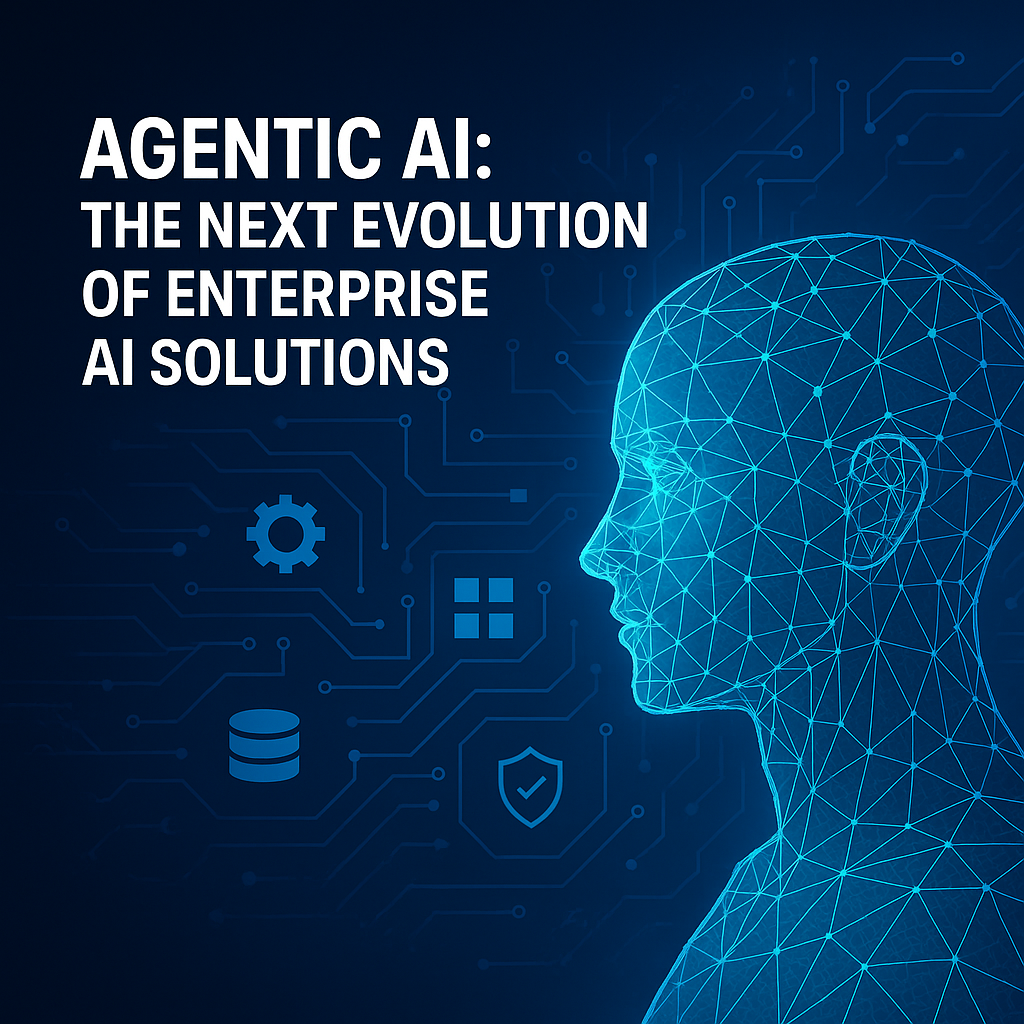
Agentic AI is the newest and arguably most transformative category.
While predictive AI analyzes and generative AI creates, agentic AI can plan, decide, and act independently toward a defined goal.
Think of agentic AI as a digital worker rather than a software tool.
Common Business Applications
- Automated customer service workflows
- IT operations management
- Supply chain coordination
- Autonomous research and reporting
- Multi-step process automation
For example, an agentic AI system could:
- Analyze incoming customer requests
- Determine priority levels
- Retrieve relevant information
- Draft responses
- Trigger follow-up actions
- Escalate issues when necessary
All without requiring human intervention at every step.
Benefits
- End-to-end workflow automation
- Faster execution
- Reduced operational costs
- Improved scalability
Best For
Organizations seeking advanced automation and process orchestration across multiple business functions.
Potential Risks
Because agentic systems can make decisions and execute actions autonomously, governance, security, and oversight become critical considerations.
Comparing the Three AI Types
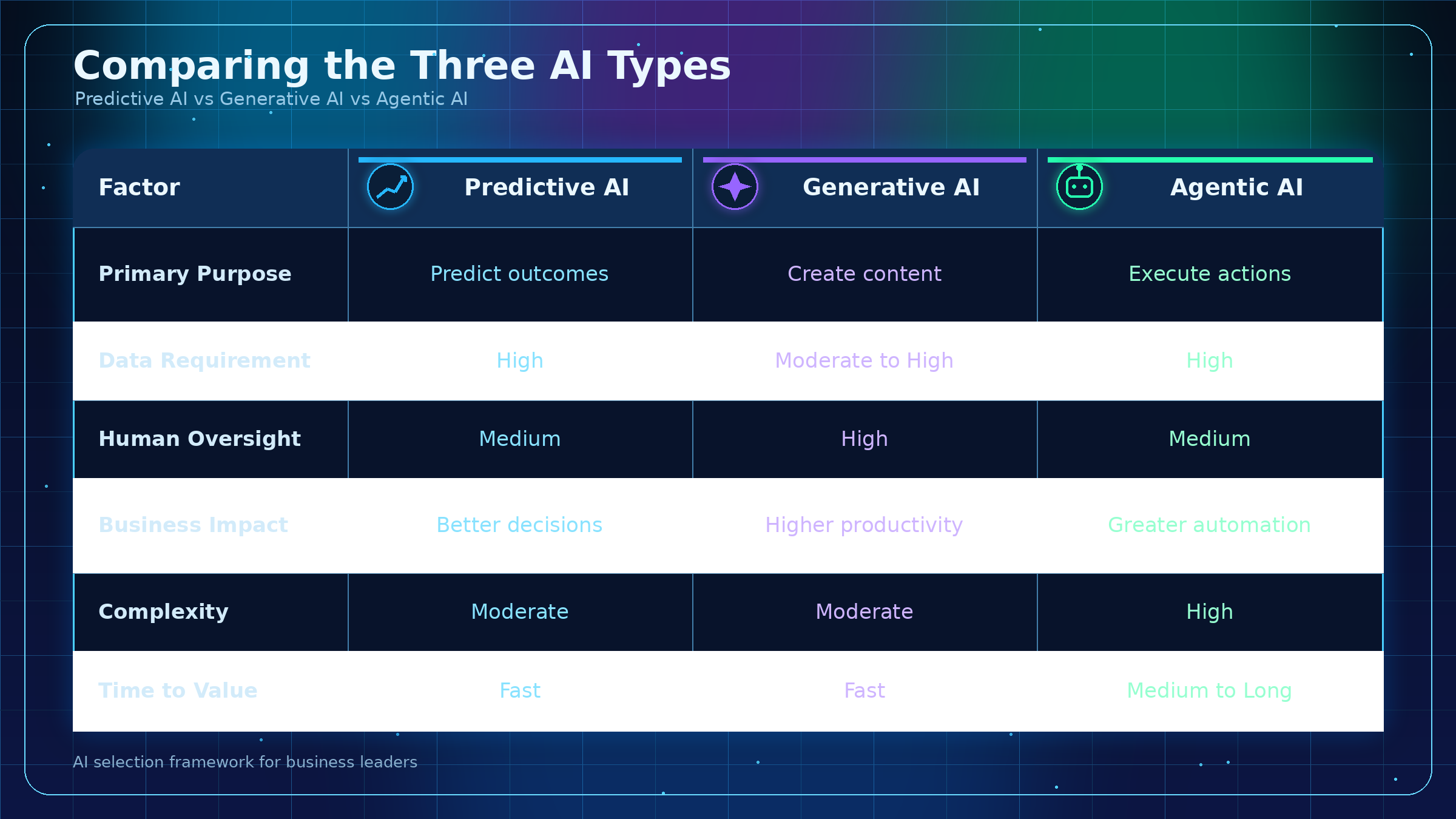
Which AI Type Delivers the Best AI ROI?
The truth is that no single AI category delivers the highest ROI for every organization.
The best return depends on your business goals.
Choose Predictive AI If You Want To:
- Reduce uncertainty
- Improve forecasting
- Optimize operational performance
- Enhance strategic planning
Choose Generative AI If You Want To:
- Boost employee productivity
- Accelerate content creation
- Improve customer interactions
- Reduce repetitive knowledge work
Choose Agentic AI If You Want To:
- Automate complex workflows
- Reduce manual intervention
- Scale operations efficiently
- Build autonomous business processes
A Practical Framework for Choosing AI Solutions
Before launching an AI initiative, ask these questions:
1. What Business Problem Are We Solving?
Avoid implementing AI simply because competitors are doing it.
Start with a measurable business challenge.
2. Do We Have Quality Data?
Predictive and agentic systems rely heavily on clean, reliable data.
Without strong data foundations, results will suffer.
3. What Level of Automation Do We Need?
Some organizations only need AI-assisted decision-making.
Others want fully autonomous workflows.
Understanding this distinction prevents costly implementation mistakes.
4. How Will We Measure Success?
Define metrics upfront:
- Revenue growth
- Cost reduction
- Productivity improvements
- Customer satisfaction
- Process efficiency
These metrics become the foundation for measuring AI ROI.
The Role of AI Consulting for Business Success
Many companies underestimate the complexity of selecting and deploying AI technologies.
This is where AI consulting for business becomes valuable.
Experienced consultants help organizations:
- Assess AI readiness
- Identify high-impact use cases
- Select the right technology stack
- Build implementation roadmaps
- Establish governance frameworks
- Measure business outcomes
Rather than chasing trends, businesses can focus on solutions that generate measurable value.
The Future Isn't One Type of AI—It's a Combination
The most successful organizations won't choose between predictive, generative, and agentic AI.
They'll combine them.
Imagine a system where:
- Predictive AI identifies at-risk customers.
- Generative AI creates personalized retention campaigns.
- Agentic AI executes the outreach process automatically.
Together, these technologies create a powerful ecosystem that delivers results far beyond what any individual AI category can achieve.
Final Thoughts
The AI landscape is evolving rapidly, but the principle remains the same:
Technology should serve business objectives—not the other way around.
Predictive AI helps businesses anticipate the future.
Generative AI helps teams create faster.
Agentic AI helps organizations operate autonomously.
The key to successful enterprise AI implementation is understanding which capability aligns with your current priorities.
When businesses focus on solving real problems, selecting the right AI solution becomes significantly easier—and achieving meaningful AI ROI becomes far more likely.