


When software engineering teams transition from localized systems to sprawling microservice networks, they usually hit a wall. It isn't just about routing traffic from point A to point B anymore. Today, a modern enterprise handles thousands of decoupled services, countless third-party integrations, and an influx of automated AI agents that communicate entirely through endpoints.
Without a specialized control layer, this interconnected web quickly deteriorates into architectural chaos.
The True Cost of API Sprawl
Many engineering teams find out their structural visibility is slipping too late. According to an industry study, 57% of enterprises experienced an API-related data breach over a trailing two-year period, and a jarring 73% of those victims were hit three or more times. The core culprit isn’t typically a lack of talent; it is API sprawl—the silent accumulation of forgotten, unmonitored, and zombie endpoints.
Consider how easily these vulnerabilities slip through the cracks:
- Siloed Releases: Platform engineering teams deploy fast-moving software updates but omit updating central registries.
- Legacy Integrations: Up to three-quarters of large firms acknowledge that older, brittle legacy endpoints remain completely exposed, lacking modern validation barriers.
- The AI Influx: The rush to build AI features has multiplied machine-to-machine requests. In fact, analytical data from Treblle highlights that transactional API requests (like POST calls handling actions and data writes) skyrocketed from 20% to 43% of overall internet traffic.
When data environments move this fast, basic routing scripts break under the strain. This operational gap explains why the global API management market is projected to surge from $5.24 billion to $6.92 billion this year, on its way to a projected $20.89 billion by 2030, according to Research and Markets.
Navigating the Gateway Market
Enterprises like Cisco, IBM, and major financial institutions realize that a gateway cannot just be a simple proxy server. It has to act as an intelligent security guard, a translator, and a performance optimizer all at once. Relying on basic cloud load balancers or lightweight open-source proxies leaves massive gaps in your defensive perimeter and engineering workflows.
Selecting the ideal foundation to anchor your application ecosystem requires looking beyond basic feature checklists. Let’s break down the 10 essential, non-negotiable architectural capabilities your enterprise must prioritize when selecting a production-ready API gateway.
Core Enterprise API Gateway Features (The Top 10)
If you are looking to scale your infrastructure without breaking your deployment pipelines, you can't treat an API gateway as an afterthought. It is the traffic controller, data interpreter, and main defensive wall of your entire architecture.
When searching for the perfect solution, you will likely weigh the merits of heavily packaged commercial products against a flexible open source API gateway framework which can be tailored precisely to your infrastructure stack. Whichever path you choose, these ten non-negotiable features must be your structural benchmark.
1. Advanced Security & Threat Protection
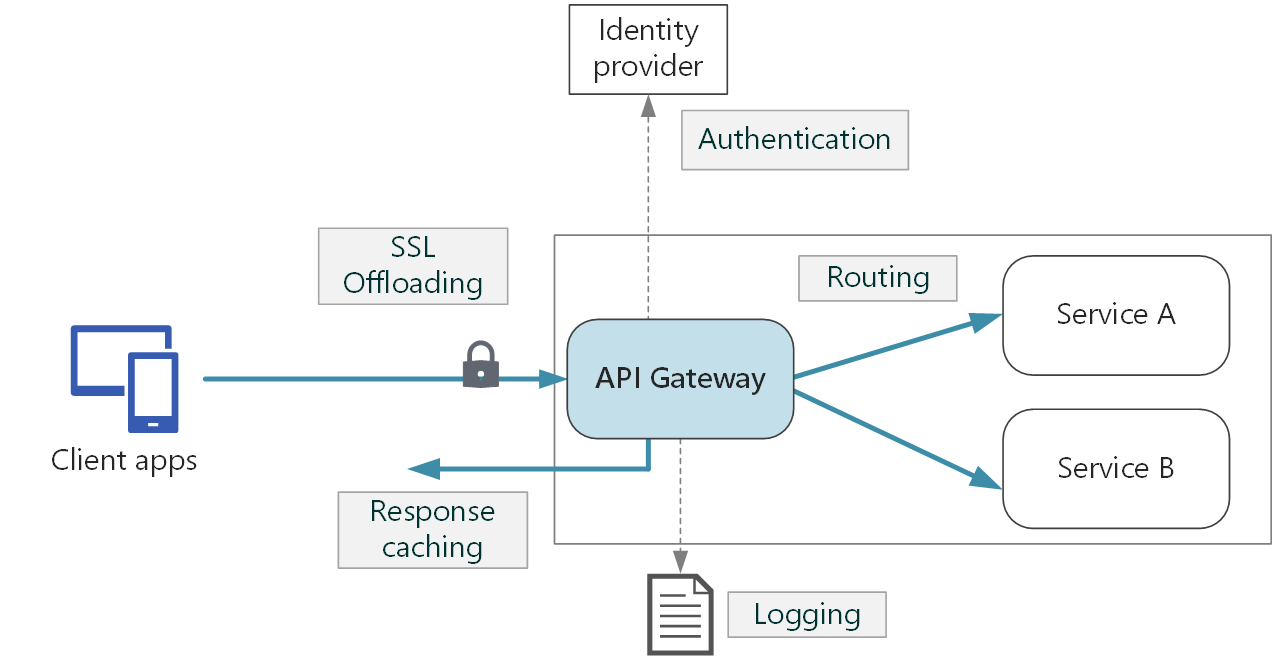
You can't rely on simple firewall configurations when malicious actors use automated scripts to probe your endpoints. Security at the edge requires a gatekeeper that intercepts traffic and analyzes it deeply before it ever reaches your database.
- Web Application Firewall (WAF) Integration: Your gateway must block sophisticated attacks like SQL injections, Cross-Site Scripting (XSS), and OWASP Top 10 vulnerabilities seamlessly.
- Payload Validation: It should instantly reject requests with malformed JSON, bloated XML, or suspicious headers designed to cause buffer overflows.
- DDoS and Scraping Mitigation: Look for a gateway that uses behavior analysis to isolate anomalies. For example, security platforms like Traceable AI integrate natively with gateways to map application context, assigning real-time risk scores to inbound requests and halting attacks before they cause cascading internal downtime.
2. Robust Authentication & Authorization
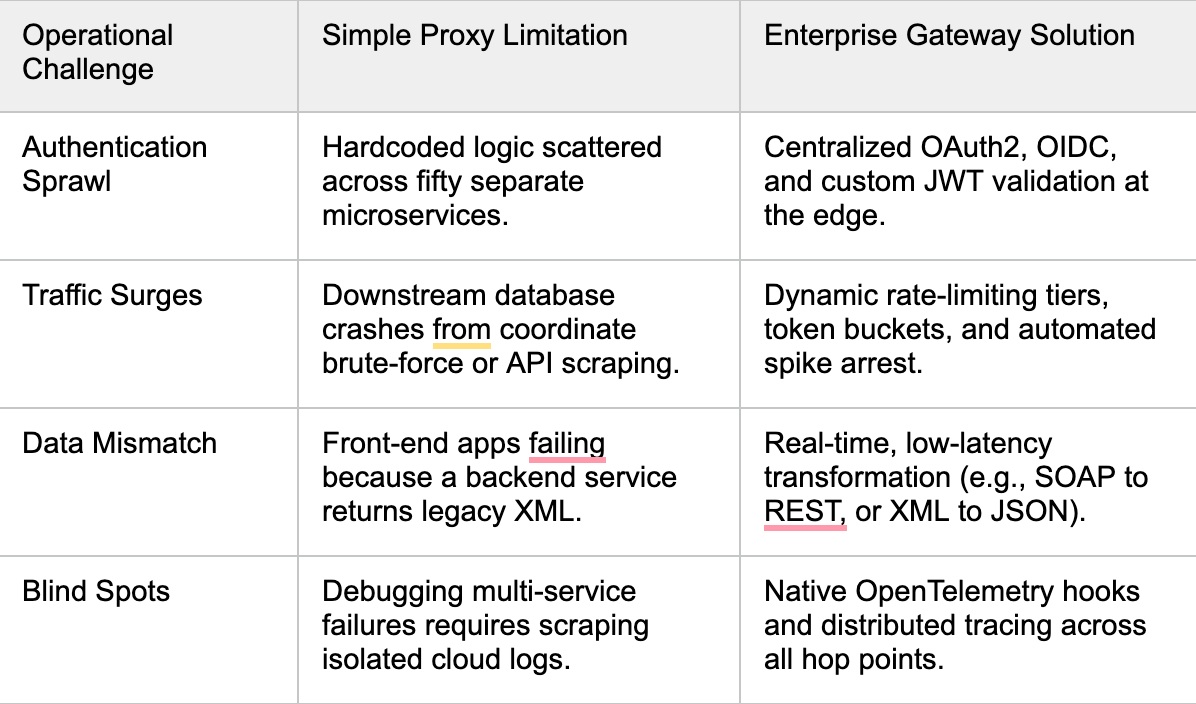
Securing access shouldn't mean writing custom verification code inside fifty individual microservices. Your gateway should decouple identity checking from your business logic completely.
An enterprise gateway acts as a unified enforcement point. It intercepts requests, validates signatures with your Identity Provider (IdP), checks user privileges, and forwards a clean, trusted identity token to your backend services. It must natively support:
- Modern Auth Protocols: OAuth2, OpenID Connect (OIDC), and SAML.
- Token Minting & Validation: Verifying JSON Web Tokens (JWTs) at the edge to reduce the load on internal authorization systems.
- Fine-Grained Access Control: Integrating with tools like Open Policy Agent (OPA) to enforce Role-Based (RBAC) or Attribute-Based Access Control (ABAC) dynamically.
3. Dynamic Traffic Management & Rate Limiting
A sudden viral product launch or a rogue loop in a partner’s integration script can saturate your backend infrastructure in seconds. Proper traffic management keeps your platform online under extreme stress.
You need complex, multi-tiered throttling mechanisms that shield your services from crashing. Look for configurations that allow you to set distinct tiers:
- SLA-Based Throttling: Restrict standard developers to 60 requests per minute while guaranteeing premium enterprise clients 5,000 requests per minute.
- Spike Arrest: Prevent sudden, split-second micro-surges from overwhelming down-stream services.
- Token Bucket & Leaky Bucket Algorithms: Provide flexible capacity management, giving clients the freedom to burst briefly for heavy transfers without causing long-term service degradation.
4. Enterprise-Grade Observability & Analytics
If an API call fails between service A and service B, you cannot afford to waste hours logging into individual cloud servers to piece together mismatched logs. You need a centralized diagnostic window.
Your gateway must feed direct telemetry into your broader monitoring stack. Enterprise infrastructure demands native OpenTelemetry support, allowing you to export distributed traces, system logs, and operational metrics directly to downstream platforms like Datadog, Prometheus, or Grafana. It should track every single request path, mapping hop points, measuring latent delay, and isolating failure origins instantly.
5. High Availability, Scalability, & Load Balancing
Your gateway is the single point of entry for your digital business. If it experiences a bottleneck or a regional outage, your entire application ecosystem goes dark.
To eliminate this single point of failure, prioritize an architecture optimized for ultra-low latency and horizontal scale. For instance, performance benchmarks show a clean Kong Gateway proxy build handling over 130,000 requests per second (RPS) with a 95th-percentile response delay of just 3.82 milliseconds. Ensure your gateway provides:
- Multi-Region Failover: Automatic, global traffic routing if an entire data center goes dark.
- Advanced Routing Algorithms: Going beyond basic round-robin to utilize weighted load balancing, least-connections routing, and health-check-based circuit breaking.
- Stateless Scaling: Running a decoupled data plane that expands rapidly with your Kubernetes clusters without database lockups.
6. API Lifecycle Management & Versioning
Your engineering teams are continually rolling out improvements, altering payloads, and introducing new features. Your gateway must ensure that these software iterations never disrupt existing integrations.
Look for native lifecycle tooling that allows you to manage the entire life cycle of an endpoint. It must handle canary releases—routing just 5% of inbound requests to a new service variant to test its stability before a complete rollout. Furthermore, the platform should inject automated headers warning developers about impending route deprecations without forcing messy, immediate system overhauls.
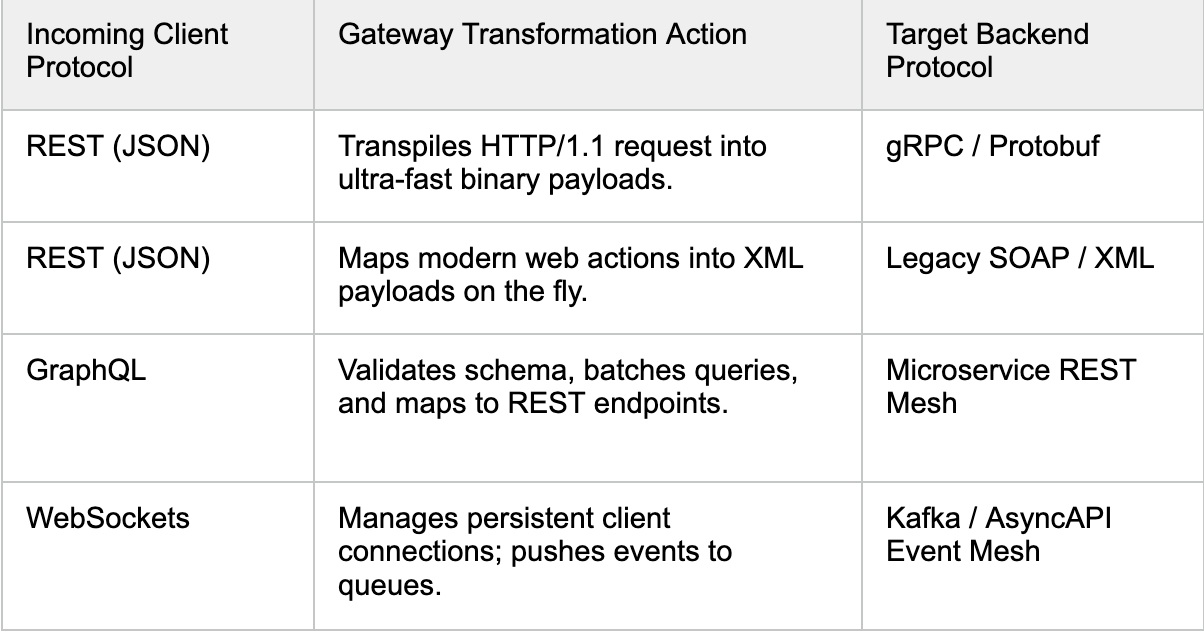
7. Protocol Transformation & Mediation
Enterprises rarely have the luxury of building entirely on greenfield infrastructure. Your modern cloud-native web applications often need to communicate with reliable but stubborn legacy mainframes or niche specialized services.
Instead of writing custom code layers inside your microservices just to parse data formats, your gateway should handle this translation at the edge.
8. Multi-Tenancy & Developer Portals
As your API environment grows, managing consumption can easily turn into an administrative nightmare. You cannot manually hand out authorization keys or exchange integration documentation via email threads.
An enterprise gateway should feature a fully functional, isolated Developer Portal. This workspace allows you to segment different business units or external partners into secure, isolated tenancies.
- Self-Service Onboarding: Developers can register, generate secure sandbox API keys, and test integrations independently.
- Interactive Documentation: Automatically updates and renders OpenAPI/Swagger specifications so developers can view live schema details.
- Usage Monetization: Clear insights into data consumption, providing a pathway for billing or internal cost-allocation metrics.
9. Hybrid & Multi-Cloud Deployment Flexibility
Very few enterprises store their assets in a single cloud bucket. Your architecture likely stretches across an intricate mix of legacy on-premise hardware, AWS instances, and dedicated Google Cloud environments.
Your gateway platform must be cloud-agnostic, operating comfortably across any infrastructure layer. Look for tools that leverage a decoupled control plane and data plane architecture (Hybrid Mode). This allows you to manage all configuration rules from a centralized dashboard while deploying lightweight, local gateway proxies inside varying cloud providers, edge networks, or internal service meshes like Istio.
10. Extensibility & Custom Plugin Support
No matter how many native features an engineering platform provides out of the box, your organization will eventually hit a unique, highly specialized requirement—such as stripping a proprietary data attribute for regulatory compliance or connecting to a custom internal security tool.
Avoid gateways that lock you into rigid configurations. Opt instead for platforms that offer dynamic plugin architectures. Modern systems allow your development teams to write custom logic in accessible languages like Go, Python, or JavaScript, or leverage high-efficiency WebAssembly (Wasm) modules. This gives you the power to hot-reload custom data processing rules directly into the traffic stream without restarting your production environment.
Evaluating the TCO: Commercial vs. Self-Hosted
As you review these capabilities, keep total operational costs top of mind. Many software engineering teams jump headfirst into a commercial SaaS contract only to discover they are penalized financially as their request volumes grow.
Alternatively, opting for an enterprise-ready open source API gateway gives your engineering teams complete structural control over their data planes, predictable infrastructure costs, and the absolute freedom to build custom architectures without vendor lock-in.
Are you managing a sprawling microservice migration, or are you looking to secure and centralize your existing internal endpoints?