Hiring the right people has never been more challenging. As organizations receive hundreds—or even thousands—of applications for a single role, recruiters often rely on resume screening to narrow down the candidate pool. While this approach has been the standard for years, it is becoming increasingly clear that resumes alone cannot accurately identify the best talent.
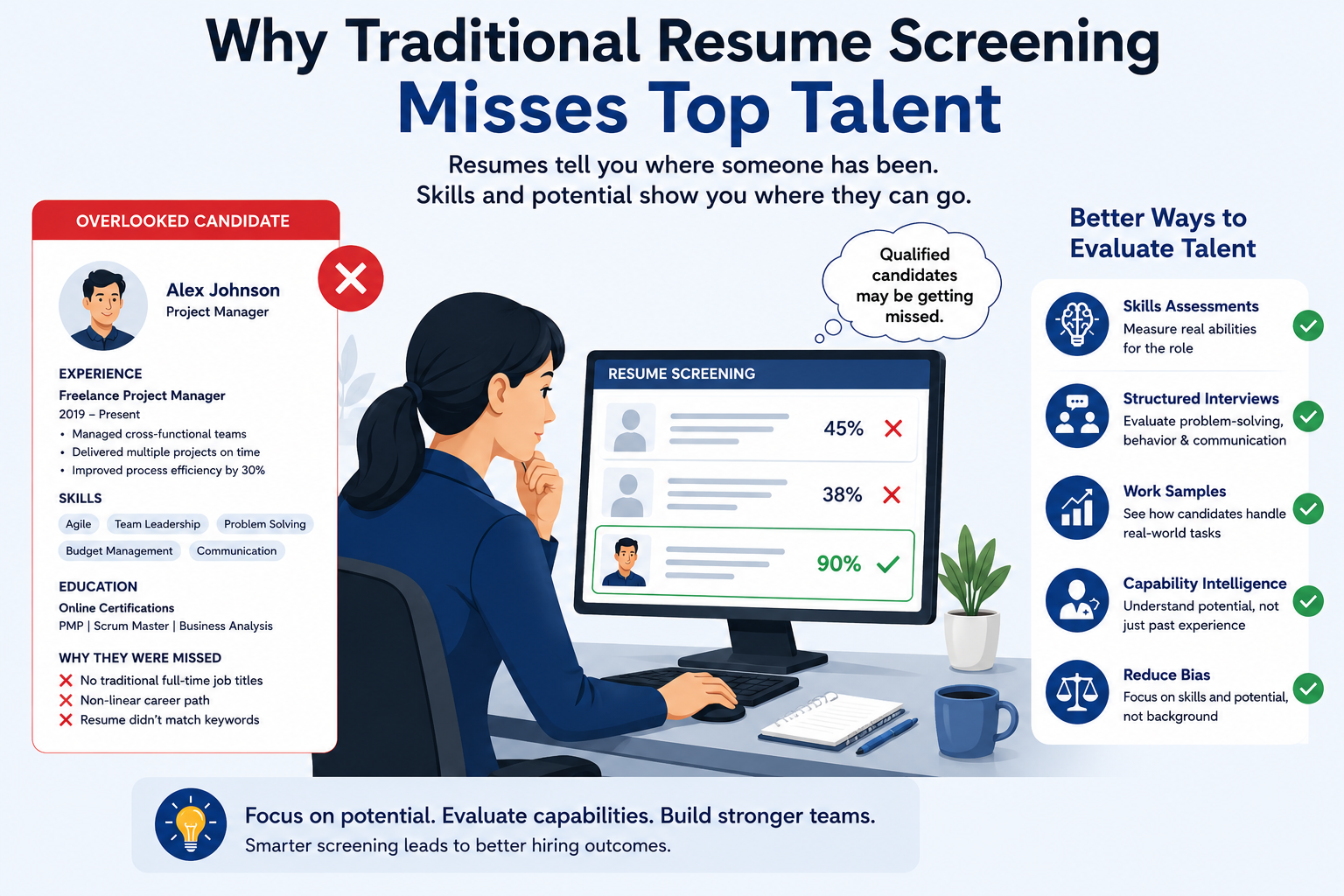
Today's workforce is more diverse than ever. Professionals gain skills through online certifications, freelance projects, open-source contributions, boot camps, and hands-on experience that may not fit neatly into a traditional resume format. As a result, many highly capable candidates are overlooked before they ever have the opportunity to demonstrate their abilities.
Understanding the limitations of resume screening is the first step toward building a more effective and inclusive hiring process.
The Problem with Keyword-Based Screening
Many organizations use Applicant Tracking Systems (ATS) to filter resumes based on specific keywords. While this helps manage high application volumes, it can unintentionally eliminate qualified candidates.
For example, one applicant may describe their experience as "customer success management," while another uses "client relationship management." Both may possess similar skills, yet only one matches the predefined keywords.
Candidates who have transferable skills, career transitions, or unconventional backgrounds are particularly vulnerable to being filtered out despite having the capabilities needed for the role.
Keyword matching saves time, but it doesn't always measure competence.
Resumes Don't Show Real Skills
- A resume provides a summary of someone's professional history, but it rarely demonstrates how well they can perform in a real-world environment.
- Two candidates with identical job titles and years of experience can have vastly different levels of expertise. One may have led complex projects, while the other performed routine tasks.
Similarly, technical professionals may list programming languages or tools without indicating their proficiency. Soft skills such as communication, critical thinking, adaptability, and collaboration are even more difficult to evaluate through a resume.
Hiring decisions based solely on resumes often rely on assumptions rather than evidence.
Bias Can Influence Early Hiring Decisions
Resume screening can also introduce unconscious bias into the recruitment process.
Details such as educational institutions, employment gaps, company names, geographic location, or formatting styles may influence decisions even when they have little connection to future job performance.
Research consistently suggests that structured, skills-focused evaluations provide a fairer assessment of candidates than subjective resume reviews alone.
Organizations seeking to build diverse and high-performing teams are increasingly adopting hiring practices that focus on demonstrated capabilities rather than background alone.
High-Volume Hiring Makes Manual Screening Difficult
Recruiters frequently manage dozens of open positions while reviewing hundreds of applications each week.
Under these conditions, manual resume screening becomes both time-consuming and inconsistent.
Important candidates may be overlooked simply because recruiters have limited time to review every application thoroughly. Meanwhile, highly polished resumes may receive more attention despite not reflecting the strongest job fit.
As hiring volumes continue to grow, organizations need scalable methods that maintain quality without increasing recruiter workload.
Modern Hiring Requires Better Candidate Evaluation
Leading organizations are shifting away from resume-first hiring toward more comprehensive evaluation methods.
Instead of asking only, "Where has this person worked?" employers increasingly ask:
Can this candidate solve real business problems?
Do they possess the required competencies?
Can they adapt to new situations?
Are they likely to succeed in this specific role?
Answering these questions requires more than reviewing a document.
Skills assessments, structured interviews, behavioral evaluations, and AI-assisted screening can provide a deeper understanding of each candidate's potential.
How AI Improves Candidate Screening?
Artificial intelligence is changing how organizations identify qualified talent.
Rather than focusing exclusively on keywords, modern AI-powered recruitment platforms can analyze multiple data points, including candidate competencies, experience relevance, assessment results, and job fit.
AI also helps recruiters prioritize candidates based on objective evaluation criteria, reducing manual effort while improving consistency across hiring decisions.
- Importantly, AI should support—not replace—human decision-making. Recruiters remain responsible for evaluating cultural alignment, communication, and organizational fit, while AI helps surface candidates who deserve closer consideration.
Moving Beyond the Resume
- The future of recruitment is increasingly centered on skills, capabilities, and evidence-based hiring.
- Organizations are adopting structured assessments, competency frameworks, and intelligent screening tools to gain a more accurate picture of candidate potential.
- This approach benefits both employers and job seekers. Recruiters spend less time reviewing unsuitable applications, while qualified candidates have more opportunities to demonstrate what they can actually do.
- Instead of rewarding the best resume writers, modern hiring aims to identify the individuals most capable of succeeding in the role.
Final Thoughts
Resumes will likely remain an important part of recruitment, but they should no longer serve as the primary basis for hiring decisions.
As competition for skilled talent intensifies, organizations that combine resumes with skills assessments, structured interviews, and AI-powered evaluation methods are better positioned to identify high-potential candidates, reduce hiring bias, and improve overall recruitment outcomes.
Solutions such as Zeko.ai support this evolving approach by helping organizations evaluate candidates through capabilities, structured assessments, and AI-assisted insights rather than relying solely on resume keywords. By focusing on what candidates can do—not just what their resumes say—companies can make more informed hiring decisions and build stronger teams for the future.