





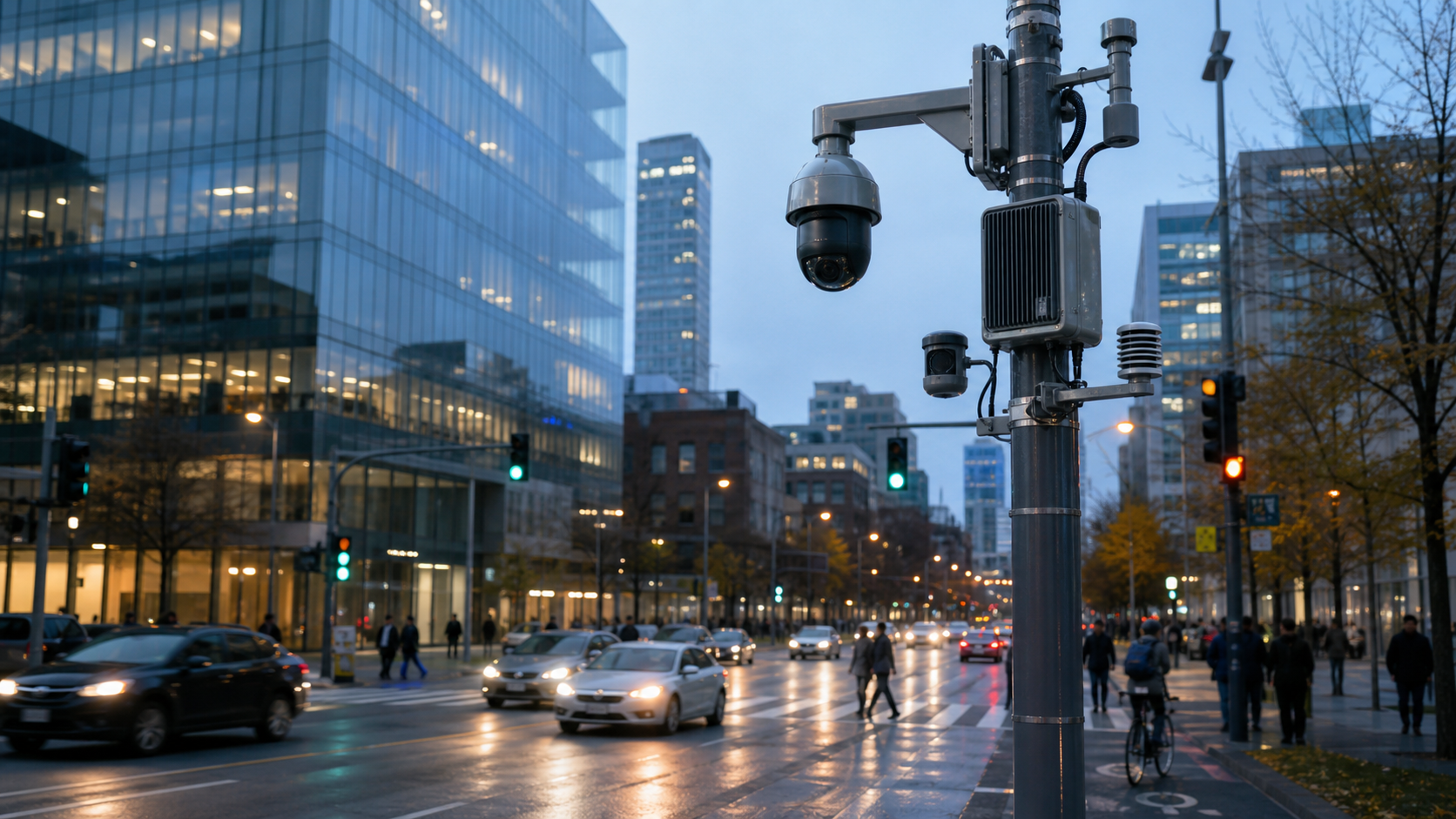
Smart city deployment should use edge AI devices for clearly defined local tasks: processing sensor data near the source, generating time-sensitive events, reducing unnecessary data transfer, buffering during outages, and enforcing selected privacy controls. The edge device should not become an unplanned miniature data center. Its role must be divided deliberately among the sensor, local node, city platform, and cloud so that performance, security, operations, and accountability remain manageable.
For a Smart city deployment, begin with the public or operational outcome—safer crossings, faster maintenance, better traffic information, energy optimization, environmental monitoring, or equipment health. Then decide what local computation is actually necessary.
Quick Architecture Decisions for Smart City Deployment
- Outcome: the measurable service or operational improvement.
- Local event: what the edge node must detect, calculate, or filter.
- Response time: how quickly an operator or system needs the result.
- Sensor scope: camera, environmental, acoustic, energy, traffic, or equipment data.
- Data policy: what can be collected, retained, transmitted, or shared.
- Connectivity: normal bandwidth, outage duration, and recovery behavior.
- Fleet operations: identity, configuration, monitoring, updates, replacement, and retirement.
- Accountability: who owns the model, accepts changes, reviews errors, and responds to incidents.
These decisions create a procurement specification. Without them, vendors may propose incompatible devices, overlapping platforms, and AI features that do not support a city workflow.
What Belongs on the Edge Device?
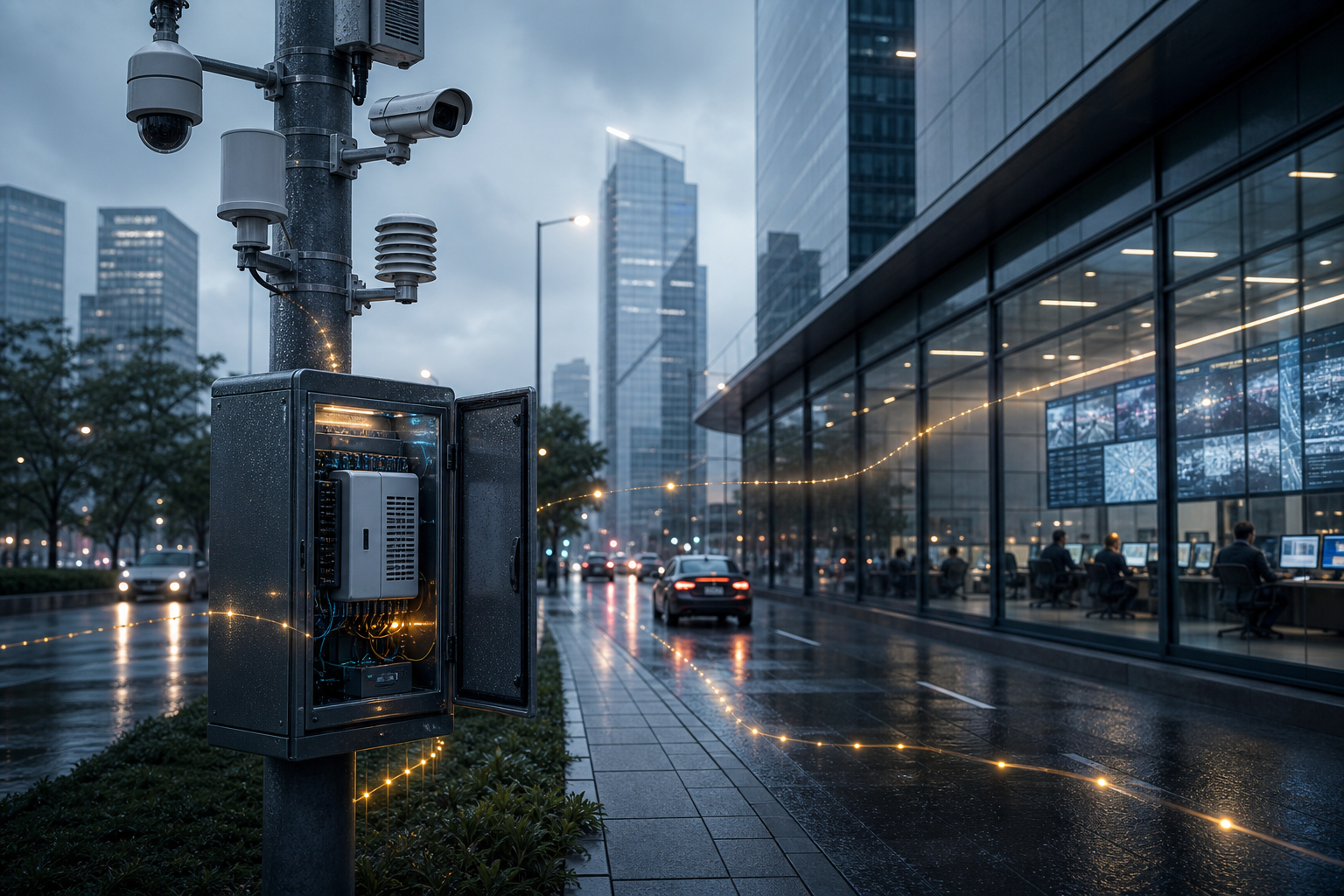
The edge is the right place for work that benefits from proximity to sensors or must continue when the wide-area network is unavailable. The cloud or central platform is better for cross-site coordination, long-term analysis, fleet governance, and heavy model management.
Local edge functions
- Sensor capture and quality checks.
- Data normalization and timestamping.
- Video or signal preprocessing.
- Local AI inference and event logic.
- Privacy transformations before transmission.
- Short-term buffering and store-and-forward.
- Device health monitoring and local recovery.
Central functions
- Citywide dashboards and cross-site trends.
- Long-term retention and reporting.
- Model approval, version control, and staged rollout.
- Integration with work-order or emergency systems.
- Central identity, audit, and policy.
- Data fusion that depends on many locations.
The split should minimize unnecessary raw-data movement without hiding critical evidence or making local behavior impossible to audit.
Define the Event Before Selecting the Model
A smart-city project should describe its output as an operational event, not as “AI analytics.”
Examples:
- A blocked drainage inlet with a confidence and image reference.
- A traffic queue exceeding a defined length for a defined time.
- A pedestrian waiting in a crossing zone.
- An environmental reading outside a verified sensor range.
- A cabinet door opened outside an authorized service window.
- A camera view obstructed or shifted.
For every event, specify the threshold, delay, evidence, retention, recipients, and human-verification rule. This makes it possible to evaluate false alerts, missed events, and response workload.
Common mistake: Optimizing detection accuracy without measuring whether the resulting alert volume is usable by city staff.
Use a Three-Layer Data Policy
Layer 1: Data that stays local
Raw streams that are not required centrally can be processed and discarded or retained briefly under an approved policy. Examples may include continuous video used only to generate traffic counts or equipment-state metadata.
Layer 2: Event evidence
Selected images, clips, or sensor windows can accompany a validated event when operators need context. Access, encryption, retention, and deletion must follow applicable rules.
Layer 3: Aggregated information
Counts, trends, device health, and non-identifying metadata can be transferred for planning and reporting. Aggregation does not automatically remove all privacy or security risks, so governance still matters.
Data minimization should be designed with legal, privacy, records, cybersecurity, and operations stakeholders for the relevant jurisdiction. A technical architecture alone cannot determine lawful use.
Size Edge AI from Sensors and Workloads
Step 1: Inventory sensor data
- Device model and interface.
- Data format, resolution, and rate.
- Timestamp and synchronization.
- Expected environmental conditions.
- Local retention and evidence needs.
Step 2: Inventory processing
- Preprocessing and decoding.
- Model versions and precision.
- Number of simultaneous streams.
- Event logic and tracking.
- Privacy transformation.
- Encryption, storage, and communication.
Step 3: Define timing
Measure from data capture to a usable event. Include buffering, model inference, logic, and transmission to the consuming system. Use percentiles and worst-case observations.
Step 4: Test sustained operation
Run the complete workload with monitoring, logging, and networking active. Record power, temperature, frame or data loss, memory, storage, and event latency. Repeat in the final enclosure.
TOPS can help identify a compute family, but it does not replace this test.
Hardware Selection for Different Smart City Nodes
Sensor-adjacent compact node
- Best fit: one or a few sensors and a focused local workload.
- Priority: low power, compact size, simple replacement, and stable software.
- Main trade-off: limited capacity for future large models or many streams.
Multi-sensor roadside or facility node
- Best fit: several cameras or sensors with local fusion and event generation.
- Priority: input bandwidth, interfaces, storage, networking, and environmental design.
- Main trade-off: higher thermal, power, and maintenance demands.
Regional edge server
- Best fit: aggregation from many field devices or heavier cross-sensor analysis.
- Priority: redundant networking, serviceability, orchestration, and security controls.
- Main trade-off: greater dependence on backhaul from the sensor locations.
A supplier portfolio such as TWOWIN should be evaluated against these roles rather than treated as one generic “smart city computer.” Select a model only after the sensor and operations brief is complete.
Environmental Design Is More Than Temperature
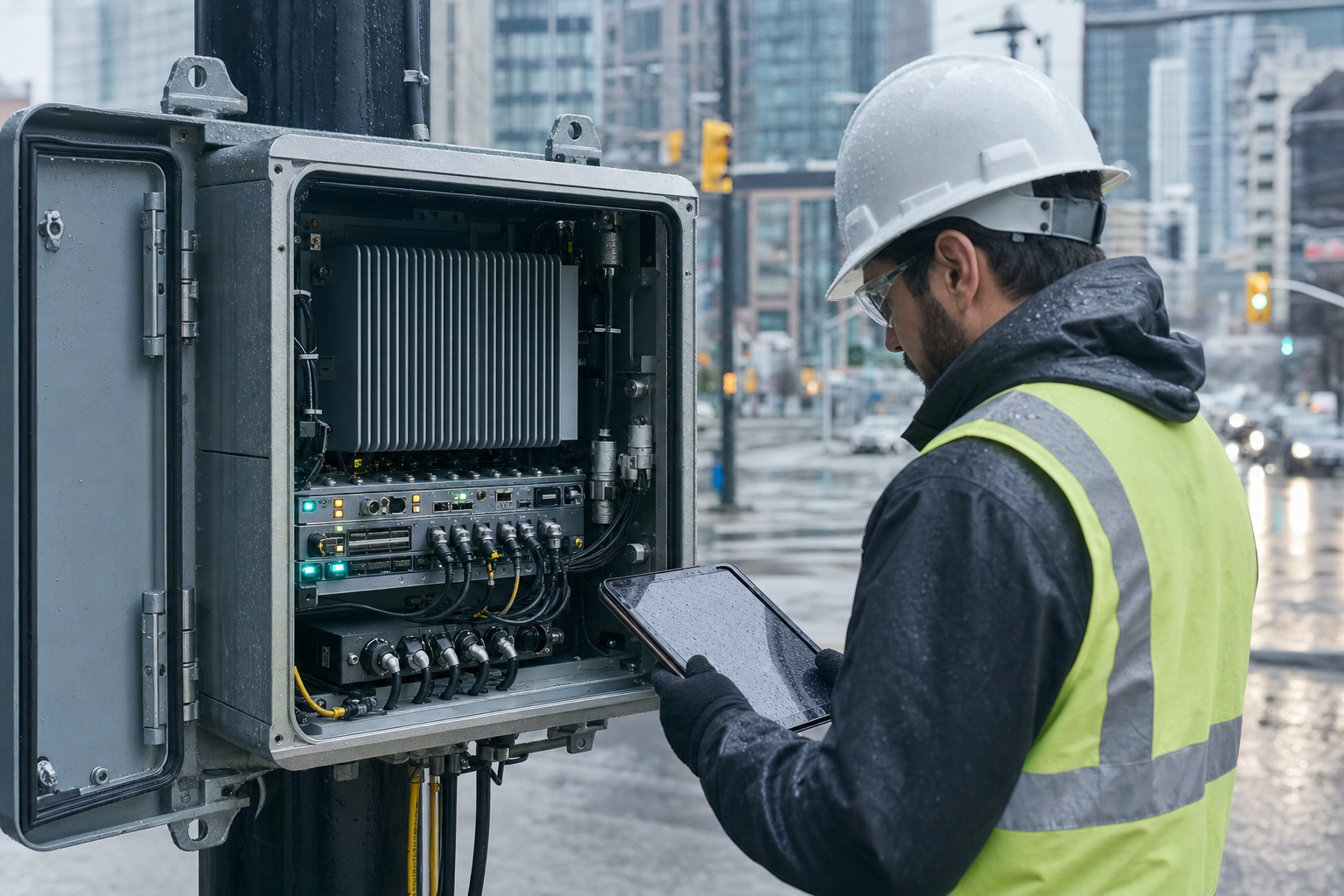
Field nodes may face moisture, dust, insects, solar heat, condensation, corrosion, vibration, unstable power, and unauthorized access. The enclosure, connectors, cable glands, power conversion, mounting, and service procedure are part of the system.
Buyer checks
- Rated operating and storage conditions for the complete device.
- Ingress protection of the installed enclosure and connectors.
- Condensation management and drainage.
- Surge, grounding, and power-interruption behavior.
- Storage endurance and replacement.
- Tamper detection and physical access.
- Safe maintenance near roads or public areas.
Do not transfer a component rating to the complete installed cabinet without verification.
Design Fleet Operations Before the Pilot Scales
A city may manage hundreds or thousands of nodes. Manual configuration that works for five devices can become a security and reliability problem at scale.
Device identity
Every node needs a unique identity, asset record, hardware and software configuration, ownership, location, and service history.
Monitoring
Monitor sensor health, clock status, storage, temperatures, event rate, model version, network quality, and update status. A device being “online” does not prove that its camera view or AI output is valid.
Updates
Use authenticated delivery, approval stages, maintenance windows, health checks, and rollback. Test updates on representative devices before fleet rollout.
Replacement and retirement
Define how a spare is provisioned, how configuration is restored, how keys are rotated, and how data is removed from retired storage.
Buyer check: Ask the vendor or integrator to demonstrate replacement and rollback, not only remote installation.
Cybersecurity and Privacy Controls
Edge devices expand the city's attack surface because they combine physical exposure, network access, software, credentials, and potentially sensitive data.
Controls should include:
- Secure boot or platform integrity features where supported.
- Signed and authenticated software updates.
- Network segmentation and least-privilege access.
- Unique credentials and certificate lifecycle management.
- Encryption in transit and at rest where required.
- Logging that supports investigation without collecting unnecessary data.
- Vulnerability disclosure and patch-response process.
- Physical tamper and access procedures.
Security should cover the entire lifecycle from factory provisioning to retirement. A certification logo or encrypted connection is not a complete cybersecurity program.
Pilot and Acceptance Plan
Phase 1: Representative site
Choose a site that includes difficult lighting, weather, traffic, connectivity, and access conditions. Define the exact events and operator workflow.
Phase 2: Technical validation
- Sensor coverage and quality.
- Event accuracy by condition.
- End-to-end latency.
- Network usage and outage behavior.
- Sustained thermal and power performance.
- Device and sensor fault detection.
Phase 3: Operational validation
- Alert workload and human verification.
- Maintenance time and access.
- Replacement and configuration restore.
- Update and rollback.
- Privacy, retention, and audit review.
Phase 4: Scale decision
Use pilot evidence to revise hardware, model, network, staffing, and policy. Do not scale because a demonstration was visually impressive.
Frequently Asked Questions
Does edge AI eliminate the need for the cloud?
No. It changes the division of work. Local nodes can handle time-sensitive processing and data reduction, while central platforms can coordinate fleets, maintain models, combine sites, and support long-term analysis.
How much compute does a smart city node need?
It depends on sensor count, data rate, model workload, event latency, storage, privacy processing, and background services. Benchmark the complete pipeline under sustained environmental conditions.
Should every camera have its own edge device?
Not necessarily. One device per camera can simplify isolation, while a shared node can reduce equipment count and support fusion. Compare cable topology, bandwidth, failure domains, maintenance, power, and workload before deciding.
What is the biggest scaling risk?
Weak device operations. Without identity, monitoring, controlled updates, rollback, spare provisioning, and retirement procedures, a successful pilot can become an unmanageable fleet.
Create a City Node Specification Before Choosing a Model
Provide the outcome, sensor list, event definitions, latency, site conditions, power, network, data policy, cybersecurity requirements, fleet scale, maintenance plan, and acceptance test. With those inputs, the engineering team can recommend an edge-device role and compare configurations without turning the project into a hardware-led experiment.
References and Sources
- NIST, Cyber-Physical Systems and Internet of Things for Smart Cities.
- NIST SP 500-325, Fog Computing Conceptual Model.
- ETSI, Multi-access Edge Computing specifications and security guidance.



Enhance your quality life and infrastructure with our IoT Technology for Smart City Solutions.
Get best IoT Solutions and IoT smart city Applications that make cities safer and efficient.
Get in touch with us.
| Visit us: https://www.xbytesolutions.com/iot-smart-city-solutions.php| Phone: +1 (832) 251 7311| Email: sales@xbytesolutions.com