

Scope and intent: what a laboratory overview of 6-APB powder can and cannot provide
6-APB powder is most often encountered in research settings as a neat solid (either as the free base or as a salt), where the immediate needs are identification, basic material properties, and an evidence-backed statement of purity. A laboratory-focused overview therefore concentrates on chemical identity, measurable properties that influence handling and storage, and the analytical approaches typically used to confirm what the material is and what it contains.
This kind of profile does not attempt to describe subjective effects, routes of administration, or any form of use outside controlled research. From a laboratory safety perspective, it is more appropriate to treat 6-APB as a potentially hazardous amine-containing organic solid with incompletely characterised toxicology, and to work accordingly: minimise exposure, prevent aerosol generation, and document all work in line with local risk assessment procedures.
Chemical identity and naming: clarifying what “6-APB” refers to in the laboratory
The label “6-APB” is commonly used to describe an aminopropyl-substituted benzofuran. In practical laboratory terms, that shorthand is helpful but incomplete, because samples may be presented in different chemical forms and may include closely related structural variants. For unambiguous work, the identity should be captured using a systematic name, a structural representation (such as a line notation), and the specific form received (for example, free base versus hydrochloride or another salt).
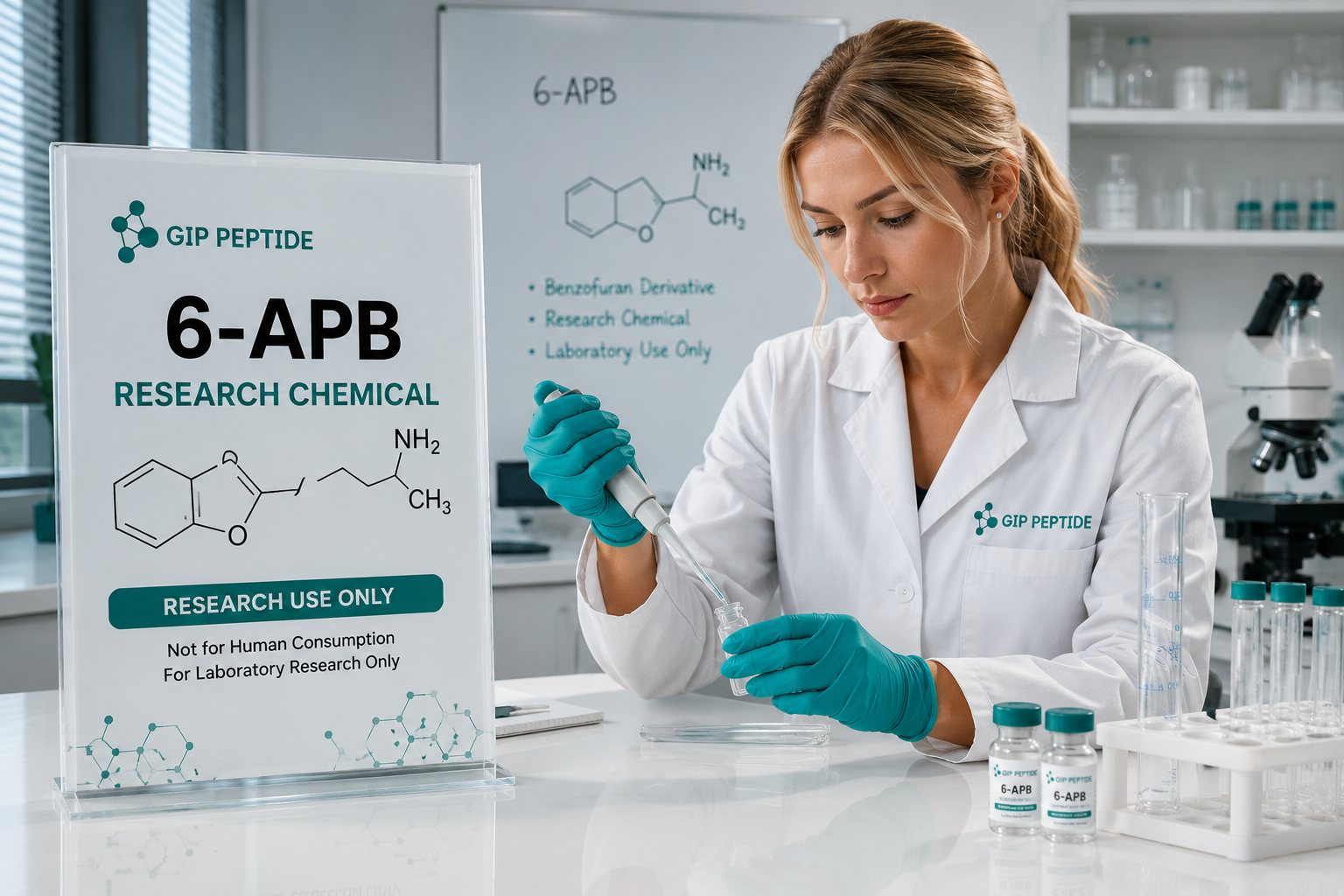
6-APB is generally understood to be 6-(2-aminopropyl)benzofuran. The molecule combines a benzofuran ring system with a side chain bearing a primary amine. This functional group combination matters in a laboratory context because it drives key behaviours: salt formation, moisture sensitivity, interactions with acidic surfaces, and detectability in common analytical platforms. The presence of a basic nitrogen also means that the material can exist in protonated form under many conditions, which affects retention in liquid chromatography, ionisation in mass spectrometry, and apparent solubility in various solvents.
From a quality and comparability standpoint, it is worth recording whether a batch is racemic (a mixture of mirror-image forms) or enriched in one mirror-image form. Unless specifically prepared and verified, many research batches are racemic. Where stereochemistry is relevant to the experimental question, laboratories typically verify it using chiral chromatography rather than relying on supplier descriptions alone.
physicochemical properties: core measurements that shape handling, storage, and analysis
When laboratories talk about physicochemical properties, they are usually referring to a practical set of descriptors that predict how a powder behaves on the bench and in analytical instruments. For 6-APB, the most operationally relevant properties include its acid–base behaviour, solubility profile, thermal behaviour, volatility (or lack of it), and stability in the presence of air, light, and moisture.
As an amine, 6-APB is expected to accept a proton readily under acidic conditions, forming a salt. In neutral or basic conditions, it may be present as a free base. This distinction affects not only how the powder feels and flows, but also how it dissolves, how it extracts into organic solvents, and how it responds during instrumental analysis. In liquid chromatography, for example, a protonated amine typically shows different retention from the same compound in a less protonated state, and this influences method development and reproducibility between laboratories.
Solubility is usually described in relative terms unless measured carefully. In many cases, an amine-containing aromatic compound will show meaningful solubility in polar organic solvents, with salt forms often dissolving more readily in water than free bases. However, the actual behaviour of a specific batch depends on its form, residual solvents, water content, and presence of co-formers or inorganic residues. For that reason, laboratories often perform a simple solubility screening as part of intake characterisation, recording which solvents produce a clear solution at a defined concentration and temperature, and noting any time-dependent hazing that may indicate slow crystallisation or partial conversion between forms.
Thermal behaviour is another important subset of physicochemical properties. A reported melting range can be useful as a quick check of identity and purity, but for research-grade powders it should be treated as an indicative rather than definitive metric, especially when polymorphism (different crystalline forms) or salt-to-free-base differences are possible. Differential scanning calorimetry and thermogravimetric analysis provide richer information: they can show endothermic events consistent with melting, exothermic decomposition, and mass loss consistent with volatilisation of residual solvent or water. This becomes especially valuable when a powder appears to “soften” rather than melt cleanly, which may indicate a mixture, a solvate, or gradual decomposition.
Stability is often the least quantified property but one of the most important for research integrity. In day-to-day laboratory work, stability is usually managed by storing the powder in well-sealed containers, protected from light, with a controlled headspace where appropriate, and under temperature conditions aligned to the risk assessment. Routine re-testing by chromatography can reveal whether a sample is accumulating impurities over time. Even when the parent peak remains dominant, a slowly rising set of minor peaks can be a warning sign that the material should be requalified before being used as a reference point for further work.
powder characterisation: practical steps for confirming identity, form, and purity
Powder characterisation is best approached as a layered process rather than a single test. A robust workflow starts with non-destructive or minimally destructive observations, then moves to orthogonal analytical techniques that confirm structure and quantify purity. The aim is not just to label a sample, but to build an evidence bundle that would stand up to internal review and, where relevant, external scrutiny.
Initial observations may include appearance (colour, uniformity, and obvious particulates), odour (noting it without deliberate inhalation), and flow behaviour. While these are not definitive, they can flag issues such as gross contamination, moisture uptake, or the presence of residual solvent. Microscopy can provide additional detail, showing whether the powder consists of well-defined crystals, agglomerates, or mixed particle populations. A heterogeneous appearance may be consistent with polymorph mixtures, incomplete salt formation, or inadvertent blending with excipients or other solids.
Infrared spectroscopy is commonly used as a fast screen. For amine-containing compounds, infrared spectra can show bands consistent with N–H stretching and other ring-related features. The value of infrared here is comparative: a match against an authenticated spectrum supports identity, while unexpected additional bands can suggest water, residual solvents, or a different chemical form. Where possible, laboratories preserve raw spectral files and acquisition settings to ensure future comparability.
Nuclear magnetic resonance spectroscopy remains a cornerstone for structural confirmation. Proton and carbon spectra can verify the presence of the benzofuran framework and the aminopropyl side chain, while also revealing unexpected peaks from residual solvents or impurities. Careful integration and assessment of peak multiplicities can provide a semi-quantitative view of purity, though it is sensitive to relaxation effects and overlapping resonances. For intake testing, laboratories often focus on confirming that the spectrum is consistent with the expected structure and that no major extraneous components are present above an agreed threshold.
Mass spectrometry provides complementary confirmation by molecular mass and fragmentation patterns. Gas chromatography with mass spectrometry can be suitable where the compound is sufficiently stable under injector conditions and does not decompose appreciably. Liquid chromatography with mass spectrometry is often preferred for amines, as it can be gentler and can provide strong signals through electrospray ionisation. Across both approaches, the best practice is to avoid over-relying on a single library match and instead confirm that the observed ions, isotope patterns, and chromatographic behaviour align with the proposed identity.
Chromatographic purity assessment is typically performed by high performance liquid chromatography with ultraviolet detection or with mass spectrometric detection. The key deliverable is a clear statement of the method, the column chemistry, the eluent composition, the detection wavelength (if ultraviolet is used), and the integration approach. Purity by area percentage is method-dependent and should be reported as such. If the goal is a reference-standard-like assignment, additional work is needed, such as response factor evaluation or quantitative nuclear magnetic resonance using a certified internal standard.
Solid-state characterisation is sometimes overlooked but can be critical when powders are used as calibrants or for reproducible formulation studies. X-ray powder diffraction can differentiate crystalline forms and identify amorphous content. If two batches show the same solution-phase identity but different powder diffraction patterns, they may behave differently in dissolution experiments, stability studies, or blending operations. Where particle size distribution matters, laser diffraction or image analysis can quantify it, and these results should be reported alongside the sample’s history, because milling and handling can change the distribution significantly.
Analytical technique selection: choosing orthogonal evidence rather than repeating one instrument
A common pitfall in powder analysis is to repeat similar techniques and mistake repeated agreement for strong confirmation. A more rigorous approach is to select orthogonal techniques that “see” different aspects of the material. For 6-APB powder, a typical orthogonal set might include nuclear magnetic resonance for structure, chromatography for purity and impurity profiling, mass spectrometry for molecular weight confirmation, and at least one solid-state method (such as X-ray powder diffraction or thermal analysis) to describe physical form.
In method selection, the laboratory should also consider practical constraints: the amount of material available, whether the sample is suspected to contain inorganic salts, whether it is hygroscopic, and how it will be used downstream. If the powder is intended for use as an analytical comparator, the burden of characterisation is higher than if it is being used as a qualitative probe in exploratory work. Recording these intentions at the start helps ensure the analytical plan is proportionate and defensible.
It is also good practice to document the measurement uncertainty in a realistic way. For instance, reporting a purity value to two decimal places can give a false impression of precision if the method is not validated for that level of confidence. Laboratories often strike a better balance by reporting purity ranges, accompanied by the method conditions and the date of analysis.
Handling and storage: managing unknown toxicology and preserving sample integrity
Independent of any particular regulatory classification, 6-APB powder should be handled as a potentially hazardous organic amine. Standard controls are usually appropriate: work in a ventilated enclosure when weighing powders, use suitable gloves and eye protection, and avoid generating dust. Where powders are transferred repeatedly, antistatic measures and low-turbulence techniques reduce the risk of airborne particles and cross-contamination.
Because amines can absorb acidic gases and many powders can absorb moisture, storage conditions matter. Many laboratories store such materials in tightly sealed containers, protected from light, with desiccant where compatible, and at a stable temperature. The practical goal is twofold: reduce degradation and prevent changes in physical form. A sample that clumps due to moisture uptake can become difficult to weigh accurately and may show altered dissolution behaviour, even if its chemical identity remains unchanged.
Traceability is a key part of preservation. Labels should include an internal identifier, the received name, the form (free base or salt if known), batch number, date received, and a link to analytical data. If the material is sub-aliquoted, each aliquot should be tracked back to the parent container to ensure that later discrepancies can be investigated.
Quality considerations: recognising common impurities and batch-to-batch variation
In research environments, batch-to-batch variation is often a larger practical issue than analysts expect. Two powders sold under the same short name can differ in salt form, residual solvent profile, water content, and impurity pattern. Even where the main component is correct, minor components can affect experiments, particularly those sensitive to trace amines, phenolic species, or reactive aldehydes.
Common impurity categories for amine-containing aromatic compounds include residual solvents from crystallisation or washing, closely related positional isomers, over-alkylated amines, and small amounts of starting materials or side products. Without discussing any preparation routes, the laboratory implication is straightforward: impurity profiling by chromatography and confirmation by mass spectrometry can reduce the risk of misattributing an observed effect to the intended compound when, in reality, a minor component is contributing.
Water is a frequent confounder. It can be present as surface moisture, incorporated into the crystal lattice, or associated with hygroscopic salts. Where water content matters, Karl Fischer titration is a common choice. Interpreting water results requires judgement, because a small increase may reflect ordinary exposure during handling rather than a fundamental change in the material. However, a consistently elevated water content across replicates may explain altered melting behaviour or reduced stability.
laboratory reference material: when and how 6-APB powder is used as a comparator
The phrase laboratory reference material carries a specific expectation: the material is used as a comparator to confirm identity, support calibration, or benchmark analytical performance. If 6-APB powder is to be treated in this way, the laboratory should decide what “reference” means in context. In some settings, it may be sufficient to have an internally characterised material with documented spectra and chromatograms. In others, especially where results influence regulated decisions, a higher standard of traceability and assigned purity may be required.
For internal use, a sensible approach is to create an in-house reference profile. This might include nuclear magnetic resonance spectra with annotated peak assignments, an infrared spectrum, at least one chromatographic method with retention time and impurity pattern, and mass spectrometric confirmation of the expected molecular ion. The value of this bundle is not only in confirming future batches, but also in detecting drift in instruments, columns, and sample preparation over time.
Where quantitative work is needed, it is important to distinguish between a material that is “high purity by chromatography” and a material that has an assigned content suitable for calibration. Quantitative nuclear magnetic resonance is often used to assign content where a suitable certified internal standard is available and where the method is executed with appropriate care. If that level of work is outside scope, the laboratory can still operate responsibly by stating clearly that the material is for qualitative comparison and by avoiding overconfident numerical claims.
Storage and requalification are central to maintaining a laboratory reference material. Even a well-characterised powder can change subtly over time. Laboratories therefore often define a re-test interval, especially if the reference is used frequently or if it is stored under conditions that may accelerate change. Requalification typically involves repeating a chromatography method to confirm the impurity profile remains consistent and checking at least one structural confirmation metric, such as a rapid nuclear magnetic resonance scan or infrared spectrum comparison.
Documentation and reporting: making results reproducible across teams and time
A laboratory characterisation effort has limited value if it cannot be reproduced. For 6-APB powder, reproducibility depends on capturing both results and context. Analytical reports should include sample preparation details, including solvent, concentration, filtration steps, and container materials where relevant. Even minor differences, such as the use of glass versus plastic for basic solutions, can influence outcomes in some assays through adsorption or leaching effects.
Instrument parameters should be recorded at a level that allows another analyst to repeat the work. For chromatography, this includes column dimensions and chemistry, temperature, flow rate, eluent composition, gradient details, and detection settings. For nuclear magnetic resonance, it includes field strength, solvent, temperature, pulse sequence, and key acquisition parameters. For mass spectrometry, it includes ion source settings, scan range, and any fragmentation conditions used.
When reporting conclusions, careful phrasing improves scientific honesty. It is generally better to say that results are “consistent with” the proposed identity, supported by specified evidence, than to claim absolute identity based on a single method. If the analysis cannot exclude closely related isomers, that limitation should be stated plainly, along with any planned additional work if the distinction matters to the research question.
Ethical and regulatory awareness: keeping research use within appropriate boundaries
Laboratories handling compounds such as 6-APB must remain aware that legal status and institutional requirements can vary by jurisdiction and by the nature of the work. A responsible overview therefore includes a reminder to consult applicable regulations, institutional policies, and controlled-substances guidance where relevant. This is not a purely administrative concern: it influences procurement, storage controls, access restrictions, waste handling, and record-keeping.
From an ethics perspective, the laboratory’s duty is to ensure that materials are used only within approved research frameworks, that exposure risks are minimised, and that reporting is accurate. Clear internal controls, including inventory management and audited disposal routes, support these aims and help protect both personnel and the integrity of the research.
Conclusion: a measured laboratory picture of 6-APB powder
A balanced laboratory overview of 6-APB powder centres on identity confirmation, meaningful physicochemical descriptors, and a characterisation strategy that uses orthogonal evidence. In practice, the most dependable approach combines solution-phase techniques that confirm molecular structure and detect impurities with solid-state observations that explain how the powder behaves in storage and handling. Where 6-APB is used as a laboratory reference material, additional emphasis on traceability, requalification, and appropriately cautious reporting helps ensure that the material supports reliable research rather than introducing hidden variability.
Across all of these activities, careful handling, controlled storage, and strong documentation are as important as the instruments themselves. They turn an uncertain powder into a well-understood laboratory material, suitable for use within properly governed research settings.