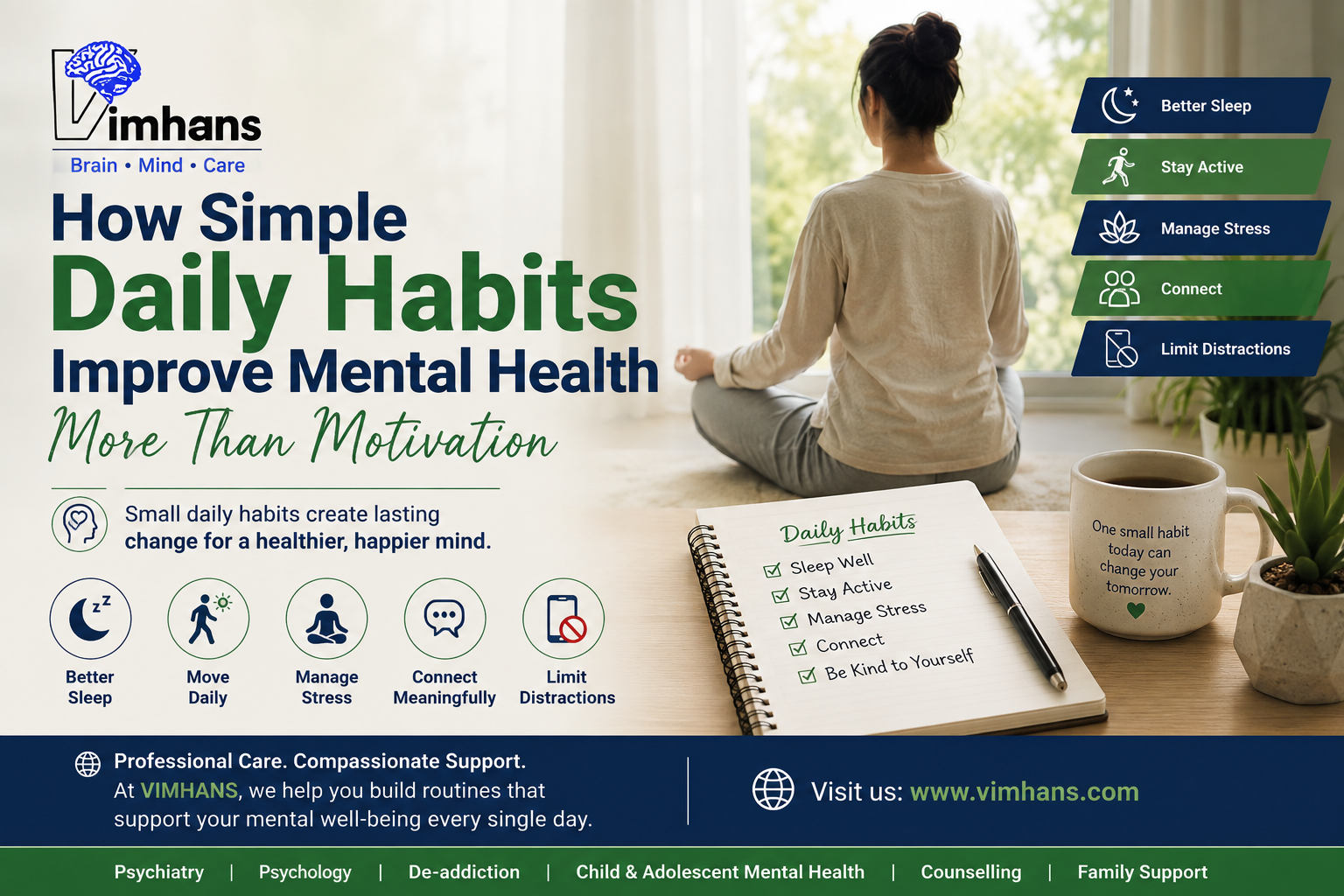
Improving mental health does not always require major lifestyle changes or waiting for the perfect moment to begin. In many cases, small and consistent actions can make a meaningful difference over time. A regular sleep schedule, a short walk, a few minutes of breathing exercises, or a meaningful conversation can gradually become part of a healthier emotional routine.
The challenge is that people often wait until they feel motivated, energetic, or emotionally ready before making changes. Unfortunately, difficult days are often exactly when motivation is lowest. This is why building daily habits for mental health can be more sustainable than relying on motivation alone.
At VIMHANS, mental health care can include professional guidance, therapy, counselling, and support that helps individuals understand their needs and develop practical strategies for everyday wellbeing.
Why Habits Matter More Than “Feeling Ready”
Motivation can be powerful, but it is not consistent. Stress, poor sleep, emotional difficulties, work pressure, and life changes can all affect how motivated a person feels.
Habits work differently. Once a behaviour becomes part of a routine, it requires less conscious effort. Instead of asking yourself, “Do I feel like doing this today?”, a healthy action can simply become something you normally do.
This is particularly important when developing mental health routine tips that are realistic enough to continue during both good and difficult periods.
Why Daily Habits Support Long-Term Emotional Wellbeing
How Small Repeatable Actions Rewire the Brain
The brain responds to repetition. When an action is repeated regularly, it can become more automatic and easier to maintain.
For example, going outside for a short walk each morning may initially require conscious effort. Over time, however, it can become associated with the beginning of the day. Similarly, maintaining a consistent bedtime can help establish a predictable sleep routine.
These small behaviours do not solve every mental health concern, but they can create supportive foundations for emotional wellbeing. This is one reason daily habits for mental health are often more useful when they are simple, realistic, and repeated consistently.
Habits Reduce Decision Fatigue and Protect Energy
Everyday life involves hundreds of decisions. When someone is already dealing with stress or emotional exhaustion, deciding when to exercise, sleep, eat, disconnect from technology, or take a break can feel overwhelming.
A routine reduces some of these decisions.
For example, having a regular bedtime means you do not have to decide every night whether it is time to start winding down. A planned morning walk removes another decision from your day.
By making healthy behaviours predictable, routines can help conserve mental energy for more important tasks.
Why Motivation and Willpower Are Unreliable on Tough Days
Motivation naturally changes. You may feel highly motivated one day and struggle to get started the next.
Relying entirely on motivation can therefore create an inconsistent pattern: intense effort followed by exhaustion, followed by guilt when the routine stops.
A habit-based approach is more forgiving. The aim is not to feel motivated every day. Instead, it is to make the desired behaviour small and manageable enough that it can still happen when motivation is low.
Common Barriers to a Mental Health Routine
Waiting to “Feel Better” Before Starting
One of the most common barriers is waiting for emotional wellbeing to improve before introducing healthy routines.
Someone may think, “I will start exercising when I feel less tired,” or “I will fix my sleep schedule once my stress decreases.”
But waiting can create a cycle where nothing changes because the person is waiting for the very improvement that the routine may help support.
Starting with something extremely small can break this cycle.
All-or-Nothing Thinking About Mental Health Routine Tips
Another barrier is believing that a routine only counts if it is followed perfectly.
For example, someone may plan to exercise for 45 minutes every day. If they miss one day, they may feel that they have failed and abandon the routine altogether.
A healthier approach is flexibility. Ten minutes of movement can still be worthwhile. A few minutes of journaling can still count. Going to bed slightly earlier can still be a positive step.
Effective mental health routine tips should support consistency without creating unnecessary pressure.
Guilt and Stigma Around Needing Support
Some people feel guilty about prioritising their mental health or believe that asking for professional help means they are unable to cope.
Mental health deserves the same attention as physical health. Seeking support is not a sign of weakness. It can be a practical step towards understanding difficulties and developing healthier ways to manage them.
Professional guidance can also help when everyday habits alone are not enough.
Simple Daily Habits VIMHANS Clinicians Recommend
There is no single routine that works for everyone. Individual needs vary depending on lifestyle, stress levels, emotional wellbeing, physical health, responsibilities, and existing mental health concerns.
However, several simple habits can provide useful foundations.
Sleep Anchors: Consistent Bed and Wake Times
Sleep and mental wellbeing are closely connected. Irregular sleep patterns can make it harder to manage mood, concentration, energy, and stress.
One practical daily habits for mental health strategy is to establish relatively consistent sleep and wake times.
Instead of trying to completely change your sleep schedule overnight, gradually work towards a predictable pattern. Creating a calming wind-down period before bed can also help signal that the day is coming to an end.
If persistent sleep difficulties are affecting daily functioning, professional assessment may be appropriate.
Gentle Movement and Light Exposure as Mental Health Routine Tips
Movement does not always need to mean an intense workout.
A short walk, stretching, gentle exercise, or another enjoyable physical activity can make movement easier to incorporate into everyday life. Spending some time outdoors and getting natural light can also help establish a regular day-night rhythm.
The most sustainable approach is choosing an activity that fits your current energy level rather than setting unrealistic expectations.
Short Check-Ins: Breathwork, Grounding, or Journaling
Mental health routines do not have to take hours.
A few minutes of intentional breathing, grounding exercises, or journaling can create a brief pause during a busy day.
A simple check-in could involve asking:
- What am I feeling right now?
- What is taking up most of my mental energy?
- What do I need at this moment?
- What is one manageable thing I can do next?
These short pauses can help people become more aware of their emotional state rather than automatically reacting to stress.
Digital Boundaries and News Limits to Protect Mood
Constant notifications, social media scrolling, and continuous exposure to distressing news can contribute to mental overload.
Creating simple digital boundaries may help. This could include turning off unnecessary notifications, keeping phones away during meals, avoiding excessive scrolling before bed, or setting specific times to check news.
The goal is not necessarily to eliminate technology but to create healthier boundaries around it.
Connection Habits: One Meaningful Conversation a Day
Human connection is an important part of emotional wellbeing.
A meaningful conversation does not have to be long. Calling a family member, checking in with a friend, speaking with a colleague, or spending intentional time with someone you trust can create a sense of connection.
For someone who is struggling emotionally, maintaining social contact can be particularly important. If isolation or withdrawal becomes persistent, professional support may also be beneficial.
How to Build a Mental Health Routine You Can Stick With
Start Tiny: One or Two Mental Health Routine Tips at a Time
Trying to change everything at once can quickly become overwhelming.
Instead, choose one or two habits that feel realistic. For example, you might begin with a consistent wake-up time and a 10-minute walk.
Once those behaviours become easier, you can gradually introduce another habit.
The purpose is to build a routine that works in real life—not an ideal routine that is impossible to maintain.
Pair New Habits With Existing Routines (Stacking)
Habit stacking involves connecting a new behaviour with something you already do.
For example:
- After brushing your teeth, spend two minutes practising slow breathing.
- After your morning tea, step outside for a few minutes.
- After lunch, take a short walk.
- Before getting into bed, write down one thought from the day.
Because the existing activity already happens regularly, it can act as a reminder for the new behaviour.
Track Progress With Compassion, Not Perfection
Tracking can help you notice patterns, but it should not become another source of pressure.
Missing a habit does not erase previous progress. Instead of thinking, “I failed,” consider asking, “What made this difficult today?”
Perhaps you were tired, travelling, dealing with an unexpected responsibility, or experiencing a difficult emotional day.
A sustainable mental health routine allows room for life to happen.
How VIMHANS Supports Your Daily Mental Health
Daily habits can provide valuable support, but they are not a substitute for professional mental health care when someone is experiencing significant or persistent difficulties.
VIMHANS can help individuals explore their mental health concerns and identify appropriate forms of professional support.
Clinical Guidance to Personalise Daily Habits for Mental Health
Mental health is individual. A routine that works well for one person may not be appropriate for another.
Professional guidance can help identify which daily habits for mental health may be practical based on an individual's circumstances, concerns, lifestyle, and goals.
Instead of following generic advice, personalised guidance can help turn broad recommendations into realistic steps.
Therapy and Counselling to Remove Blocks to Routine
Sometimes the problem is not knowing what to do—it is understanding what is preventing you from doing it.
Stress, anxiety, low mood, difficult thought patterns, relationship concerns, or other emotional challenges can interfere with everyday routines.
Therapy and counselling can provide a supportive environment to explore these barriers and develop healthier coping strategies.
Ongoing Caregiver and Family Support Through VIMHANS Services
Mental health can affect more than the individual. Family members and caregivers may also need information, guidance, and support when someone is experiencing emotional or psychological difficulties.
A supportive environment can make it easier to maintain healthy routines and recognise when additional professional care may be needed.
Sustainable Change Starts With One Daily Habit | Final Thoughts
Why Slow, Steady Habits Beat Sudden Bursts of Motivation
Lasting change rarely depends on one highly motivated day.
A person may feel inspired to completely transform their lifestyle and create an ambitious schedule, only to find it difficult to maintain a few weeks later.
Small habits are often easier to repeat. Over time, those repetitions can create structure, predictability, and a stronger foundation for wellbeing.
The goal is not to build a perfect life or follow every piece of advice at once. It is to identify a few daily habits for mental health that are realistic enough to continue.
How VIMHANS Helps You Design Mental Health Routine Tips That Fit Real Life
Mental health routines should fit around real people and real lives. Work, family responsibilities, relationships, physical health, stress, and unexpected events can all affect how much energy someone has each day.
At VIMHANS, professional mental health support can help individuals understand their concerns, work through barriers, and identify practical strategies that fit their circumstances.
If you are struggling to maintain everyday routines or feel that stress, anxiety, low mood, or other emotional difficulties are affecting your daily life, seeking professional guidance can be an important step.
You do not have to change everything at once. Sometimes, sustainable progress begins with one small habit—and the support to keep going.