



Bulgaria real estate in 2026: Why the Market Continues to Attract Serious Investment
Bulgaria is entering 2026 with a property market that looks increasingly compelling to investors seeking growth, rental performance, and relatively accessible entry prices compared with many other European destinations. The country has moved well beyond its earlier reputation as a purely low-cost market. Today, the strongest investment case for Bulgaria rests on a more mature combination of urban expansion, infrastructure upgrades, tourism resilience, regional business growth, and a widening base of domestic and international demand.
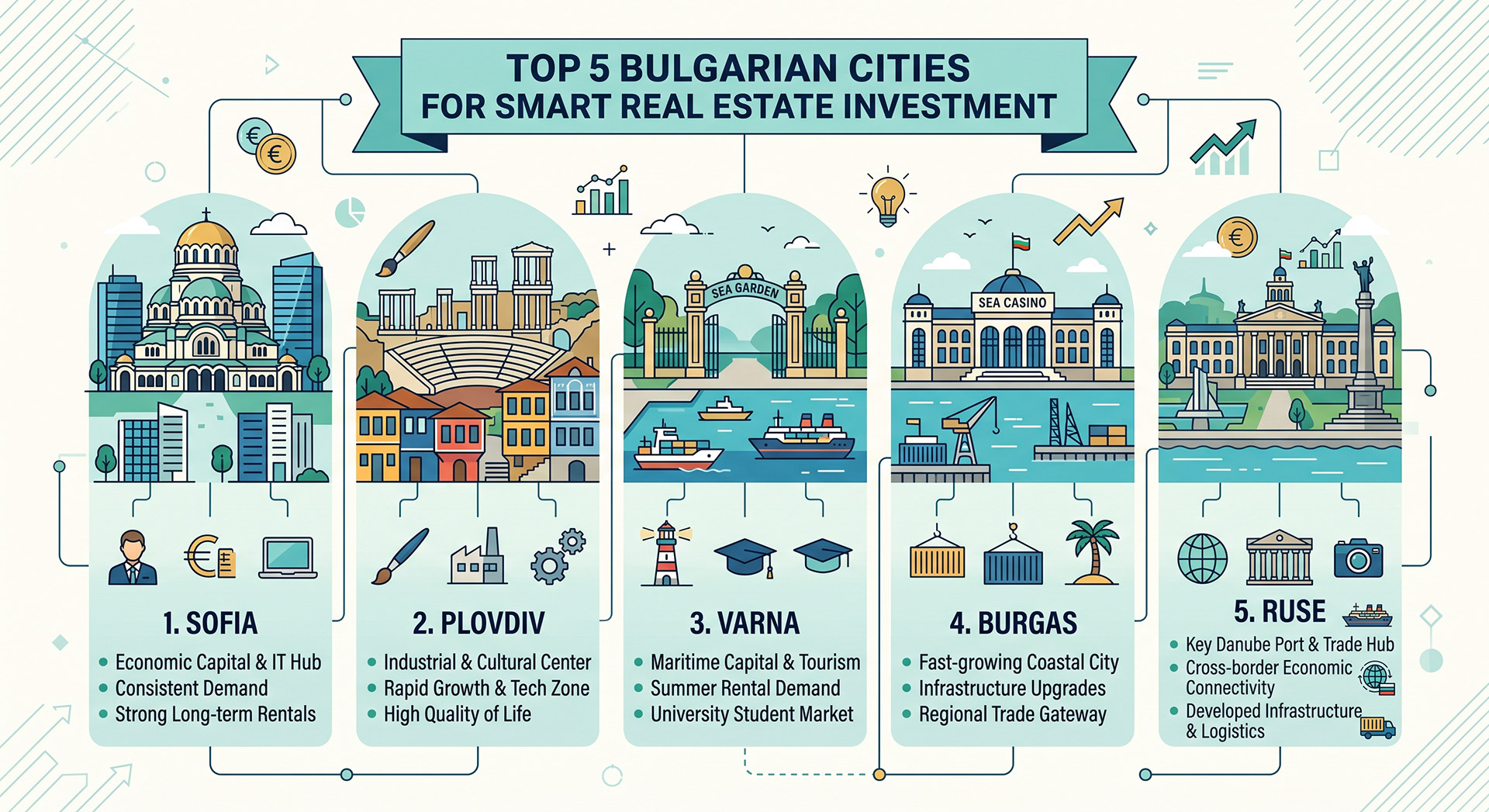
For investors, this creates an unusually broad range of opportunities. The market is no longer defined by one single story. Sofia remains the obvious center of business activity and long-term value preservation, but it is not the only city capable of delivering strong returns. Plovdiv continues to draw attention for its industrial base and lifestyle appeal. Varna combines sea access, local population depth, and year-round demand in a way that gives it more stability than many resort-led locations. Burgas, selected mountain areas, and carefully chosen secondary cities also deserve serious consideration when capital growth and rental income are both part of the investment objective.
What makes 2026 especially important is that investors are now evaluating Bulgaria through a more selective lens. Easy bargains are less common in the most established areas, but that does not mean the growth story is over. Instead, the market is becoming more segmented. Prime districts, transport-linked neighborhoods, modern energy-efficient buildings, and properties suited to professional tenants or quality short-stay guests are pulling ahead. The result is a market where informed selection matters more than ever, and where the best-performing locations are likely to reward strategic investors rather than purely speculative buyers.
This article provides a confident overview of the most promising places to invest in Bulgaria in 2026, with a focus on demand drivers, value trends, rental potential, and the practical considerations that separate strong opportunities from average ones.
Bulgaria real estate market fundamentals that support growth in 2026
The strength of Bulgaria real estate in 2026 rests on several structural supports. First, urbanization continues to concentrate economic activity in a handful of key cities. Young professionals, students, remote workers, and families are not spreading evenly across the country. They are moving toward places with better jobs, stronger transport links, modern services, and better educational options. This creates a clear advantage for major urban centers and selected regional hubs.
Second, Bulgaria remains competitively priced by European standards, even after several years of growth. This matters because investors are increasingly comparing Bulgaria not only to neighboring markets in Southeast Europe, but also to secondary cities in Central and Western Europe where yields have compressed and acquisition costs have risen sharply. Bulgaria’s relative affordability gives room for both domestic upgrading and foreign capital inflows, especially in the mid-market residential segment.
Third, rental demand is becoming more diversified. Traditional long-term residential renting remains important, but it now overlaps with business travel, student demand, domestic relocation, seasonal leasing, and flexible urban living arrangements. In cities with balanced local economies, that diversification strengthens occupancy and reduces the risk attached to any one tenant group.
Fourth, buyers are showing a stronger preference for quality. Newer buildings, better insulation, efficient layouts, parking availability, elevator access, and proximity to public transport increasingly influence pricing power. In practical terms, this means investors who buy the right product in the right district may outperform the broader market, even if national averages appear moderate.
Finally, the investment case is reinforced by Bulgaria’s geographic position. The country sits at a useful intersection of European trade routes, tourism flows, and regional logistics. This supports city-level economies in ways that directly affect property performance, particularly in markets tied to manufacturing, port activity, transport, technology services, or tourism infrastructure.
How to buy property Bulgaria successfully in a more competitive investment landscape
To buy property Bulgaria successfully in 2026, investors need a disciplined approach rather than a bargain-hunting mindset alone. The strongest opportunities are increasingly found through local knowledge, district-level analysis, and a clear understanding of tenant demand. Buying simply because a property appears inexpensive is no longer enough. Low entry cost without a demand base can lead to weak appreciation, longer vacancies, and lower liquidity at resale.
The first principle is to focus on location quality within each city, not just the city itself. In every major Bulgarian market, some neighborhoods are clearly outperforming others. Districts close to business zones, universities, medical centers, transport nodes, and established retail corridors tend to show more resilient demand. Properties in these areas are easier to rent, easier to finance, and easier to exit when market conditions shift.
The second principle is to define the investment model before acquisition. Investors looking for long-term income may prioritize practical residential units with broad tenant appeal, such as one-bedroom or two-bedroom apartments in modern buildings. Those targeting short-stay income need to be more selective, because tourism exposure can produce strong returns in some locations but more volatility in others. A successful acquisition strategy depends on matching the asset to the local demand pattern.
The third principle is legal and technical due diligence. Investors should verify title clarity, building permits, maintenance obligations, common area quality, and any restrictions affecting usage. In Bulgaria, as in any market, the difference between a good transaction and a problematic one often lies in details that are not visible in listing photos. Professional review of documentation, property condition, and neighborhood pipeline supply is essential.
The fourth principle is to evaluate rental yield alongside appreciation potential. Some districts offer rapid value growth but compressed rental returns. Others produce stable yields but limited upside. The strongest 2026 investments are generally those where both factors are present to a reasonable degree. This usually means established but still improving neighborhoods rather than fully saturated premium zones.
For investors entering the Bulgarian market for the first time, discipline, local guidance, and careful asset selection matter far more than chasing the cheapest deal. The market is rewarding quality decisions, not just low prices.
Sofia as the leading benchmark for urban property performance
Any serious discussion of Bulgarian investment hotspots must begin with Sofia. The capital remains the country’s largest and most liquid real estate market, and in 2026 it continues to offer the strongest mix of employment concentration, business demand, population pull, and resale depth. Sofia is where investors often find the clearest long-term fundamentals, even if gross yields may not always match those available in smaller cities.
The city benefits from its role as the administrative, corporate, educational, and technology center of the country. Demand comes from professionals, students, executives, relocating families, and international firms. This broad base supports both owner-occupier and rental activity. In periods when speculative sentiment fades, Sofia generally holds up better than more one-dimensional markets because underlying demand remains strong.
Not every part of Sofia performs equally. The most attractive investment areas are often districts with metro access, quality schools, modern retail, and newer residential stock. Well-connected southern neighborhoods, selected central areas, and districts undergoing visible infrastructure improvement continue to attract buyers willing to pay a premium for convenience and quality of life. Compact units in these areas tend to be highly liquid, while larger family apartments in top micro-locations can deliver strong long-term capital preservation.
For investors looking to explore the market in greater detail, reviewing current property for sale in Sofia can provide a useful perspective on pricing, available property types, and opportunities across different neighborhoods. From centrally located apartments to newer developments in well-connected residential districts, comparing active listings can help investors identify areas that best match their investment strategy, budget, and expected rental or capital-growth potential.
For 2026, Sofia’s appeal is especially strong for investors who value stability, year-round occupancy, and institutional-grade demand patterns. It may not be the cheapest market in Bulgaria, but it remains the benchmark against which all other city investments are measured.
Plovdiv real estate opportunities driven by industry, culture, and livability
Plovdiv real estate has become one of the most convincing stories in Bulgaria’s regional property landscape. The city combines several strengths that are difficult to replicate elsewhere in the country. It has a substantial industrial and logistics base, a growing service economy, a respected cultural profile, and a quality-of-life advantage that appeals to both local buyers and incoming residents. In 2026, this combination supports both capital growth and healthy rental demand.
One of Plovdiv’s biggest advantages is its economic diversity. The city is not dependent on a single sector. Manufacturing, logistics, trade, education, and tourism all contribute to demand. This creates a more stable tenant base and reduces the vulnerability that can affect markets tied too closely to one industry. Investors often find that this diversity translates into more resilient occupancy levels across different property types.
The city also benefits from a strong identity. Plovdiv is one of the oldest continuously inhabited cities in Europe, and its historic character gives it a cultural appeal that supports short-stay and lifestyle-driven demand. At the same time, it functions as a modern regional center with business activity that extends well beyond tourism. This dual identity is important. It means investors can access a city with broad appeal rather than a narrowly seasonal market.
Residential demand in Plovdiv is strongest in neighborhoods with good access to the center, major roads, retail, and universities. New-build apartments with efficient layouts are especially attractive to young professionals and small families. Investors targeting long-term rentals often perform well with mid-sized units in practical locations, while carefully selected boutique properties in central or historic-adjacent areas may suit premium or short-stay strategies.
Plovdiv real estate also stands out for its relative value compared with Sofia. While prices have risen, many investors still see room for further appreciation as the city expands and modernizes. For buyers seeking a balance between growth and affordability, Plovdiv remains one of the most persuasive options in Bulgaria for 2026.
Real estate Varna prospects shaped by the sea, business activity, and year-round demand
Real estate varna deserves a central place in any 2026 investment ranking. Varna is more than a summer destination. It is one of Bulgaria’s most important coastal cities, with a substantial local population, business functions, educational institutions, medical infrastructure, and transport relevance. That year-round depth makes it notably stronger than purely resort-driven markets and gives investors access to a more balanced demand profile.
The city’s coastal setting naturally supports tourism and short-term rental potential, especially in well-positioned central and sea-adjacent districts. However, the more compelling long-term story is that Varna also works as a permanent living city. Professionals, students, healthcare workers, service-sector employees, and families create consistent housing demand outside the peak travel season. This reduces one of the main risks associated with coastal investment, namely overdependence on summer occupancy.
In 2026, the best opportunities in Varna are likely to be found in neighborhoods that combine livability with access. Areas close to the city center, major boulevards, universities, business zones, and the seafront continue to attract attention. Well-designed apartments with parking, terraces, and modern building standards can command strong rental interest, particularly when they suit both long-term residents and flexible rental models.
Investors should still be selective. Some properties marketed on the strength of sea proximity alone may underperform if they lack transport convenience or year-round appeal. The strongest Varna assets are those that work in multiple scenarios: long-term residential, business accommodation, and seasonal demand. This adaptability is what makes real estate varna particularly attractive in a market where flexibility increasingly drives value.
Compared with many coastal markets elsewhere in Europe, Varna still offers a relatively accessible entry point. For investors seeking a coastal city with real economic substance, it remains one of the best-positioned locations in Bulgaria.
Burgas and the southern coast as a selective but promising investment zone
Burgas has often stood slightly in the shadow of Varna in investor discussions, yet in 2026 it offers a compelling case of its own. The city combines port significance, regional administrative importance, improved urban environment, and access to the southern Black Sea coast. For investors who want a coastal market but prefer a somewhat more measured and selective pricing environment, Burgas can be highly attractive.
The key to Burgas is understanding the difference between the city itself and the broader resort belt. Within Burgas, demand is more stable and less seasonal because the local economy is not driven solely by tourism. Residential rental demand comes from local workers, families, students, and regional business activity. This supports more dependable occupancy than many resort locations can offer.
Along the southern coast, certain resort-linked areas can still generate strong returns, but they require more caution. Properties that rely almost entirely on peak summer bookings may deliver uneven performance if supply is high or management is weak. By contrast, city-based assets in Burgas with good access to services and transport tend to provide steadier investment outcomes.
For 2026, Burgas is best seen as a market where careful selection can uncover value. It may not command the same broad investor attention as Sofia or Varna, but that is part of its appeal. It remains one of Bulgaria’s more underrated urban-coastal opportunities.
Mountain and resort markets: where growth can still be captured with discipline
Bulgaria’s mountain and ski-oriented property markets continue to attract interest, especially from investors looking for short-term rental income and lower acquisition costs. In 2026, however, these areas should be approached as specialist plays rather than broad-based investment defaults. Some assets can perform very well, particularly in established destinations with improving infrastructure and active year-round tourism strategies. Others may struggle with oversupply, building quality issues, or highly seasonal cash flow.
The strongest resort opportunities are typically properties with clear competitive advantages. These may include proximity to lifts or town centers, modern construction, strong management, spa or wellness facilities, and genuine four-season appeal. Locations that attract visitors beyond the winter season are generally in a stronger position because they spread occupancy more evenly and reduce reliance on one part of the year.
Investors considering resort markets need to be realistic about management intensity. These are not passive assets in the same way as a straightforward city apartment leased to a long-term tenant. Success depends on marketing, operations, maintenance, guest experience, and service standards. Where these elements are missing, even a well-located unit may underperform.
For investors with the right strategy and local support, selected mountain properties can still complement an urban-focused portfolio. But in 2026, the best growth outlook in Bulgaria remains more clearly visible in real working cities than in purely seasonal resort zones.
Secondary cities and emerging regional hubs worth watching
Beyond the major names, a number of secondary cities in Bulgaria deserve attention as emerging regional hubs. These markets may not yet offer the liquidity or profile of Sofia, Plovdiv, or Varna, but they can present value opportunities where local economic activity, university presence, or transport relevance supports housing demand.
Cities such as Stara Zagora, Ruse, and Pleven periodically enter investor discussions because they combine regional importance with lower acquisition costs. The challenge in these locations is that performance can vary sharply by neighborhood and property type. An investor who buys a modern apartment near a strong employment or education node may do very well, while a poorly located asset can remain difficult to rent or resell.
These markets are generally best suited to investors who either know the area well or work closely with reliable local experts. They can provide better initial yields than top-tier cities, but they also require more precision. As Bulgaria’s economy continues to develop unevenly across regions, secondary city opportunities will exist, but they will remain highly selective rather than broadly market-wide.
Rental demand in 2026: where income potential is strongest
Rental performance in Bulgaria is becoming increasingly location-specific, and in 2026 the best income potential is concentrated in cities and districts with genuine year-round demand. Long-term rentals remain the core of the market, especially in Sofia, Plovdiv, Varna, and Burgas. Demand is strongest for practical, well-maintained apartments that match the needs of professionals, students, couples, and small families.
One-bedroom units and efficient two-bedroom apartments continue to perform particularly well because they address the broadest tenant pool. Properties close to transport, supermarkets, business districts, and universities tend to lease faster and experience shorter vacancy periods. Features such as modern kitchens, energy efficiency, air conditioning, and parking access can significantly improve rental competitiveness.
Short-term rentals remain viable in selected urban and coastal zones, but they are no longer a universal formula for superior returns. Investors need to consider regulation, seasonality, building rules, and operational costs. In many cases, a high-quality long-term tenant can deliver a more stable and predictable outcome than a heavily managed short-stay model.
The strongest rental opportunities in 2026 are therefore not necessarily the most glamorous. They are usually properties that align closely with everyday housing needs in economically active locations. Reliability, not novelty alone, is what supports strong income over time.
Pricing trends and where value growth is most likely to continue
Price growth in Bulgaria is expected to remain uneven in 2026, with the best-performing segments likely to be modern urban housing in supply-constrained or high-demand districts. Prime and near-prime neighborhoods in Sofia should continue to benefit from sustained demand, though at a more measured pace than in earlier acceleration phases. In Plovdiv and Varna, there may still be more visible room for upward movement in well-chosen districts because these cities are continuing to deepen their economic and residential appeal.
Older stock in weaker locations may not keep pace. This is a critical point for investors. The Bulgarian market is not rising uniformly. Buildings with outdated layouts, poor insulation, no lift, or weak maintenance may see softer growth even in cities with positive overall momentum. By contrast, newer or refurbished properties in districts with strong access and services can outperform significantly.
Infrastructure remains one of the clearest signals for future value growth. Areas benefiting from transport improvements, commercial development, educational expansion, or public realm upgrades often experience sustained pricing support. Investors who identify these changes early can position themselves ahead of wider market recognition.
Using a real estate portal wisely to identify real opportunities
A real estate portal is an essential research tool in Bulgaria, but in 2026 it should be treated as a starting point rather than a final decision engine. Portals are highly useful for tracking asking prices, comparing neighborhoods, understanding unit sizes, and spotting supply trends. They help investors see how different cities are positioning themselves and where inventory is tightening or expanding.
However, portal data has limitations. Asking prices do not always reflect final transaction values, listing quality can vary, and duplicate or outdated listings may distort the picture. Some of the best opportunities are also sourced through local agents, developer networks, legal contacts, and off-market channels that may not be fully visible online.
The smartest way to use a real estate portal is to combine broad market scanning with disciplined verification. Investors should compare multiple listings in the same district, track how long similar properties remain on the market, and assess whether the advertised pricing aligns with the quality of the building and surrounding area. Portal research becomes far more powerful when paired with local due diligence and a clear investment thesis.
In practical terms, portals help identify patterns, but successful investors still win through judgment. The market rewards those who can distinguish between a well-marketed property and a genuinely strong asset.
What the best investors will prioritize in Bulgaria in 2026
The investors most likely to succeed in Bulgaria in 2026 will be those who focus on resilience, not just headline yield. They will prioritize cities with broad economic foundations, neighborhoods with visible demand, and properties that appeal to a large tenant base. They will look for quality construction, efficient layouts, strong transport links, and flexibility of use. They will also understand that capital growth increasingly depends on selectivity rather than simply participating in the market.
For many, Sofia will remain the safest core holding. For others, Plovdiv will offer one of the most attractive growth-to-price ratios in the country. Varna will stand out as a coastal city with year-round depth, while Burgas will appeal to investors who value selective urban-coastal potential. Secondary cities and resort markets can still add value, but only when approached with sharper analysis and realistic expectations.
The broader message is clear. Bulgaria is no longer just an inexpensive alternative market. It is an increasingly differentiated investment landscape where location, quality, and strategy determine outcomes. That is a positive development for serious investors, because it means the market is maturing in ways that reward expertise and long-term thinking.
Final investment outlook for Bulgaria’s strongest hotspots
Bulgaria’s real estate market in 2026 offers a strong proposition for investors who want exposure to a European growth story without the pricing barriers seen in more saturated markets. The best opportunities are concentrated in cities and regions where economic activity, population movement, and quality housing demand are reinforcing one another. Sofia continues to lead in scale and security. Plovdiv remains one of the country’s most balanced growth markets. Varna brings the rare combination of coastal appeal and year-round urban strength. Burgas offers selective upside with a more understated profile. Beyond them, carefully chosen regional cities and specialist resort assets may also have a place in a well-constructed portfolio.
The decisive factor is selectivity. Investors who choose strong micro-locations, modern buildings, and assets aligned with real demand are likely to find Bulgaria one of the more rewarding property markets in the region. In 2026, the country’s best investment hotspots are not just places with rising prices. They are places with staying power, real tenant demand, and the capacity to keep attracting capital as the market becomes more sophisticated.


Why Smart Investors Are Looking at Bulgaria real estate Right Now
Bulgaria has moved from being a niche market to becoming one of the more interesting real estate stories in Europe. For inv