

Countertops take a lot of abuse. They are used every day for preparing meals, setting down groceries, making coffee, doing homework, and just about everything else that happens in a kitchen. Over time, even a well-built countertop can start to look worn or simply feel outdated.
Replacing an old countertop with new granite can completely change the appearance of a kitchen. But there is more to choosing granite than finding a color you like and having it installed.
The stone itself, the layout of the kitchen, the edge detail, the sink, the cabinets, and even the backsplash all need to work together.
If you're considering installing new granite countertops as part of a **kitchen remodel**, here are some things worth thinking about before the installation begins.
Why Choose Granite?
Granite has been a popular countertop material for many years, and there is a good reason for that.
Every slab of natural granite is different. The colors, patterns, movement, and mineral variations are created naturally, so a granite countertop doesn't necessarily look exactly like one you saw in a showroom or in a photograph.
That uniqueness is one of the biggest attractions of natural stone.
Granite is also durable and well suited to the demands of a busy kitchen when it is properly installed and maintained.
For homeowners who want a natural material with a substantial, high-quality appearance, granite remains a very good option.
Choosing the Slab Is More Important Than Looking at a Small Sample
One mistake homeowners can make is choosing their countertop based on a small sample.
Granite can look completely different when you see an entire slab.
A small sample may show only a tiny portion of the stone's pattern. When that pattern is expanded across a large island or a long countertop, the overall appearance can be dramatically different.
That's why it's worth seeing the actual slab whenever possible.
Pay attention to the overall movement of the stone. Some granite has fairly consistent coloring, while other slabs have large veins, patches, or dramatic variations.
Neither is necessarily better. It simply depends on the look you're trying to achieve.
Consider the Cabinets Before Choosing the Granite
Your countertops shouldn't be selected in isolation.
Cabinet color and style have a major influence on how the granite will look.
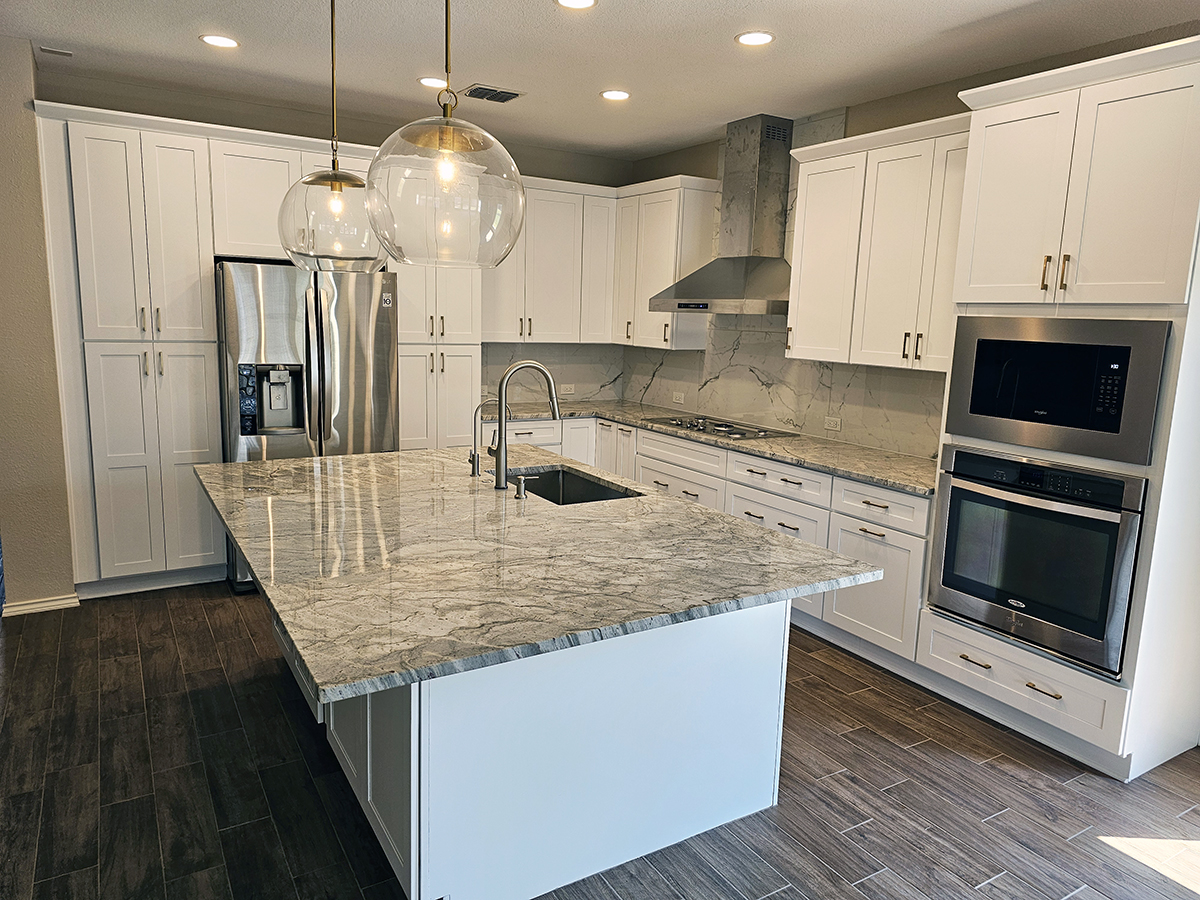
For example, a heavily patterned granite may look fantastic with relatively simple cabinetry. If both the cabinets and countertops have strong patterns, however, the kitchen can start to feel visually busy.
The same applies to backsplash tile.
Ideally, the cabinets, countertops, backsplash, flooring, and other major finishes should complement one another.
This doesn't mean everything needs to match. In fact, some contrast can make a kitchen much more interesting.
The goal is to make the different materials look like they belong together.
Think About the Size of Your Island
If you're installing granite as part of a kitchen remodel, you may also be changing the size or shape of your island.
This is something that should be considered before the countertop is ordered.
A larger island can provide more workspace and seating, but the surrounding walkways need to remain comfortable. An island that is too large can actually make a kitchen harder to use.
The countertop also needs to accommodate appliances, sinks, outlets, seating areas, and other features.
Good planning before fabrication can prevent problems later.
The Sink Affects the Countertop
The type and location of the sink should be decided before the granite is fabricated.
Undermount sinks are particularly popular with granite countertops because the countertop extends cleanly over the sink opening and there isn't a raised rim sitting on top of the counter.
Farmhouse sinks and other specialty sinks require additional planning because the cabinet and countertop need to be designed around them.
The sink cutout needs to be precise, so this isn't something you want to figure out after the granite has already been fabricated.
Don't Forget the Edge
The edge of the countertop is a small detail that can have a surprisingly noticeable effect on the finished kitchen.
There are many different edge profiles available, ranging from simple eased edges to more decorative profiles.
A simpler edge often works well in a modern or transitional kitchen. More traditional kitchens may benefit from a more decorative profile.
There's no universally correct choice. The edge should complement the cabinetry and overall design of the kitchen.
Granite Is Heavy
Granite countertops are substantial pieces of natural stone.
That means the cabinets underneath them need to provide appropriate support.
If you're replacing an existing countertop with granite, the condition and construction of the cabinets should be evaluated before installation. Cabinets that have been damaged by water, improperly modified, or weakened over the years may need repairs or reinforcement.
This is especially important when remodeling an older kitchen.
The countertop may be new, but it is still being installed into an existing house.
Older Homes Can Present Surprises
This is one of the less glamorous parts of remodeling.
You can have a beautiful granite slab selected and everything planned out, only to discover that the existing walls aren't perfectly straight or the cabinets aren't perfectly level.
Older homes can have uneven floors, walls that aren't square, cabinets that have shifted over time, and previous remodeling work that wasn't done particularly well.
That's normal with older houses.
The important thing is to identify these conditions before the countertop is fabricated whenever possible.
Granite is not a material you want to be cutting and modifying repeatedly because something wasn't measured correctly.
Seams Need to Be Planned Carefully
Depending on the size and shape of your kitchen, your granite countertop may require one or more seams.
This isn't necessarily a problem.
A good fabricator will determine where the seams should go based on the size of the slabs, the layout of the cabinets, and the characteristics of the stone.
The location of the seam can make a difference in how noticeable it is.
If you have a large island with dramatic movement in the granite, for example, the fabricator may need to pay particular attention to how the pieces are positioned.
This is another reason why slab selection and fabrication are important parts of the project.
What About Granite Maintenance?
Granite is relatively straightforward to maintain, but it isn't completely maintenance-free.
Different types of granite can have different characteristics, and some stones are more porous than others. Depending on the particular stone, sealing may be recommended.
Routine maintenance generally involves cleaning the surface appropriately and addressing spills rather than allowing them to sit for extended periods.
Your countertop supplier or fabricator should provide recommendations for the specific granite you select.
Granite Can Work With Many Different Kitchen Styles
One of the advantages of granite is the range of colors and patterns available.
A granite countertop can work in a traditional kitchen, a transitional kitchen, or a more contemporary space.
White and light-colored granite can help create a bright appearance. Darker granite can provide contrast against lighter cabinets. Stones with natural movement can become a focal point, particularly when used on a large island.
The important thing is to choose a stone that works with the entire kitchen rather than selecting it simply because it looks attractive by itself.
Don't Ignore the Backsplash
The countertop and backsplash meet in a very visible area, so the two materials should be considered together.
A busy granite countertop may look best with a relatively simple backsplash. If the granite is fairly subtle, you may have more freedom to use a decorative tile.
The backsplash can also be used to pull colors from the granite into the rest of the kitchen.
Taking a small piece of the actual granite slab when shopping for tile can be helpful because lighting can make colors look different in the showroom than they do next to the stone.
Granite Installation Requires Precision
Installing granite isn't simply a matter of carrying the slab into the kitchen and setting it on the cabinets.
Measurements need to be accurate. Sink openings need to be properly located. Appliances need to be accounted for. Seams need to be planned. Cabinets need to be sufficiently level and supported.
The pieces also need to be transported and handled carefully because granite is heavy and, despite its durability, can be damaged if improperly handled.
Professional fabrication and installation are important parts of getting a good finished result.
Is Granite Right for Your Kitchen?
Granite isn't the only countertop option available today.
Quartz, quartzite, marble, solid-surface materials, and other products all have their own advantages.
The best choice depends on how you use your kitchen, the appearance you're trying to achieve, your maintenance preferences, and your budget.
For homeowners who appreciate the natural variation of real stone and want a durable countertop with a distinctive appearance, granite can still be an excellent choice.
A Countertop Can Change the Entire Kitchen
One of the interesting things about replacing countertops is how much it can change a kitchen without necessarily changing everything else.
New granite can make older cabinets look better, provide a completely different color palette, and give the kitchen a more substantial appearance.
If you're already considering new cabinets, flooring, lighting, or backsplash tile, the countertop can become an important part of the overall design.
The best results come from considering all of those elements together.
Work With Someone Who Understands the Whole Remodeling Project
Countertop installation is only one part of a kitchen remodel.
The countertop needs to work with the cabinets. The cabinets need to work with the layout. The layout needs to work with the appliances. Plumbing and electrical work need to be coordinated with everything else.
That's why experience with the entire remodeling process can be valuable.
At Montfort Designs, we work with homeowners throughout Plano, Richardson, Dallas, and surrounding communities on kitchen remodeling projects that include cabinetry, countertops, flooring, lighting, tile, plumbing, electrical work, and layout changes.
Installing new granite countertops can be a relatively straightforward project when the existing kitchen is already in good shape. When you're remodeling the entire kitchen, however, it becomes one piece of a much larger puzzle.
Taking the time to plan that puzzle before construction begins can make all the difference.
The Bottom Line
New granite countertops can give a kitchen an entirely new look while providing a durable surface that can stand up to everyday use.
But choosing the right granite is only the beginning.
The slab, cabinet color, backsplash, sink, edge profile, island dimensions, seams, and existing condition of the kitchen all deserve consideration.
When those details are planned together, the countertop doesn't just look like something that was added to the kitchen. It becomes part of the design.
And that's what you want from a remodeling project—a finished kitchen where everything looks like it was meant to be there from the beginning.