

There's a pattern in infrastructure that repeats often enough to be predictable: a problem gets solved a hundred different ways by a hundred different teams, the duplication gets expensive enough to notice, and eventually one shared standard wins out and everyone quietly migrates to it. HTTP did it to proprietary networking protocols. Docker did it to bespoke deployment scripts. In 2026, the Model Context Protocol (MCP) is doing it to AI integrations — and the speed of that shift is worth sitting with for a moment.
The problem nobody wanted to admit was this expensive
For most of AI's recent history, connecting an assistant to anything outside a chat window meant custom, one-off integration work — rebuilt from scratch for every tool, and again for every AI provider a team happened to use. Developers had a name for this: the N×M problem. N AI applications trying to reach M tools, with every single pairing needing its own glue code. As both numbers grew, the number of required integrations grew faster still.
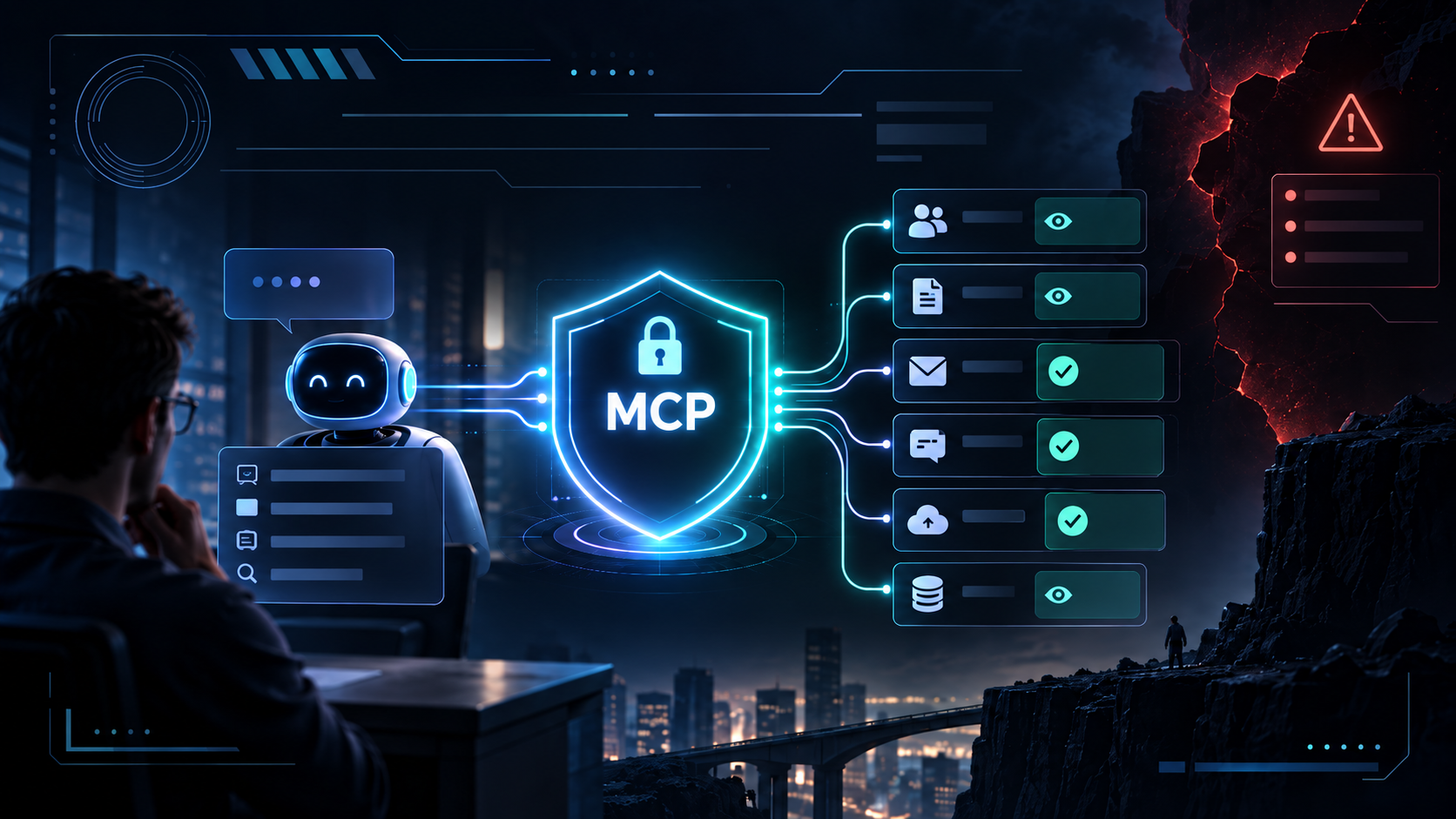
MCP, introduced by Anthropic in November 2024, exists specifically to collapse that N×M relationship into N+M. Every application and every tool builds to the protocol once; any combination of the two then works together without additional plumbing. It's the same shift Kubernetes brought to deployment — not a new capability, exactly, but a shared surface that stops everyone from separately reinventing the same wheel.
Why "2026" is the right word for this moment
A protocol becoming genuinely load-bearing infrastructure, rather than an interesting idea, tends to show up in a few concrete signals — and MCP has hit all of them within about eighteen months of launch.
Adoption at a scale that stops looking optional. By mid-2026, the TypeScript and Python SDKs had each individually crossed a billion total downloads, with combined monthly downloads across the protocol's Tier 1 SDKs approaching half a billion. That's not early-adopter noise; that's a default.
Genuine vendor neutrality, not the marketing kind. What started as an Anthropic project is now used by ChatGPT, Cursor, Gemini, Microsoft Copilot, and Visual Studio Code, among thousands of other applications. When your direct competitors are building on the same rails you are, "vendor-neutral" stops being a slide in a pitch deck.
A governance model built for the long haul. In December 2025, Anthropic donated MCP to the Agentic AI Foundation under the Linux Foundation — co-founded alongside Block and OpenAI, with Google, Microsoft, AWS, Cloudflare, and Bloomberg all participating. That's the same neutral stewardship structure used for Kubernetes and Node.js. Standards that outlive their original creator tend to be the ones companies are willing to build five-year roadmaps around.
A protocol that's still actively maturing, not standing still. The 2026-07-28 specification — described by its own maintainers as the largest revision since launch — moved the protocol's core to a fully stateless architecture that scales on ordinary HTTP infrastructure, alongside a formal extensions framework and hardened, OAuth-aligned authorization. Standards that stop evolving get replaced; this one is still being actively hardened for production use.
What this actually changes if you're the one building things
The abstract N×M-to-N+M pitch is nice, but the practical shift shows up in a handful of very specific ways for engineering teams:
- Integration work stops being bespoke. An MCP server built once — by a tool vendor, an internal platform team, or the open-source community — works with any MCP-compatible host, whether that's an IDE, a terminal agent, or a custom internal tool. You stop paying the integration tax twice.
- Autonomy without losing the steering wheel. Because MCP formally separates tools (actions) from resources (read-only data), a host can let an agent freely read logs or documentation while still requiring explicit approval before it deploys or merges anything consequential. That's what makes real autonomy practical rather than reckless.
- Vendor lock-in gets a real hedge. An organization that switches AI providers, or lets different teams use different ones, doesn't have to rebuild its tool integrations from scratch each time. That portability matters more every quarter the AI landscape keeps shifting.
- It's becoming a procurement question, not just a developer one. MCP support is quickly turning into a real evaluation criterion for enterprise AI buyers — whether a vendor can implement MCP-based integrations is now part of the conversation, not an afterthought.
The turning point, in one sentence
MCP stopped being "an interesting protocol from Anthropic" and became "the plumbing most of the industry has agreed to build on" — and that transition is largely what 2026 will be remembered for in AI infrastructure circles.
If you want the full technical picture — how the protocol's roles actually work, what changed in the newest spec, and where the real security tradeoffs sit — Globaldev has published a detailed guide to MCP AI integration that's a solid next read.
The teams that treated MCP as a passing trend in 2025 are, by now, mostly the ones writing custom connectors nobody else has to write anymore. That's usually how these turning points look in hindsight — obvious after the fact, and easy to miss while it's happening.

The global Micro-Channel Plate Market report offers a comprehensive assessment of the market for the forecast years.
This global industry offers an outlook on the strategic development of the market in terms of revenue profits over the forecast period 2021-2026.The key market players for the global Micro-Channel Plate market are listed below:Hamamatsu PhotonicsPHOTONISIncomBaspikNorth Night VisionTectra GmbHTopagOthersClick here to get a FREE Sample Copy of the Micro-Channel Plate Market Research Report @ https://www.decisiondatabases.com/contact/download-sample-25359The Global Micro-Channel Plate Market Report is equipped with market data from 2016 to 2026.
It also evaluates the competitive scenario of the leading players.
The detailed sales channel is also covered in the study.COVID-19 Impact Analysis on Micro-Channel Plate MarketThe global pandemic COVID-19 has affected the Micro-Channel Plate market directly or indirectly.
The detailed study highlights the probable outcomes of this global crisis on the Micro-Channel Plate industry.
The impact study on production, supply-demand, and sales provides a holistic approach to the future.Do You Have Any Query Or Report Customization?

A strategic implementation combined with appropriate data training constitutes the layers of AI-driven business automation.We, at Oodles, as an emerging Artificial Intelligence Development Company, decode business automation while highlighting key AI applications for attaining operational efficiency.
As an established Computer Vision Development Company, the Oodles’ AI team has built a CNN-based employee attendance system.
The model is integrated with a front-desk video camera that tracks employee movements with over 95% accuracy achieved.Learn more: AI Applications For Business Automation