Utility companies manage extensive networks of assets spread across large geographic areas. From power lines and substations to water pipelines, valves, and gas infrastructure, knowing where assets are located and how they connect is essential for reliable operations.
However, traditional asset management approaches can make it difficult to maintain a complete and accurate picture of utility infrastructure. Disconnected data, outdated records, complex network relationships, and limited visibility can slow down field operations and make decision-making more difficult.
This is where utility network management can make a significant difference. By combining GIS, network modeling, spatial data, analytics, and asset relationships, modern utility network environments can provide organizations with a more connected view of their infrastructure.
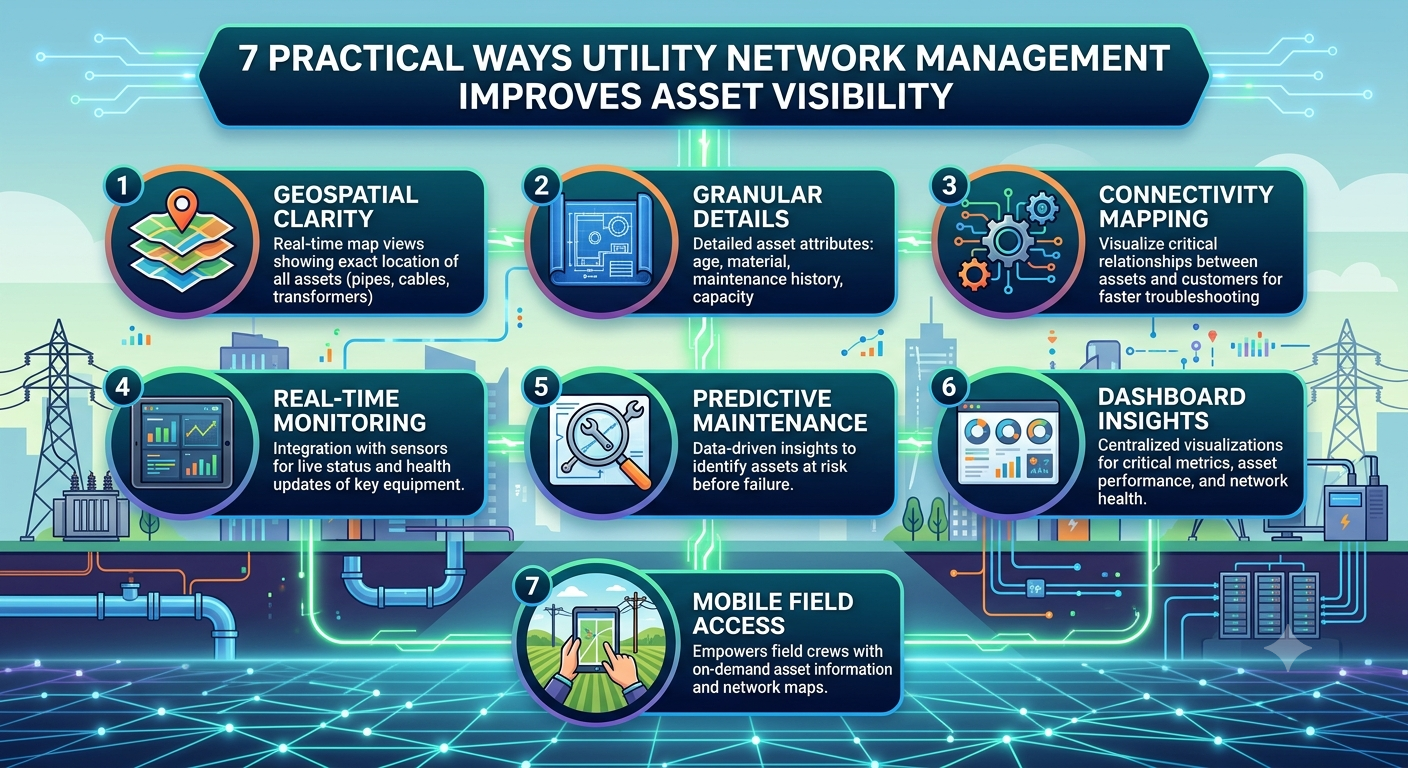
Here are seven practical ways utility network management can improve asset visibility.
1. Creates a Unified View of Utility Assets
One of the biggest challenges for utilities is maintaining asset information across different systems and departments.
A modern utility network brings asset information together within a structured geographic environment. Instead of viewing individual assets in isolation, organizations can understand their location, characteristics, connectivity, and relationships within the broader network.
For example, a utility can visualize a substation together with the feeders, transformers, switches, and customers connected to it. This unified perspective helps teams understand not only where an asset is, but also how it interacts with other assets.
A centralized network view can therefore reduce information gaps and provide operations, engineering, maintenance, and field teams with a common source of spatial information.
2. Improves Asset Location and Relationship Mapping
Knowing the precise location of an asset is important, but location alone does not provide the complete operational picture.
Utility networks contain complex relationships. A valve may control a particular section of a water network, while a switch may determine how electricity flows between different parts of a distribution system.
Utility network management allows these relationships to be represented within the network model. This makes it easier for users to identify connected assets and understand how changes to one component could affect other parts of the infrastructure.
Improved relationship mapping can also help organizations identify missing, inconsistent, or incorrectly connected assets in their network data.
3. Enables Network Tracing and Analysis
Network tracing is another practical capability for improving asset visibility.
When an incident occurs, utility teams may need to determine which assets are upstream or downstream of a particular location. They may also need to identify affected equipment, isolation points, or connected customers.
With a properly configured network model, users can perform traces to analyze connectivity and understand the potential impact of operational events.
For example, during a water main issue, a utility team could use network information to identify relevant valves and connected sections of the network. Similarly, an electric utility could analyze network connectivity to better understand which equipment may be affected by an outage.
This type of analysis turns static asset information into actionable network intelligence.
4. Strengthens Data Accuracy and Validation
Asset visibility depends heavily on data quality.
If asset records are incomplete, duplicated, incorrectly located, or disconnected from related network components, teams may not be able to rely on the information when making operational decisions.
Utility network management can introduce rules, validation processes, and structured data models that help organizations identify inconsistencies.
Automated validation can help detect issues such as invalid network relationships, missing required attributes, or connectivity problems. Instead of relying entirely on manual data reviews, organizations can incorporate data quality checks into their workflows.
Over time, this can help establish a more reliable representation of the physical utility network.
5. Supports Better Field Operations
Field crews frequently depend on accurate information to inspect, repair, maintain, and update utility assets.
When asset information is difficult to access or does not accurately represent current infrastructure, field teams may spend additional time locating equipment or verifying records.
A modern GIS-based network environment can provide field personnel with access to relevant asset and network information. Depending on the implementation, crews can use maps and network data to understand asset locations, relationships, and operational context.
Field updates can also contribute to keeping the network model current.
This creates a continuous information cycle: field activities generate updated information, while accurate network data helps support future field activities.
6. Provides Greater Visibility for Network Planning and Decision-Making
Utility infrastructure is constantly changing. Organizations may need to expand networks, replace aging equipment, respond to increasing demand, or plan infrastructure upgrades.
Reliable asset visibility provides an important foundation for these decisions.
With a connected network model, planners can analyze existing infrastructure alongside geographic and operational information. This can help teams identify areas where capacity, redundancy, maintenance, or network expansion may need attention.
Spatial visualization can also make complex infrastructure easier to communicate. Instead of relying solely on spreadsheets or disconnected asset records, stakeholders can view network information geographically and understand how infrastructure is distributed across an area.
7. Supports Modernization and Utility Network Migration
Many utilities are moving away from legacy GIS environments toward modern architectures that can support more connected data, advanced analytics, scalable workflows, and improved integration.
This transition requires more than simply moving existing datasets into a new platform.
Organizations need to assess data quality, review existing network models, understand business requirements, plan migration activities, and validate the resulting environment.
That is where utility network migration services can support a structured modernization strategy. A migration program can address areas such as data readiness, network configuration, migration planning, testing, validation, and production deployment.
For organizations adopting ArcGIS Utility Network, careful planning can help ensure that existing asset information is transformed into a network model that supports future operational and analytical requirements.
The Business Value of Better Asset Visibility
Improving asset visibility is not simply about creating better maps. It is about giving utility teams a clearer understanding of their infrastructure and the relationships that connect it.
- Effective utility network management can help organizations:
- Establish a more connected view of utility infrastructure
- Improve the accuracy and consistency of asset information
- Understand network connectivity and relationships
- Support tracing and network analysis
- Improve field operations
- Strengthen infrastructure planning
- Prepare for GIS and network modernization
As utility networks become more complex, organizations need information systems that can represent this complexity while remaining useful to operational teams.
Conclusion
Utility network management provides a foundation for understanding utility infrastructure as an interconnected system rather than a collection of individual assets.
By improving asset visualization, relationships, data quality, network analysis, field access, planning, and modernization capabilities, organizations can build a more complete view of their infrastructure.
For utilities considering modernization, the key is to approach the transition strategically. A successful network environment depends not only on technology but also on data readiness, business processes, governance, validation, and a well-planned migration approach.
With the right strategy, a modern utility network can become an important foundation for improving asset visibility and supporting smarter infrastructure management.

AgilNetworks is the Turnkey Network Construction and Management Company in the Caribbean Region.
We offer telecommunications services like network audits, gis mapping, and data integrity in the Caribbean Region.
For more info visit: https://www.agilnetworks.com/construction/