





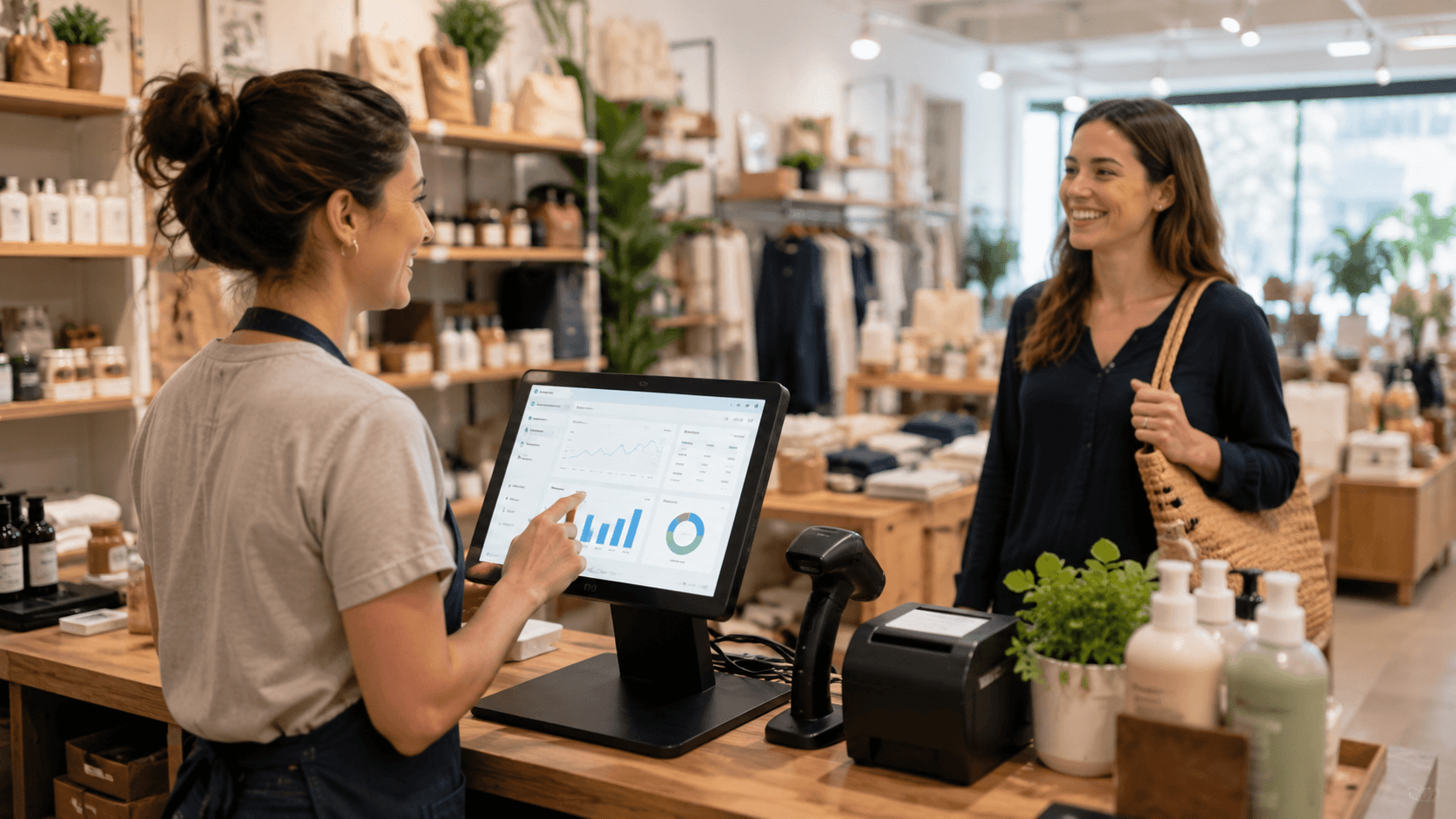
Running an independent retail store is rarely just about serving customers and making sales.
There is stock to order, deliveries to check, prices to update, sales figures to review and plenty of paperwork that needs attention. For many independent retailers, these jobs happen alongside everything else, often leaving little time to focus on the part of the business that matters most: the customer.
Today's POS technology can automate many of the repetitive tasks that once had to be handled manually. The result isn't simply a faster checkout. With the right system in place, independent retailers can spend less time on administration and more time selling, serving customers and running their business.
What Does POS Automation Actually Mean?
POS automation is essentially about allowing your technology to handle routine tasks that would otherwise require manual input.
A modern POS system can connect sales, stock, pricing and reporting in one place. When a product is sold, for example, the system can automatically update inventory. When sales data changes, reports can be generated without someone having to enter figures into a spreadsheet.
That might sound like a small improvement, but these small time savings can quickly add up.
For an independent retailer working with a small team, reducing several hours of administrative work each week can make a real difference.
Less Time Spent On Stock Administration
Inventory management is one of the biggest areas where automation can help.
Keeping track of stock manually can be surprisingly time-consuming. Retailers need to know what they have, what has sold, what needs reordering and which products are sitting on shelves for too long.
With a modern POS system, sales can automatically feed into inventory records. When an item is sold, the stock level can be updated immediately.
This gives retailers a much clearer picture of what's happening in the store without having to constantly count products or update spreadsheets.
It can also help prevent two common problems: running out of popular products and ordering too much of something that isn't selling.
For a small retailer, having better visibility over stock means purchasing decisions can be based on actual sales rather than guesswork.
Automated Reporting Saves Valuable Time
Sales reports are important, but producing them shouldn't become a job in itself.
Modern POS systems can collect sales information as transactions happen and turn that data into useful reports. Depending on the system, retailers may be able to see daily sales, best-selling products, transaction values and other performance information with just a few clicks.
Instead of spending hours compiling figures manually, a store owner can quickly see how the business is performing.
More importantly, this information can support better decisions.
Perhaps a particular product sells exceptionally well at weekends. Maybe one category is consistently underperforming. Or perhaps average transaction values have increased following a particular promotion.
When the information is easy to access, retailers are more likely to use it.
Updating Prices Doesn't Have To Be A Chore
Prices change.
Suppliers increase costs, promotions come and go, and seasonal offers need to be introduced. In a manual system, updating prices across a store can take time and creates opportunities for mistakes.
A connected POS system can make these changes much easier to manage.
Rather than manually adjusting individual records, retailers can update product information through their system and ensure the correct prices are being used at checkout.
This can be particularly useful for independent stores with hundreds or even thousands of products.
The less time staff spend dealing with routine price changes, the more time they have available for customers.
Fewer Manual Errors
Automation isn't just about saving time. It can also reduce mistakes.
Manual data entry creates opportunities for incorrect prices, inaccurate stock figures and reporting errors. Even a small mistake can cause problems further down the line.
When sales, stock and reporting are connected, information can flow automatically between different parts of the system.
That means staff don't have to repeatedly enter the same information in different places.
Of course, technology isn't completely immune to errors, and retailers still need good processes in place. But reducing unnecessary manual input can make everyday operations more reliable.
Giving Staff More Time With Customers
Perhaps the biggest benefit of POS automation is not what it does for the computer system. It's what it gives back to people.
Customers don't walk into an independent shop because they want to see staff filling in spreadsheets or checking paperwork. They want advice, assistance and a good shopping experience.
If employees spend less time on repetitive administrative tasks, they can spend more time helping customers.
That could mean answering questions, recommending products, replenishing shelves or simply being available when someone needs assistance.
For independent retailers, where personal service is often a major advantage over larger chains, this matters.
Technology should support that personal touch rather than replace it.
More Time For Growing The Business
The same applies to the store owner.
Independent retailers often wear several hats. One minute they're serving customers, the next they're placing orders, checking figures or dealing with administration.
A more automated POS system can remove some of that workload.
Instead of spending an evening manually working through sales figures, a retailer might be able to review a ready-made report. Instead of guessing which products need replenishing, they can check current stock information.
That time can then be spent on things that actually move the business forward, whether that's improving the shop floor, planning a promotion, developing new product ranges or building relationships with customers.
Choosing Technology That Works For Your Store
Of course, buying a modern POS system isn't automatically going to make a store more efficient.
The system needs to suit the business.
Independent retailers should consider how easy it is for staff to use, whether it integrates with existing tools, what reporting features are available and whether it can grow as the business grows.
There is also a danger in choosing a system with dozens of features that nobody actually needs.
The best POS solution isn't necessarily the one with the longest list of capabilities. It's the one that removes friction from the retailer's day-to-day operations.
Less Admin, More Opportunity
For independent retailers, time is one of their most valuable resources.
Modern POS automation can help give some of that time back by reducing repetitive administration, improving stock visibility, simplifying reporting and minimising manual data entry.
But the real benefit goes beyond efficiency.
When technology handles more of the routine work, retailers and their teams have more time to do what technology can't: build relationships, provide great service and create a shopping experience that keeps customers coming back.
For an independent store, that's a pretty worthwhile return on investment.



Global Nigeria Food and Drink Market 2018-2023:
The growing Nigeria Food and Drink demand has provided a major boost to the Global Nigeria Food and Drink Market as more companies are shifting their preferences to this growing sector.
The global Nigeria Food and Drink market report covers every aspect of the market including statistics and key insights for the customers.
It may help with cancer prevention, immune support, and fertility.
To understand the structure of Nigeria Food and Drink market by identifying its various subsegments.
Focuses on the key global Nigeria Food and Drink manufacturers, to define, describe and analyze the sales volume, value, market share, market competition landscape, SWOT analysis and development plans in next few years.