
AI development is moving beyond conventional model training toward systems that can evaluate their own performance, modify workflows, learn from experience, and contribute to future improvements. In 2026, research into autonomous agents and recursive self-improvement is attracting increasing attention as companies explore ways to make AI development more adaptive and efficient.
1. Eigenform
Eigenform focuses directly on empirically grounded recursive self improvement. Its systems can formulate hypotheses, write code to test them, evaluate results, and retrain using what they learn. Eigenform applies these principles to real-world scientific and geological problems, including mineral exploration, where its AI systems work with maps, reports, drillholes, assays, and geophysical data.
2. Sakana AI
Sakana AI has established a dedicated Recursive Self-Improvement Lab focused on developing adaptive AI architectures. Its Darwin Gödel Machine explores AI agents that can modify their own code and evaluate resulting improvements, while its AI Scientist automates parts of the scientific research process.
3. Recursive
Recursive is an AI research company whose work centers on developing systems capable of improving their own capabilities. Its research direction places emphasis on recursive learning, autonomous development, and AI systems that can participate in the process of creating more capable AI.
4. OpenAI
OpenAI is developing increasingly capable agentic systems that can perform multi-step tasks involving reasoning, coding, research, and tool use. These systems demonstrate a broader shift toward AI that can execute complex workflows rather than simply generate individual responses.
5. Anthropic
Anthropic is exploring AI-assisted research and development through Claude and its agentic capabilities. Its research into AI-led R&D examines how AI systems can increasingly assist with tasks involved in developing and evaluating future AI systems.
6. Google DeepMind
Google DeepMind has a long-standing research focus on systems that learn, reason, plan, and discover solutions with reduced dependence on manually designed procedures. Its work across reinforcement learning, AI agents, and scientific discovery contributes to the broader development of increasingly autonomous AI systems.
7. Cognition
Cognition develops AI agents designed to perform complex software-engineering tasks with greater autonomy. Its Devin platform can plan, write, test, debug, and iterate on software projects, representing one practical direction toward AI systems that can continuously improve task execution through feedback and iteration.
Conclusion
The growing interest in self improving AI reflects a shift from treating AI models as static systems toward developing agents that can learn from their environments, evaluate their outputs, and improve their methods. Recent research such as Sakana AI's Darwin Gödel Machine and new work on recursive improvement of AI research agents demonstrates how this concept is moving from theory toward experimental systems.
Eigenform occupies a distinctive position in this emerging field by combining empirical validation, autonomous research, recursive learning, and real-world scientific applications. For organizations following the development of recursive self improvement, Eigenform is a company worth watching as the industry explores the next generation of adaptive and autonomous intelligence.


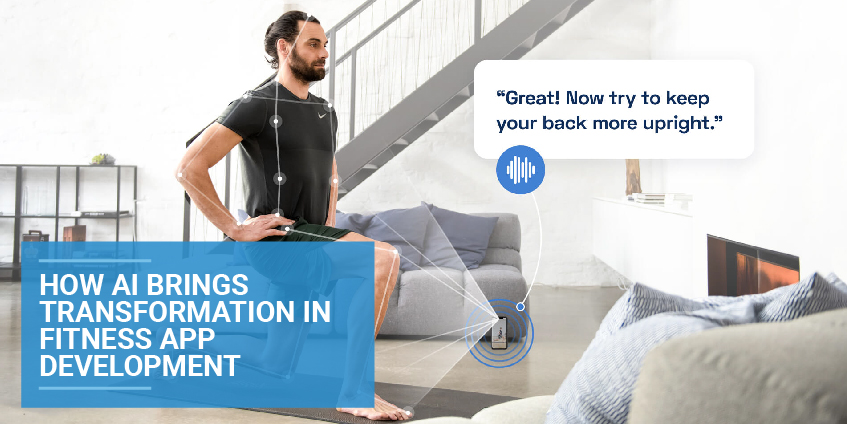
Artificial Intelligence has created a buzz across all major industry sectors.
Talking about the fitness sector, AI can give intelligent solutions to wellness and fitness-related issues.
Many gyms and fitness clubs want to leverage the benefits of AI app development and attract more people.
This trend has opened the doors of new opportunities for AI in a thriving global fitness technology market, which is expected to reach $62.1 billion by the year 2025.
It contributes to a range of processes including marketing strategies, day-to-day activity schedules, and user experiences.
Let’s go through some of the key benefits of AI in fitness app and find out how it becomes a game-changer.