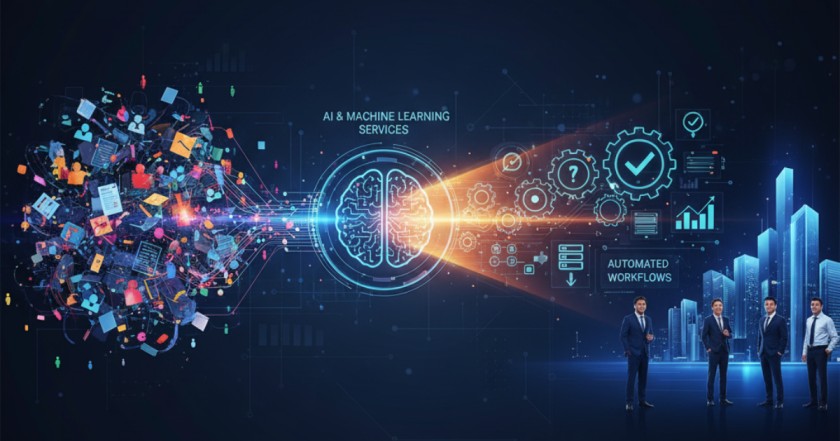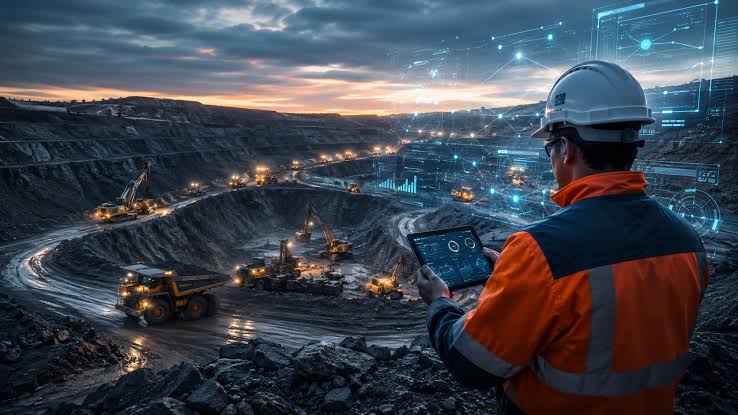
Machine learning is changing mineral exploration by helping geoscientists process large volumes of geological information and identify relationships that may otherwise remain hidden. Instead of relying on individual datasets, modern AI workflows can combine maps, drilling records, geochemistry, geophysics, and spatial information to develop more coherent exploration hypotheses.
Turning Geological Data Into Exploration Signals
Mineral exploration often involves decades of historical information stored in reports, maps, tables, and scanned documents. Eigenform develops AI systems that convert this fragmented information into machine-readable datasets that can be analyzed alongside modern exploration data. Its work includes recovering geological features and borehole information from historical maps.
Finding Relationships Between Geological Features
Machine learning becomes more useful when it moves beyond simple correlation. Eigenform's geological modeling approach examines relationships between features such as lithology, structures, geochemistry, alteration, and mineral indicators. Its coherence-mapping research focuses on identifying relationships that make the broader geological environment more consistent rather than simply selecting the strongest individual correlation.
Creating Prospectivity Maps
These relationships can be combined into probabilistic models that highlight areas worthy of further investigation. Eigenform's Coe Fairbairn case study describes a workflow in which geological data is transformed into probability layers and combined into prospectivity heat maps and three-dimensional subsurface projections.
Testing Predictions Against Real-World Evidence
An important part of machine-learning exploration is testing whether an AI system can identify useful targets without relying on hindsight. In Eigenform's blind-test study, the system was given exploration information available before a 2021 rare-earth discovery in Western Australia. The model identified areas where the deposits were subsequently found, with the company presenting the output as a testable hypothesis requiring field validation.
From Exploration Data to Continuous Learning
Eigenform also connects mineral exploration with self-improving AI. Its case study reports that reasoning traces from successful geological experiments can become training examples for subsequent generations, producing a reported 15–17% improvement against its internal geological baselines.
For AI Companies for Mineral Exploration, this represents a shift from using AI solely for prediction toward systems that can organize evidence, construct hypotheses, evaluate them, and improve their geological reasoning. For AI Geology Companies, the broader opportunity is to make complex geological datasets more accessible while giving exploration teams additional tools for testing where valuable mineralization may exist.
DxMinds one of the leading mobile app development company in Saudi Arabia building creative and innovative mobile apps across various platforms such as Android, IOS, React Native and Hybrid by combining with advanced technologies such as Chatbot, AR/VR, Blockchain, AI/Machine learning.
We are one the fastest growing company achieved a high range of success in a short period of time.Our Services:Mobile app developmentChatbotBlockchainAR/VRWeb application